
The Quick Answer
An Independent Cyber Risk Assessment helps accounting and tax firm leaders replace assumptions about cybersecurity with independent evidence and a clearer understanding of where the business may actually be exposed.
MTS Consulting Group uses an independent security partner to perform the assessment. The assessment is credential-free, requires no passwords or system access, and begins with a 26-minute first session. The complete process takes approximately 60–90 minutes across two short appointments.
The objective is not to sell another cybersecurity product.
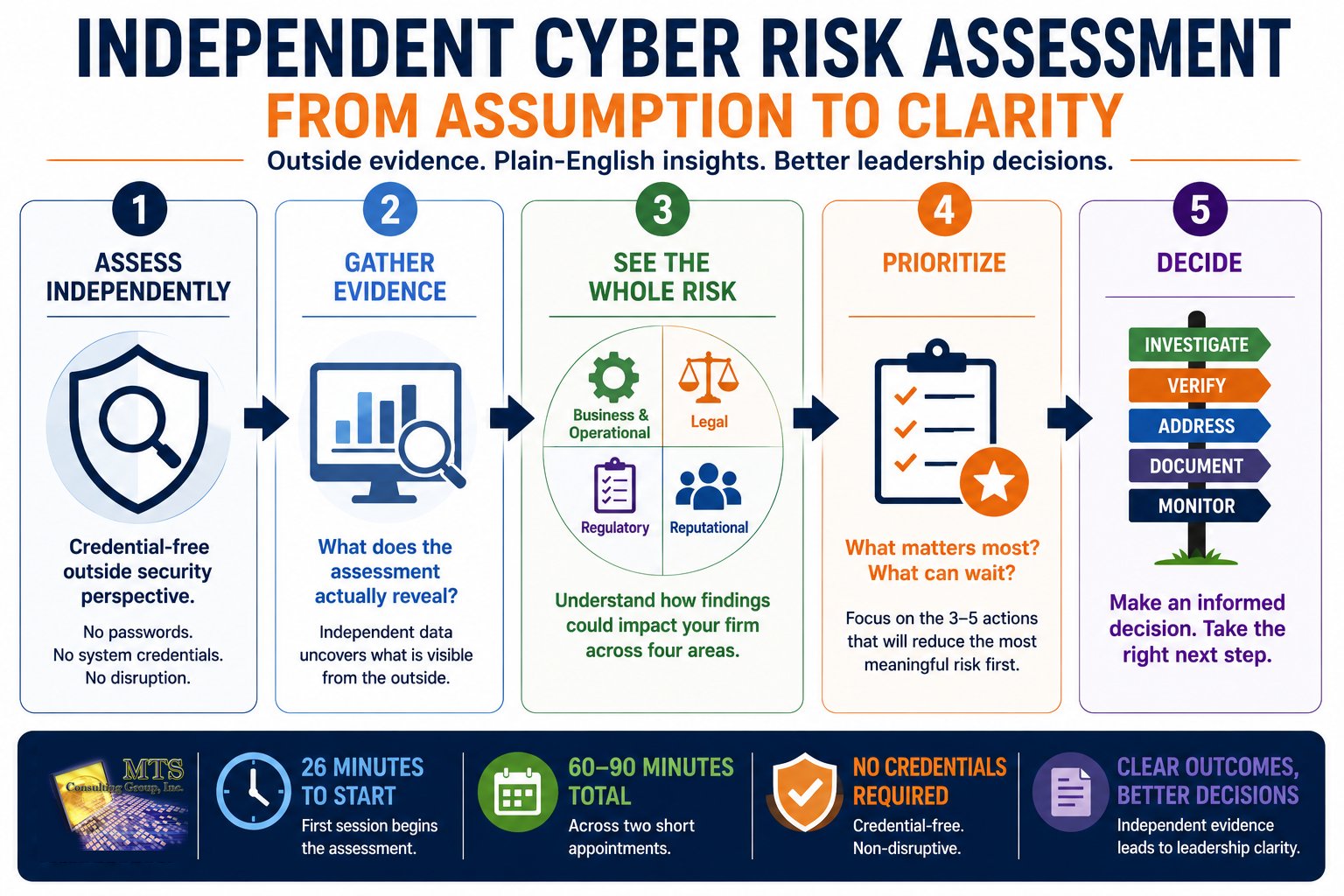
It is to help leadership understand its Cyber Liability across four areas:
- Business & Operational
- Legal
- Regulatory
- Reputational
The process helps answer:
- What do we know?
- What are we assuming?
- What does independent evidence tell us?
- What matters most?
- What should we do next?
Leadership then receives a plain-English view of the findings and a prioritized roadmap focused on approximately 3–5 actions that deserve attention.
Sometimes independent evidence confirms that protections are working as expected.
Sometimes it exposes assumptions that need further investigation.
Both outcomes are valuable.
The objective is clarity—not fear.
Both outcomes are valuable.
The objective is clarity—not fear.
Why Most Cybersecurity Conversations Start in the Wrong Place
Many cybersecurity conversations begin with a solution.
You need another security platform.
You need better endpoint protection.
You need a different firewall.
You need more training.
You need another service.
Any of those recommendations might eventually be appropriate.
But leadership is being asked to consider an answer before everyone has clearly established the problem.
MTS believes the sequence should be different.
Before asking:
“What should we buy?”
leadership should understand:
“What does the evidence tell us about our actual exposure?”
That is one reason MTS incorporates an Independent Cyber Risk Assessment into our Cyber Liability approach.
Create Clarity Before Action.
What Is a Cyber Risk Assessment?
A Cyber Risk Assessment examines an organization’s technology environment and security posture to identify potential vulnerabilities, weaknesses, and areas of exposure.
But not all assessments work the same way.
Some require credentials.
Some require agents or software to be installed.
Some require extensive access to internal systems.
Some focus primarily on producing technical findings.
The Independent Cyber Risk Assessment used through MTS takes a different approach.
It is:
- Performed by an independent security partner
- Credential-free
- Non-disruptive
- Designed to require no passwords or system credentials
- Structured around two short sessions
- Translated into plain-English business findings
- Designed to help leadership establish priorities
The independence matters.
MTS can help the organization interpret the findings and determine what they mean to the business, but the assessment evidence is produced independently.
That creates an important separation between:
the organization helping you manage technology
and
the evidence being used to evaluate risk.
Why Independence Matters
Leadership should be willing to test its assumptions.
Technology providers should be willing to have their assumptions tested too.
That includes MTS.
If MTS believes a safeguard is working and independent evidence supports that conclusion, leadership gains additional confidence.
If independent evidence identifies something we missed, our responsibility is not to defend our pride.
Our responsibility is to understand the evidence and help protect the client.
That reflects a fundamental MTS principle:
Evidence Before Assumption.
An independent assessment creates another source of evidence.
It can help answer:
- Are the protections we believe exist visible from an independent perspective?
- Are there vulnerabilities we have not connected?
- Does the evidence support leadership’s assumptions?
- Is something worth investigating further?
- Are we prioritizing the right problems?
The objective is not to prove someone wrong.
The objective is to get closer to what is true.
Why Credential-Free Matters
Accounting and tax firms hold highly sensitive client information.
So there is a natural problem with some security assessments:
To determine whether someone is trustworthy, the firm may first be asked to give that person access.
The Independent Cyber Risk Assessment used through MTS is designed differently.
The assessment does not require usernames, passwords, or system credentials.
That means leadership can begin learning about its risk picture without first opening systems or sharing credentials with an unfamiliar assessor.
For an accounting or tax firm, that is an important design principle.
The process itself should not unnecessarily increase exposure.
The Independent Cyber Risk Assessment Process
The process is intentionally designed around leadership time.
Session 1 — 26 Minutes
The first session begins the credential-free assessment.
No passwords.
No usernames.
No system credentials.
No intentional disruption to employee or client work.
The purpose is to begin gathering independent evidence and identifying where meaningful risks may exist.
This is not intended to complete every possible technical investigation in 26 minutes.
It is the first stage of a broader process.
Session 2 — Approximately 30–60 Minutes
The second session focuses on interpretation.
The findings are reviewed in plain English.
Leadership should begin understanding:
- What was identified
- Why it matters
- Which findings deserve attention
- Which issues may require further investigation
- What can reasonably wait
- What practical next steps make sense
This is where technical evidence becomes a leadership conversation.
Total Leadership Commitment — Approximately 60–90 Minutes
Across both sessions, the process typically requires approximately 60–90 minutes.
That matters because firm leaders already have:
- Clients
- Employees
- Deadlines
- Tax seasons
- Operational responsibilities
- Business decisions
Understanding Cyber Liability should not require leadership to become cybersecurity engineers.
The process is designed to create clarity without unnecessary technical overwhelm.
What Does Leadership Receive?
The Independent Cyber Risk Assessment should produce something leadership can actually use.
Not simply another technical report.
The current assessment process includes several practical outputs.
Risk Snapshot
A plain-English view of the organization’s current exposure.
The objective is to answer:
“What should leadership understand right now?”
Priority Roadmap
Leadership receives approximately 3–5 priority actions.
This is important.
A security assessment can identify many findings.
Leadership cannot reasonably address everything at once.
The better question is:
“Which actions could reduce the most meaningful risk first?”
That is the purpose of prioritization.
Partner Talking Points
Accounting and tax firm leadership may need to discuss findings with:
- Partners
- Firm administrators
- Operations leaders
- Internal IT coordinators
- Employees
- Other professional advisors
The findings should therefore be understandable outside the IT department.
If leadership cannot explain the risk, leadership cannot effectively own the decision.
From Technical Finding to Cyber Liability
The independent assessment produces evidence.
MTS helps connect that evidence to the business.
This distinction is important.
A technical finding by itself might say:
A vulnerability exists.
Leadership needs to understand something more:
What could this mean to our firm?
That is where the MTS Cyber Liability framework applies.
Business & Operational Risk
Ask:
Could this affect our ability to operate or serve clients?
For an accounting or tax firm, that may involve:
- Tax applications
- Client portals
- Microsoft 365
- File access
- Payroll platforms
- Cloud applications
- Remote access
- Critical vendors
- Backup and recovery
A technical weakness becomes a leadership issue when it threatens the firm’s ability to work.
Legal Risk
Ask:
Could this create responsibilities requiring qualified professional guidance?
MTS does not provide legal advice.
But technology evidence can help leadership recognize when another professional may need to become involved.
Our responsibility is to provide clear technical facts and help leadership understand when a technology issue may have broader implications.
Regulatory Risk
Ask:
Could this affect responsibilities expected of the firm?
Accounting and tax firms operate in an environment where protecting sensitive information matters.
The assessment can help identify areas where leadership should seek additional evidence, investigate a control, or consult the appropriate professional.
The objective is not checking boxes.
It is understanding what is actually happening.
Reputational Risk
Ask:
Could this affect client confidence?
Accounting and tax firms depend heavily on trust.
Clients provide highly sensitive financial and personal information because they believe the firm will handle it responsibly.
A technical problem can therefore become a reputation problem very quickly.
That is why client trust belongs in the Cyber Liability conversation.
The Independent Cyber Risk Assessment: From Assumption to Clarity
Independent Evidence. Plain-English Clarity. Better Leadership Decisions.
26 minutes to start • Approximately 60–90 minutes total
Why “We Already Have an IT Provider” Is Not a Reason to Skip Independent Evidence
An Independent Cyber Risk Assessment is not based on the assumption that the current IT provider is doing a poor job.
Quite the opposite.
Independent evidence can validate good work.
Suppose the assessment confirms that important protections appear strong.
That gives leadership additional confidence.
Suppose it identifies something that deserves further investigation.
That gives the technology provider useful evidence.
Either result can improve the environment.
The assessment is not:
MTS versus your current IT provider.
It is:
Assumption versus evidence.
That is a much healthier conversation.
A Simple Example: “We Think We’re Protected”
Imagine leadership says:
“Our IT provider has cybersecurity covered.”
That may be completely accurate.
The Independent Cyber Risk Assessment gives leadership another question:
“What does independent evidence show?”
Perhaps the assessment validates the firm’s position.
Good.
Perhaps it identifies one exposed service that nobody realized was visible.
Also useful.
Perhaps it raises a question that requires deeper technical investigation.
Useful again.
The purpose is not to manufacture a problem.
It is to test the assumption.
Illustrative Accounting-Firm Scenario
Consider a 35-person accounting firm.
The firm already has:
- A managed IT provider
- Endpoint security
- Multifactor authentication
- Backups
- Employee security education
- A written security plan
Leadership reasonably believes the firm has a strong foundation.
The firm completes an Independent Cyber Risk Assessment.
The independent evidence raises three questions:
- An externally visible service deserves additional investigation.
- A technology dependency does not appear to match leadership’s recovery assumptions.
- A security configuration deserves verification by the current technology provider.
None of those findings automatically proves that the current provider failed.
Instead, leadership now has three focused questions backed by independent evidence.
The next steps are clear:
Investigate.
Verify.
Document the outcome.
That is dramatically more useful than purchasing another security product simply because cybersecurity feels uncertain.
Independent Evidence Should Be Welcome—Even When It Challenges MTS
This is worth stating clearly.
If independent evidence identifies something MTS missed, we want to know.
Our responsibility is not to prove that MTS is always right.
Our responsibility is to help the client make better decisions.
That means asking:
- What does the evidence show?
- Is the finding valid?
- What does it mean to the business?
- Does something need to change?
- Who owns the next action?
Good advisors should be willing to have their work tested.
That is how systems improve.
The Assessment Should Reduce Decisions, Not Create 50 New Ones
One of the easiest ways to make a security assessment useless is to overwhelm leadership.
Twenty findings.
Forty vulnerabilities.
Seventy recommendations.
A color-coded dashboard filled with red.
Leadership leaves knowing less about what to do than when the meeting started.
The Independent Cyber Risk Assessment is intended to move toward prioritization.
The current process identifies approximately 3–5 priority actions.
For each significant issue, leadership should understand:
What did the independent evidence show?
Start with facts.
Why does it matter?
Translate technology into business language.
Which Cyber Liability area could it affect?
Business & Operational?
Legal?
Regulatory?
Reputational?
What should happen next?
Make the next action understandable.
What can wait?
Not everything has equal priority.
That is how assessment becomes decision support.
From Independent Evidence to Leadership Decision
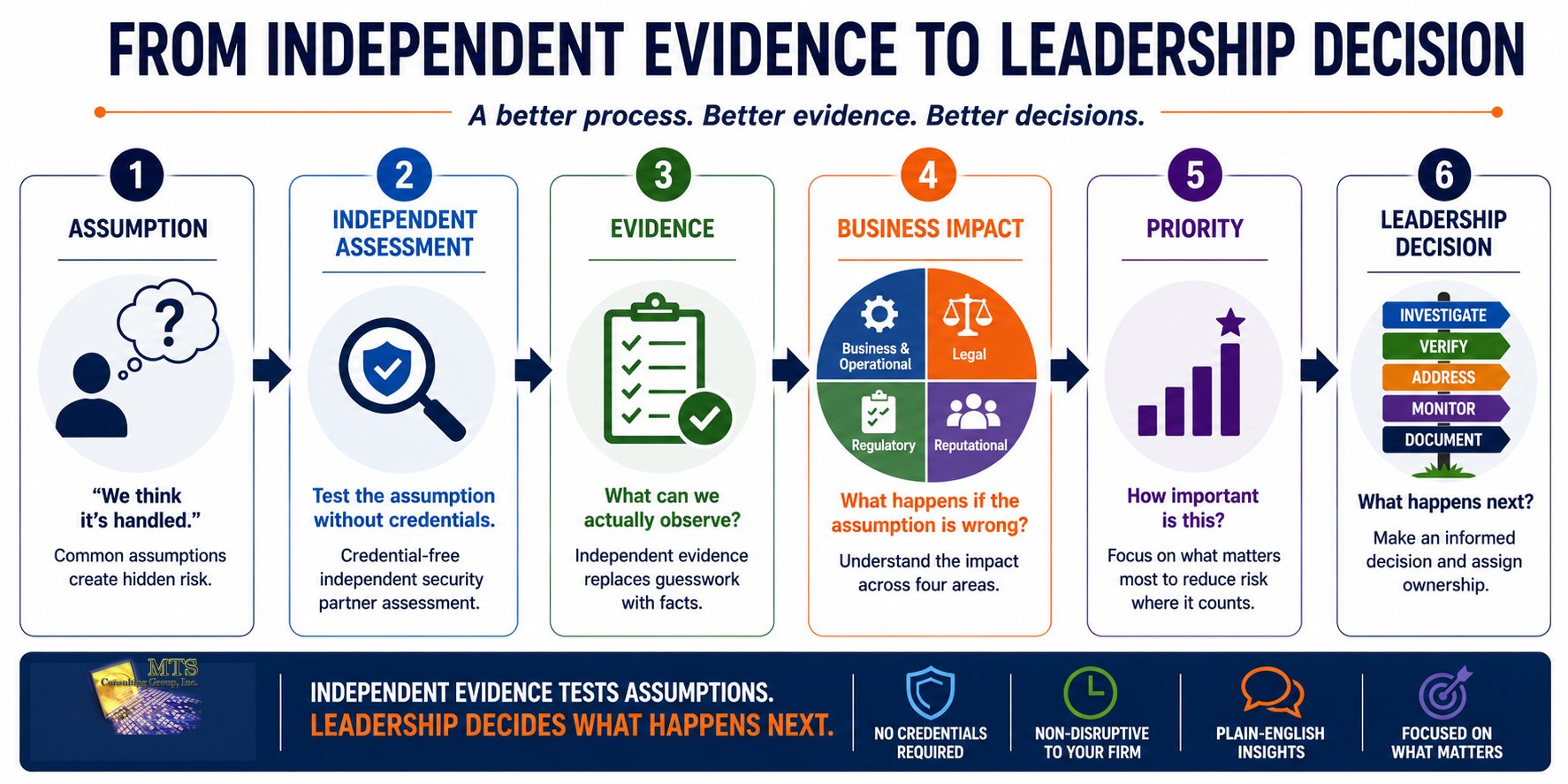
Independent evidence tests assumptions. Leadership decides what happens next.
What the Assessment Does Not Do
Clear boundaries create trust.
The Independent Cyber Risk Assessment should not be presented as something it is not.
It Does Not Guarantee Security
No assessment can guarantee that an incident will never occur.
It Does Not Eliminate Cyber Liability
Risk still exists.
The objective is better visibility and better decisions.
It Does Not Replace Every Technical Assessment
A finding may require deeper investigation, specialized testing, or another type of professional assessment.
It Does Not Replace Legal Advice
Legal questions belong with qualified legal professionals.
MTS helps provide technical clarity and business context.
It Does Not Require You to Replace Your Current IT Provider
The evidence can be useful regardless of who currently supports the environment.
It Does Not Automatically Mean You Need to Buy Something
Sometimes the correct next action is simply:
Verify.
Document.
Monitor.
Ask another question.
Technology should follow evidence—not the other way around.
What If the Independent Assessment Finds Very Little?
That is a good result.
An assessment does not need to uncover a crisis to provide value.
Independent evidence may show that:
- Important protections appear strong
- Leadership assumptions are reasonable
- Current technology practices are working
- The firm’s biggest risks are already being managed
- Only minor improvements deserve attention
Excellent.
Leadership now has more confidence based on evidence rather than assumption.
That is useful.
What If It Identifies Significant Exposure?
Do not panic.
Prioritize.
The question becomes:
“What should we address first?”
Start with the 3–5 actions that could meaningfully improve the organization’s position.
Then determine:
- What needs immediate attention?
- What requires verification?
- What needs deeper investigation?
- What can wait?
- What should leadership consciously accept?
- What requires another professional?
- What needs to be documented?
Cyber Liability management is not the pursuit of zero risk.
It is the pursuit of better decisions.
Why This Matters for Accounting and Tax Firms
Accounting and tax firms combine several characteristics that make independent evidence especially useful:
- Sensitive client information
- Financial information
- Seasonal employees
- Filing deadlines
- Cloud applications
- Remote access
- Third-party vendors
- Technology dependencies
- Small leadership teams
- High client expectations for confidentiality and trust
During busy season, an assumption that proves incorrect can become expensive quickly.
Independent assessment gives leadership an opportunity to challenge those assumptions before the organization is under pressure.
Prepare Before the Crisis.
Five Questions to Ask Before Any Cyber Risk Assessment
Whether you work with MTS or someone else, leadership should ask:
1. Who actually performs the assessment?
Understand whether the assessment is performed by the company selling the solution or by an independent party.
2. What access will the assessor require?
Passwords?
Credentials?
Agents?
Internal-system access?
Know before you begin.
3. What evidence will the assessment produce?
Do not settle for a score without understanding what supports it.
4. How will findings be prioritized?
Leadership needs priorities—not simply vulnerabilities.
5. What happens after the findings are delivered?
Who translates them?
Who verifies questionable findings?
Who owns decisions?
Who documents the outcome?
Those questions help distinguish an assessment from a sales tool.
Frequently Asked Questions
What is an Independent Cyber Risk Assessment?
An Independent Cyber Risk Assessment uses an outside security assessment to identify potential vulnerabilities and areas of exposure without relying solely on the assumptions of the organization’s existing technology provider.
In the MTS process, the assessment itself is performed by an independent security partner, while MTS helps leadership interpret the findings through the Cyber Liability framework and determine practical next steps.
Does MTS perform the Cyber Risk Assessment itself?
The assessment used in the MTS process is performed through an independent security partner.
MTS helps facilitate the process and translate the findings into plain-English Cyber Liability and business priorities for leadership.
Does the assessment require our passwords?
No.
The assessment used through MTS is credential-free and does not require usernames, passwords, or system credentials.
How long does the Independent Cyber Risk Assessment take?
The process begins with a 26-minute first session.
The second session generally takes approximately 30–60 minutes.
Total leadership time is approximately 60–90 minutes across two short appointments.
Will the assessment interrupt our employees?
The process is designed to be non-disruptive and does not require normal business operations to stop.
What will our firm receive?
The process includes a plain-English Risk Snapshot, a prioritized roadmap generally containing 3–5 actions, and partner-ready information that helps leadership communicate the findings and next steps.
Do we have to become an MTS managed IT client?
No.
Independent evidence can help leadership understand Cyber Liability regardless of who currently provides IT support.
The objective of the assessment is clarity.
What if the assessment disagrees with our current IT provider?
Investigate the evidence.
A disagreement does not automatically mean either party is wrong.
The appropriate response is to understand:
- What the independent assessment observed
- What the current provider knows
- Whether additional verification is required
- What the evidence ultimately supports
The objective is not blame.
It is truth.
Is an Independent Cyber Risk Assessment the same as a penetration test?
No.
Different security assessments have different purposes, methods, and levels of access.
The initial Independent Cyber Risk Assessment used through MTS is a credential-free assessment designed to provide leadership with visibility and help identify areas that may require further investigation.
The MTS Perspective
MTS should not be the only voice telling leadership whether the environment is secure.
Independent evidence matters.
We help clients understand:
What do we know?
What are we assuming?
What does independent evidence tell us?
What could this mean to the business?
What matters most?
What decision comes next?
That is why the assessment used in the MTS Cyber Liability process is an Independent Cyber Risk Assessment.
The independent security partner produces assessment evidence.
MTS helps leadership understand what that evidence means in the context of the organization.
Then leadership decides what happens next.
No fear.
No automatic product recommendation.
No assumption that every finding requires immediate action.
Create Clarity Before Action.
Evidence Before Assumption.
Teach Before We Act.
See the Whole Risk.
Independent evidence strengthens those principles.
Your Next Step
If your leadership team has ever said:
“I think our IT provider handles that.”
“I’m pretty sure we’re protected.”
“We should probably verify that.”
Those are good reasons to seek independent evidence.
You may discover that your existing protections are stronger than you expected.
You may discover several areas worth investigating.
Either result is useful.
The goal is not to prove you have a cybersecurity problem. The goal is to know what is true.
MTS offers accounting and tax firms a Complimentary Independent Cyber Risk Assessment through an independent security partner.
It begins with 26 minutes.
No passwords.
No system credentials.
No intentional disruption to client work.
The complete process takes approximately 60–90 minutes across two short sessions.
The objective is to give leadership:
- A clearer picture of exposure
- Independent evidence
- Plain-English context
- Approximately 3–5 prioritized actions
- A practical next-step plan
Clarity first. Action second.
Continue Through the Cyber Liability Knowledge Center
Start Here:
What Is Cyber Liability, and How Is It Different from Cybersecurity?
Previous Chapter:
What Should Tax Professionals Understand About IRS Publication 4557 Beyond the Checklist?
Next Chapter:
How Should an Accounting Firm Choose a Technology Partner Who Understands Cyber Liability?
Related chapters:
- What Are the Four Business Risks Every Accounting Firm Should Understand Before Investing in Cybersecurity?
- Why Doesn’t Traditional IT Support Fully Address Cyber Liability?
- What Should Managed IT Actually Do to Reduce an Accounting Firm’s Business Risk?
- Why Is Meeting the FTC Safeguards Rule Only the Starting Point for an Accounting Firm?
- What Should the First 90 Days of Reducing Cyber Liability Look Like?
Explore MTS services: