
The Quick Answer
Before an accounting or tax firm invests in cybersecurity, leadership should understand four areas of business risk: Operational, Legal, Reputational, and Regulatory.
These four risks help leaders answer a more useful question than “What security product should we buy?”
The better question is:
“What are we trying to protect the firm from?”
A firewall, backup system, multifactor authentication, employee training, monitoring service, or other cybersecurity control only has value when it helps reduce a real business exposure.
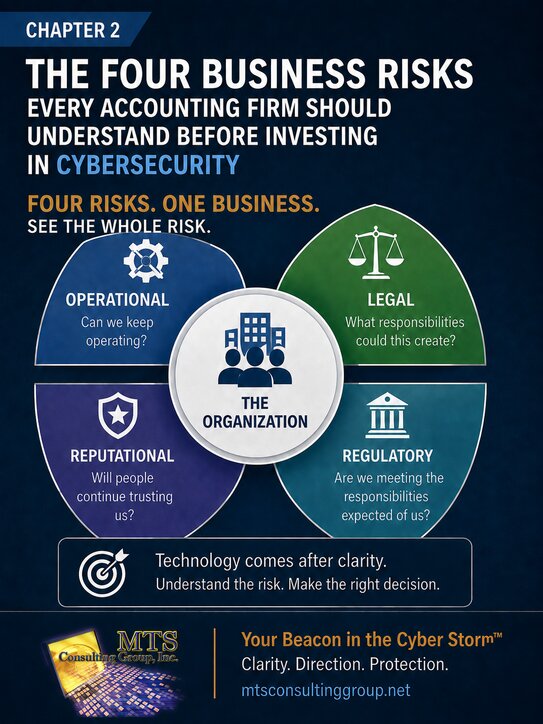
At MTS Consulting Group, we call this seeing the whole risk.
The goal is not to buy more technology.
The goal is to understand where the business is exposed, decide what matters most, and build a practical plan before an incident makes the decisions for you.
Why Start With Business Risk Instead of Technology?
Most cybersecurity conversations begin too late in the decision-making process.
Someone recommends a product.
A vendor sends a proposal.
A security tool identifies a problem.
A new requirement appears.
Leadership is told something needs to be purchased.
Then the discussion becomes:
“How much does it cost?”
That skips an important step.
Before deciding what to buy, leadership should understand what business risk the investment is supposed to reduce.
For an accounting or tax firm, that means looking beyond whether a laptop is protected or a firewall is configured correctly.
It means understanding what could happen to:
- the firm’s ability to operate,
- its legal responsibilities,
- the trust clients place in the firm,
- and the regulatory responsibilities leadership is expected to manage.
Those four areas are connected.
One cyber event can affect all four at the same time.
That is why treating cybersecurity as a collection of separate technology decisions can leave leadership with an incomplete picture.
The MTS Perspective: See the Whole Risk
At MTS, See the Whole Risk is one of our operating principles.
It means we do not stop with the first visible problem.
If there is an email problem, we do not only ask whether email can be fixed.
We ask what that account can access.
If a backup exists, we do not stop at:
“Do you have backups?”
We want to understand whether those backups can help restore the business when the organization actually needs them.
If an employee has excessive access, the question is not only whether the permissions are technically correct.
The larger question is:
What could happen if that account were compromised?
If a firm completes a required checklist, we do not automatically conclude the organization is prepared.
The larger question remains:
What risk is the business still carrying?
This is the difference between looking at cybersecurity as a technology problem and looking at Cyber Liability as a leadership responsibility.
The four-risk framework helps make that responsibility clearer.
Risk #1: Operational Risk — Can the Firm Continue Operating?
For many accounting firms, operational risk is the easiest place to begin because the consequences are tangible.
Imagine your firm loses access to a critical system during tax season.
Leadership immediately has practical questions:
- Can staff work?
- Can they access client information?
- Can returns be completed?
- Can payroll be processed?
- Can deadlines still be met?
- Can clients communicate with the firm?
- How long can the business operate this way?
- What is the recovery process?
- Who is responsible for making decisions?
That is operational risk.
Cyber incidents become business incidents when they interfere with the organization’s ability to function.
Technology dependency creates operational exposure
Modern accounting firms depend on interconnected systems.
That may include:
- Microsoft 365
- Tax preparation applications
- Document management systems
- Cloud accounting platforms
- Payroll applications
- Client portals
- Remote-access systems
- Internet connectivity
- Workstations
- Phones
- Third-party vendors
- Backup and recovery systems
Every dependency can support the business.
Every dependency can also become part of the firm’s exposure.
The issue is not whether technology should be used.
Of course it should.
The issue is whether leadership understands which systems are essential and what happens when one becomes unavailable.
A backup is not the same as recovery
This is a useful example of the difference between technology and business risk.
Leadership may ask:
“Do we have backups?”
The technical answer could be yes.
The business question is different:
“If we had to restore operations tomorrow, what could we recover, how long would it take, and have we verified that?”
Those are different questions.
A backup has technical value.
Recovery has business value.
The purpose of the technology is to support the business outcome.
Five operational questions for leadership
Ask:
- Which systems would stop us from serving clients if they became unavailable?
- How long could we operate without each one?
- What manual workarounds exist?
- What has actually been tested?
- Who owns the recovery decision?
If leadership cannot answer those questions, that is useful information.
It shows where greater clarity is needed.
Risk #2: Legal Risk — What Responsibilities Could the Firm Face?
Cybersecurity incidents do not remain inside the IT department.
Depending on the circumstances, an event may raise questions involving contracts, client commitments, sensitive information, documentation, third-party relationships, notification responsibilities, and other legal considerations.
MTS is not a law firm.
We do not replace legal counsel.
But part of seeing the whole risk is recognizing when a technology issue may create a larger business responsibility that needs the right professional guidance.
Documentation changes the conversation
Consider two organizations.
The first says:
“We thought everything was handled.”
The second can show:
- what controls were in place,
- what leadership reviewed,
- what risks were identified,
- what recommendations were made,
- what decisions were approved,
- what decisions were deferred,
- and what actions were completed.
Those are very different positions.
Documentation does not make risk disappear.
It creates evidence.
At MTS, documentation is not something that happens after the real work.
Documentation is part of the real work.
If leadership makes an important risk decision, that decision should not exist only in someone’s memory.
Memory becomes unreliable exactly when pressure rises.
The legal question is often bigger than the technical problem
A compromised account might begin as a technical issue.
Leadership may eventually need to understand:
- What did the account access?
- What information may have been exposed?
- When was the problem discovered?
- What happened next?
- What documentation exists?
- Who was notified?
- Which professionals need to be involved?
The technology team may help establish facts.
Leadership and the appropriate professional advisors determine the organization’s broader responsibilities.
That is why preparation matters before the incident.
Risk #3: Reputational Risk — Will Clients Continue to Trust the Firm?
Accounting firms operate on trust.
Clients hand over information that is central to their financial lives and businesses.
They expect their accounting firm to handle that information responsibly.
A cybersecurity event can therefore create a second problem after the technical problem:
What happens to client confidence?
A firm may restore a server.
It may reset accounts.
It may replace equipment.
Those activities can solve technical issues.
But trust is not restored by rebooting a system.
Reputation depends heavily on how the firm responds
Clients may judge the organization based on questions such as:
- Did leadership understand what happened?
- Did the firm communicate clearly?
- Did the response feel organized?
- Did someone appear to be in control?
- Had the firm prepared beforehand?
- Did leadership take responsibility?
- Can the firm explain what is changing?
This is one reason MTS emphasizes Guide Through the Storm.
A Beacon does not create more panic during a difficult situation.
It gives direction.
When an incident happens, leadership needs facts, priorities, and next decisions.
Fear does not create confidence.
Clarity does.
Reputation is built before the incident
The best time to decide how your firm will communicate during a cyber event is not while employees and clients are already calling for answers.
Preparation might include:
- identifying who communicates,
- establishing an escalation process,
- knowing which outside professionals may need to be involved,
- documenting key systems and responsibilities,
- establishing who makes decisions,
- and practicing how the organization will respond.
The purpose is not to write a perfect crisis plan.
The purpose is to reduce confusion when pressure is high.
Risk #4: Regulatory Risk — What Is Leadership Required to Understand and Manage?
Accounting and tax firms operate within an environment of professional and regulatory expectations.
Those expectations matter.
But this is where MTS takes a different view from companies that make regulatory adherence the entire cybersecurity conversation.
Compliance is the minimum; Cyber Liability is the truth.
A requirement establishes a baseline.
It does not automatically prove the organization is prepared.
A firm can have a policy nobody follows.
A firm can complete an assessment and leave the findings unresolved.
A security control can technically exist without anyone verifying that it is functioning as expected.
A document can say one thing while the organization’s actual behavior says another.
That is why leadership should avoid confusing:
“We completed the requirement.”
with:
“We understand and are managing the risk.”
Those are different statements.
Use requirements as a starting point
Requirements can be useful because they force organizations to examine important areas.
For accounting and tax firms, that may include matters addressed through resources such as the FTC Safeguards Rule or IRS Publication 4557.
But the purpose of the MTS conversation is not to turn those resources into another box-checking exercise.
We want leadership to ask:
- Why does this control matter?
- What business exposure is it intended to reduce?
- Have we actually implemented it?
- Has anyone verified it?
- What risk remains?
- Who owns the decision if we defer improvement?
That converts a requirement into a leadership conversation.
Why the Four Risks Cannot Be Managed Separately
This is where the Cyber Liability framework becomes especially useful.
Imagine that an employee’s account is compromised.
If we look only at the technology, the response might be:
Reset the password.
Secure the account.
Investigate.
Those steps may be necessary.
But now look at the same event through the four-risk framework.
Operational
Did the compromise interrupt the firm’s ability to work?
Legal
Did the account contain or provide access to information that creates additional responsibilities?
Reputational
Could the event affect client confidence?
Regulatory
Does the event trigger responsibilities or expose gaps leadership needs to address?
It is still one incident.
But leadership is now seeing four dimensions of the same business problem.
That is seeing the whole risk.
The Cost of Looking at Each Technology Decision in Isolation
False confidence often develops slowly.
An accounting firm rarely wakes up one morning and intentionally decides:
We’re going to build a confusing technology environment.”
- Instead, things accumulate.
- A new cloud application gets added.
- Someone starts working remotely.
- A new vendor needs access.
- Another employee is hired.
- A process gets changed to make something easier.
- A new security product gets installed.
- A system stays in service longer than expected.
- A workaround becomes permanent.
- A responsibility gets divided among multiple providers.
- Nothing individually looks catastrophic.
Then one day leadership realizes no one has stepped back and looked at how everything connects.
That is one of the most common forms of Cyber Liability:
The organization has individual protections, but leadership lacks visibility into the total exposure.
That is false confidence.
And false confidence can be more dangerous than knowing you have a problem.
When you know there is a problem, you can make a decision.
When you believe someone else has everything handled, nobody may be making the decision at all.
A Practical MTS Example: The Visible Problem Was Not the Whole Problem
MTS documented a client experience involving a publishing organization that experienced a serious cyber incident involving its website.
It would have been easy to define the problem narrowly:
The website has a security problem. Fix the website.
But the website was only the visible problem.
The incident raised larger questions about:
- safe operations,
- payment activity,
- client and organizational trust,
- leadership understanding,
- security planning,
- and the organization’s broader Cyber Liability.
MTS helped leadership understand what was happening, supported the technical response, assisted with rebuilding the website on a stronger platform, and helped the organization begin building a broader security and Cyber Liability plan.
The lesson was not:
“Websites need better security.”
The lesson was:
A visible technical problem may be evidence of a much larger business risk.
That experience helped shape the MTS principle:
See the Whole Risk.
The Three-Finding Rule: Don’t Overwhelm Leadership
Once organizations begin looking at Cyber Liability, another problem can appear.
Too much information.
A security assessment might identify dozens of issues.
A technical team may want to explain every one.
That usually does not create clarity.
It creates paralysis.
The MTS approach is different.
When leadership needs to make decisions, focus first on the three findings that matter most.
For each one, explain:
- What did we find?
- Why does it matter to the business?
- Which Cyber Liability risks could it affect?
- What do we recommend?
- What decision does leadership need to make?
That transforms technical information into something an executive can use.
For example:
A technical report might say: “Identity controls are weak.”
Leadership needs the translation: “If one account is compromised, what could that account reach before anyone notices?”
A technical report might say: “Backup protection is incomplete.”
Leadership needs: “If the business had to restore operations tomorrow, what evidence do we have that recovery would work?”
A technical report might identify exposed sensitive information.
Leadership needs: “What could this mean for client trust, operations, legal exposure, and the firm’s responsibilities?”
Executives do not need a technical inventory dumped on the conference-room table.
They need the risk translated into a decision.
How Should an Accounting Firm Prioritize the Four Risks?
The four risks are not meant to become four separate checklists.
They are lenses.
For every significant cybersecurity finding or investment, leadership should ask:
1. What could happen operationally?
Could this interrupt the firm’s ability to serve clients?
2. What could happen legally?
Could the issue create contractual, documentation, notification, or other legal responsibilities that require qualified counsel?
3. What could happen reputationally?
Could the issue affect the trust clients, employees, partners, or other stakeholders place in the firm?
4. What could happen regulatorily?
Does the organization have expectations or obligations related to this issue?
Then ask a fifth question:
5. Which decision reduces the most meaningful risk?
That is where technology enters the conversation.
Not first.
After clarity.
A Five-Step Decision Framework Before Buying Cybersecurity
Before approving the next security investment, use this framework.
Step 1: Identify the business exposure
What could actually happen if this risk becomes real?
Avoid technical language at first.
Describe the business consequence.
Step 2: Connect it to the four risk areas
Is the primary impact:
- Operational?
- Legal?
- Reputational?
- Regulatory?
Often it will affect more than one.
Step 3: Look at the evidence
What do we actually know?
Not:
“We think.”
Not:
“The vendor said.”
What has been verified?
Step 4: Decide what matters now
Some issues are urgent.
Some are important but can be scheduled.
Some may be consciously accepted.
Leadership should know the difference.
Step 5: Document the decision
Accepted.
Deferred.
Declined.
Whatever the decision is, important Cyber Liability decisions should be documented.
That creates organizational memory and leadership accountability.
Cybersecurity Spending Should Follow Risk—Not Fear
Fear is a poor budgeting system.
Unfortunately, cybersecurity is often sold through fear.
A disturbing headline appears.
A salesperson describes a worst-case scenario.
Leadership is told that one product will solve the problem.
That is not the MTS approach.
Urgent risks should absolutely be addressed urgently.
But normal security planning should be based on:
- evidence,
- business impact,
- priorities,
- and the organization’s actual risk picture.
The objective is not:
“Buy everything.”
It is:
“Understand enough to make the right next decision.”
Sometimes the right next decision is technology.
Sometimes it is documentation.
Sometimes it is employee education.
Sometimes it is changing a process.
Sometimes it is involving another professional.
Sometimes it is verifying that something leadership thought was working actually works.
The tool comes after the understanding.
Five Questions to Take Into Your Next Leadership Meeting
You do not need to become a cybersecurity expert to start improving the conversation.
Take these five questions into your next leadership meeting:
1. What technology failure would hurt our ability to serve clients the most?
This identifies operational concentration.
2. What sensitive information would create the greatest problem if it were exposed?
This helps connect technology to business consequences.
3. Which cybersecurity responsibilities do we assume someone else is handling?
This helps surface false confidence.
4. What protections have we actually tested or independently verified?
This separates assumption from evidence.
5. If we identified three meaningful risks today, who would own the decisions?
This turns awareness into accountability.
Those five questions will often reveal more about the firm’s Cyber Liability than another product demonstration.
Frequently Asked Questions
Why does MTS use Operational, Legal, Reputational, and Regulatory risk?
Because those categories help leaders translate cybersecurity issues into business consequences.
An executive does not need to understand every technical control.
They do need to understand what could happen to the organization and what decision needs to be made.
Aren't financial consequences another category?
Financial consequences can appear across all four areas.
Operational disruption can cost money. Legal issues can cost money. Reputational damage can affect revenue. Regulatory issues can create financial consequences.
For that reason, MTS uses the four primary business-risk categories to help leadership understand the source of the exposure rather than treating every consequence as a separate silo.
Which of the four risks is most important?
There is no universal answer.
The importance depends on the organization, the situation, its operations, the information it maintains, and the specific exposure being evaluated.
The purpose of the framework is to create better questions—not to declare one category universally most important.
Does reducing Cyber Liability mean eliminating all risk?
No.
No organization can eliminate every risk.
The objective is to understand the meaningful risks, reduce what can reasonably be reduced, consciously decide how to address remaining exposure, and document important decisions.
Should cybersecurity decisions be made by the IT provider?
The technology provider should contribute expertise and recommendations.
Leadership owns business decisions.
The goal is not for executives to become technicians. The goal is for the technology advisor to explain risk clearly enough that leadership can make an informed decision.
What if our firm already has security tools?
Good.
The next question is: What risk are those tools reducing, and what evidence do you have that they're doing what leadership believes they're doing?
That is the difference between possessing technology and managing Cyber Liability.
What if an assessment identifies dozens of problems?
Do not begin with dozens.
Start with the three findings that create the most meaningful business exposure. Understand those. Prioritize them. Make decisions. Then continue.
Clarity creates movement. An overwhelming report often creates delay.
The Goal Is Not More Technology. The Goal Is More Clarity.
Accounting and tax firm leaders have enough to manage.
They should not have to become cybersecurity engineers.
They should, however, understand the risks they are responsible for.
That begins with four questions:
Operational: Can we keep operating?
Legal: What responsibilities could this create?
Reputational: Will clients continue trusting us?
Regulatory: Are we meeting the responsibilities expected of the firm?
Those questions change the cybersecurity conversation.
They move leadership away from products and toward outcomes.
Away from fear and toward evidence.
Away from assumptions and toward clarity.
Away from:
“Somebody probably has that covered.”
toward:
“We understand the risk, we understand the decision, and we have a plan.”
That is what it means to See the Whole Risk.
Your Next Step
You do not need to solve all four areas today.
Begin by identifying the three Cyber Liability risks leadership understands the least.
Then ask:
- What do we know?
- What are we assuming?
- What has been verified?
- What is the business consequence?
- What decision comes next?
If your leadership team is not sure where to begin, MTS uses a 26-minute Cyber Liability Assessment as a guided leadership conversation designed to create a clearer picture of where the organization may be exposed.
It is not designed to overwhelm you with technical findings.
It is designed to help you understand what matters most, what can wait, and where the next decision needs to happen.
Clarity first. Action second.
Continue Through the Cyber Liability Knowledge Center
Previous Chapter:
What Is Cyber Liability, and How Is It Different from Cybersecurity?
Next Chapter:
Why Doesn’t Traditional IT Support Fully Address Cyber Liability?
Related chapters coming in this series:
- How Much Should an Accounting Firm Budget for Managed IT and Cybersecurity?
- What Should Managed IT Actually Do to Reduce an Accounting Firm’s Business Risk?
- How Does a Cyber Liability Assessment Help Business Leaders Make Better Decisions?
- What Should the First 90 Days of Reducing Cyber Liability Look Like?