
The Quick Answer
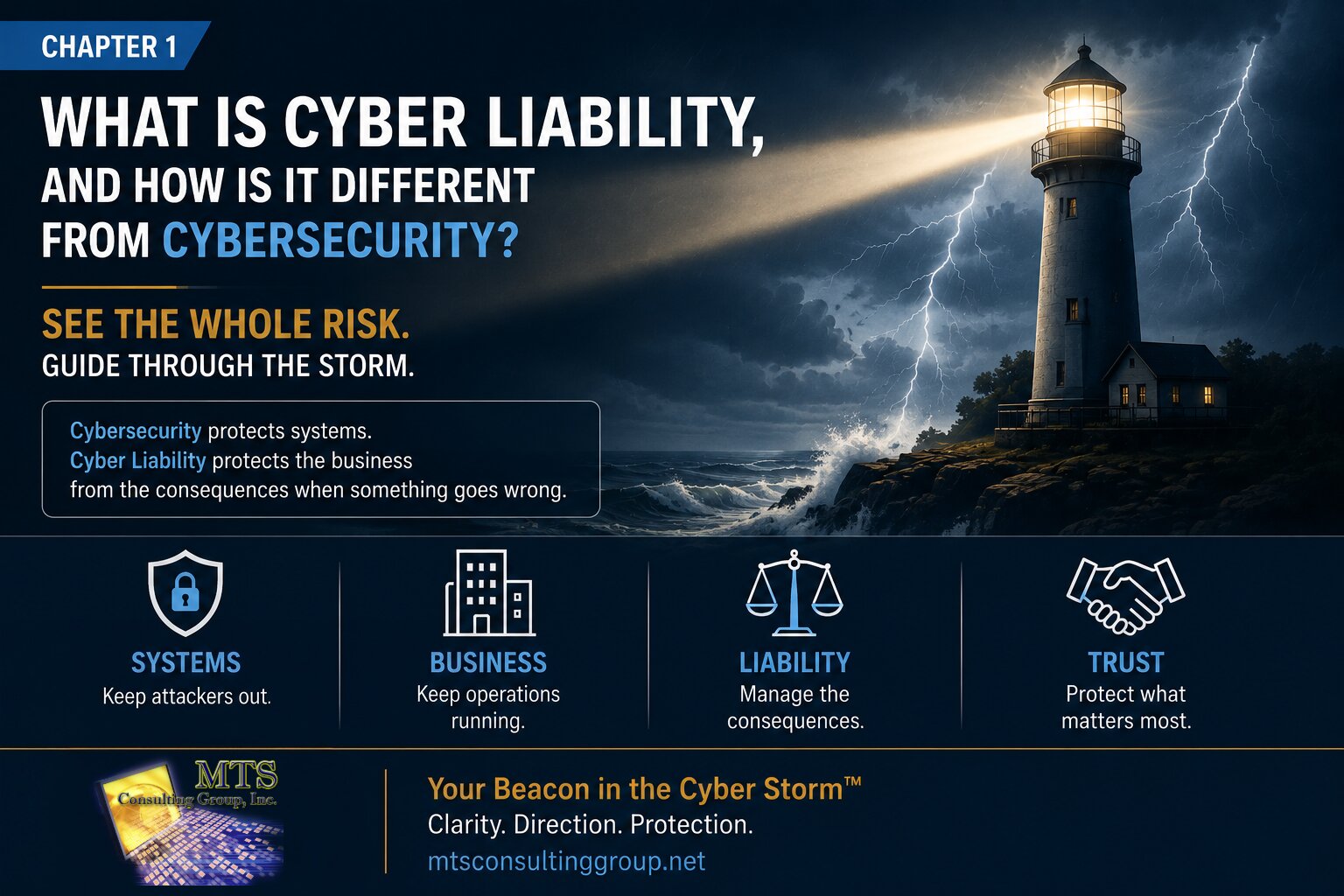
Cybersecurity and Cyber Liability are connected, but they are not the same thing.
Cybersecurity is primarily concerned with protecting systems, data, identities, and technology. Cyber Liability is the operational, legal, reputational, and regulatory exposure an organization faces when systems fail, data is exposed, controls do not work as expected, or leadership discovers that the organization was less prepared than it believed.
That distinction matters because an accounting or tax firm can have firewalls, endpoint protection, backups, multifactor authentication, and an IT provider—and still carry significant Cyber Liability.
At MTS Consulting Group, we believe leaders need to understand the whole risk before deciding what technology, process, policy, or investment comes next.
Create clarity before action.
That is where Cyber Liability begins.
Why Accounting and Tax Firm Leaders Need to Understand Cyber Liability
Most business leaders did not go into accounting, tax preparation, or professional services because they wanted to become cybersecurity experts.
Yet today’s firms depend heavily on technology.
Client records are digital.
Employees work remotely.
Files move through cloud platforms.
Sensitive information is shared electronically.
Vendors connect to systems.
Email has become a critical business platform.
Tax preparation, payroll, bookkeeping, document management, communication, and client service can all depend on technology functioning as expected.
That creates a leadership responsibility that goes beyond asking:
“Is our IT working?”
The better question is:
“What happens to our firm if it doesn’t?”
That is the beginning of the Cyber Liability conversation.
Cyber Liability helps leadership connect technology risk to the actual organization:
- Can the firm continue operating?
- What happens to clients?
- What obligations could be triggered?
- What happens to the firm’s reputation?
- Who makes decisions during an incident?
- What evidence exists to show what the firm had done before the incident?
- What happens if everyone assumed someone else was handling the risk?
Those are not simply IT questions. They are leadership questions.
Cybersecurity Protects Technology. Cyber Liability Looks at the Business.
Cybersecurity is essential.
A modern accounting firm needs appropriate protections around identities, devices, email, networks, cloud applications, sensitive information, remote access, backups, and other technology.
But cybersecurity controls are inputs.
The organization is the thing we are ultimately trying to protect.
That distinction is important.
A firewall can help protect a network.
Multifactor authentication can help protect an account.
Endpoint protection can help identify malicious activity.
A backup can help preserve data.
Employee education can help reduce human risk.
Each control has a purpose.
But none of those controls, by itself, answers the larger question:
“If something goes wrong tomorrow, what does that mean for the business?”
Cyber Liability brings those pieces together.
It asks leadership to look beyond individual tools and understand the total exposure the organization is carrying.
That is why MTS does not begin the conversation by throwing more technology at the problem.
We begin with clarity.
The MTS Cyber Liability Framework: See the Whole Risk
At MTS, we look at Cyber Liability across four connected areas:
- Operational Risk
- Legal Risk
- Reputational Risk
- Regulatory Risk
A technical problem can create consequences in more than one of these areas at the same time.
That is why looking at only the technology can create false confidence.
1. Operational Risk: Can the Firm Keep Working?
Operational risk is what happens to the organization’s ability to function.
Imagine that your accounting firm arrives Monday morning and a critical system is unavailable.
The first question probably isn’t:
“Which cybersecurity framework category does this fall under?”
The questions are more practical:
- Can employees work?
- Can we access client files?
- Can we process payroll?
- Can tax returns be completed?
- Can clients reach us?
- Can we meet deadlines?
- How long can we operate this way?
- Who knows what to do next?
That is operational exposure.
A firm can technically have a backup and still have operational risk if nobody knows how long recovery will take.
A firm can have security software and still have operational risk if critical business dependencies have never been identified.
A firm can outsource IT and still have operational risk if leadership has never discussed what should happen when a major system becomes unavailable.
Cyber Liability forces that conversation before the crisis.
2. Legal Risk: What Responsibilities Could the Incident Create?
A cyber incident can create responsibilities that extend beyond fixing the technology.
Contracts may matter.
The type of information involved may matter.
Client commitments may matter.
Third-party relationships may matter.
Documentation may matter.
What leadership knew—and what the organization did about it—may matter.
MTS is not a law firm, and technology providers should not pretend to replace qualified legal counsel.
Our role is different.
We help leaders recognize when the technology issue in front of them may represent a larger business exposure that deserves the right expertise and a documented decision.
That is part of seeing the whole risk.
3. Reputational Risk: What Happens to Trust?
Accounting and tax firms operate on trust.
Clients provide information they would not share casually with most people.
They trust their accountant or tax professional with financial records, identity information, business information, payroll details, tax records, and other sensitive data.
When something goes wrong, restoring a server or resetting an account may solve the technical problem.
It does not automatically restore confidence.
Leadership may need to answer questions such as:
- What happened?
- What information was affected?
- What did the firm have in place?
- What is being done now?
- Why should clients continue trusting us?
Reputation is difficult to measure until it is damaged.
That makes it easy to ignore during technology planning.
Cyber Liability makes it visible before the incident.
4. Regulatory Risk: What Is the Organization Responsible for Doing?
Accounting and tax firms operate within an environment that includes security expectations, professional responsibilities, and regulatory requirements.
Those requirements matter.
But at MTS, we believe there is an important distinction:
Compliance is the minimum; Cyber Liability is the truth.
Meeting a requirement does not automatically mean the organization is prepared.
A policy can exist on paper while employees do something entirely different.
A required control can technically be present while nobody verifies whether it is working.
A risk assessment can be completed and then forgotten.
A checklist can be finished while important operational risks remain unresolved.
The objective should not be to become good at checking boxes.
The objective is to build an organization that understands its exposure and makes informed decisions about reducing it.
Regulatory requirements can help establish a baseline.
Leadership still has to see the whole risk.
The Hidden Problem: False Confidence
One of the most important Cyber Liability risks is not a piece of malware.
It is false confidence.
Leadership often assumes somebody else has the problem covered.
“We have an IT company.”
“We have security software.”
“We have backups.”
“We use Microsoft 365.”
“We completed that questionnaire.”
“We passed that assessment.”
“We have policies.”
Each statement may be true.
But another question remains:
Has anyone connected all of those pieces and evaluated the actual Cyber Liability exposure of the organization?
That is where gaps can hide.
- A business grows.
- New employees are added.
- People begin working remotely.
- New cloud applications appear.
- Different vendors get access.
- Processes change.
- Leadership creates workarounds to keep things moving.
- Old technology remains in place longer than planned.
Responsibilities become spread across employees, vendors, consultants, and service providers.
Each decision may make sense individually.
Over time, however, leadership can lose visibility into the whole picture.
That is how false confidence develops.
Nothing looks obviously broken.
Until something happens.
Having an IT Provider Does Not Transfer Leadership Responsibility
An accounting firm should absolutely have qualified technology support.
But outsourcing technology does not mean leadership has outsourced responsibility for the organization.
Your technology partner can advise.
Your employees can follow procedures.
Your vendors can provide services.
Your attorney can provide legal guidance.
Other specialists can advise within their disciplines.
Leadership still has to make business decisions.
Cyber Liability therefore cannot live entirely inside the IT department—or with an outside IT provider.
Leadership needs enough clarity to understand:
- what the biggest risks are,
- which risks require action now,
- which risks can reasonably wait,
- what happens if a risk is accepted,
- and how technology recommendations connect to business outcomes.
The objective is not to turn firm leaders into cybersecurity engineers.
It is to help them become informed decision makers.
The MTS Perspective: Technology Should Reduce Risk and Create Confidence
At MTS Consulting Group, we do not believe organizations need more fear.
And they do not automatically need more technology.
They need clarity.
That means understanding the organization first.
- How does the firm operate?
- Where does sensitive information live?
- What technology does the firm depend on?
- Who has access?
- Which vendors are involved?
- What would stop the business from serving clients?
- What are leaders assuming is already protected?
- What has actually been verified?
Only after those questions become clearer should the conversation move toward recommendations.
Create Clarity Before Action.
Guide Through the Storm.
Teach Before We Act.
See the Whole Risk.
Those are operating principles at MTS, not advertising slogans.
Our goal is not to make leaders dependent on us because cybersecurity sounds too complicated.
The goal is the opposite.
A leader should leave a conversation with MTS understanding the decision better than when the conversation started.
Confidence—not dependency—is the objective.
A Practical Example: When a “Website Problem” Was Bigger Than the Website
One experience documented inside MTS involved an organization dealing with a serious cyber incident connected to its website.
At first glance, the problem could have been treated as a website issue.
- Fix the website.
- Close the ticket.
- Move on.
But the visible technical issue was not the entire risk.
Leadership needed to understand what had happened, what was at risk, what needed to be contained, and what decisions had to come next.
MTS helped bring structure to the situation, communicated clearly during the incident, assisted with rebuilding the website on a stronger platform, and helped the organization move toward a broader security and Cyber Liability plan.
The lesson was bigger than the technical fix:
The first visible problem is not always the whole risk.
That experience helped reinforce one of the core MTS principles: See the Whole Risk.
Five Questions Every Accounting-Firm Leader Should Ask
If you want to begin thinking about Cyber Liability without becoming a cybersecurity expert, start with five questions.
1. What would stop us from serving clients tomorrow?
Identify the systems, people, vendors, data, and processes that the firm cannot operate without.
2. What information would create the greatest problem if it were unavailable or exposed?
Think beyond files.
Consider client trust, deadlines, identity information, financial information, employee information, and business operations.
3. What are we assuming somebody else is handling?
This is where false confidence often lives.
Look at responsibilities shared between leadership, internal staff, technology providers, software companies, professional advisors, and other vendors.
4. What have we actually tested or verified?
There is an important difference between:
"We have it."
and:
"We know it works."
5. If we discovered a serious problem today, who would make the decisions?
The middle of an incident is a terrible time to discover that nobody knows who owns the next decision.
These questions create clarity. They also give leadership a better starting point for deciding where deeper investigation is needed.
Cyber Liability Is Not a One-Time Project
- Organizations change.
- Employees change.
- Technology changes.
- Vendors change.
- Business processes change.
- Attack methods change.
- Leadership priorities change.
That means Cyber Liability cannot be treated as a binder that gets completed once and put on a shelf.
The better model is a cycle:
Understand → Prioritize → Act → Verify → Reassess
Understand
Create a clear picture of how the organization operates and where meaningful exposure exists.
Prioritize
Separate what matters now from what can wait.
Not every issue has equal business impact.
Act
Implement the appropriate technology, process, education, documentation, or other countermeasure.
Verify
Do not assume implementation equals success.
Confirm that what was supposed to happen actually happened.
Reassess
Return to the business periodically because the organization will continue changing.
This is systems thinking applied to Cyber Liability.
A process tells you what to do.
A system tells you whether it produced the outcome you intended.
What Does a Cyber Liability Assessment Look Like?
A Cyber Liability Assessment should not feel like a technical interrogation.
At MTS, the starting point is a 26-minute guided leadership conversation.
The purpose is not to overwhelm leadership with technical findings.
It is to begin creating visibility.
We look at how the organization operates and explore exposure across the four Cyber Liability areas:
- Operational
- Legal
- Reputational
- Regulatory
From there, the objective is to help leadership understand three things:
- Where might we be exposed?
- What matters most?
- What should we investigate or address first?
Sometimes an organization discovers it is in better shape than leadership expected.
Other times, the conversation surfaces a handful of risks that nobody had connected before.
Both outcomes are useful.
The goal is clarity.
Frequently Asked Questions About Cyber Liability
Is Cyber Liability the same thing as cyber insurance?
No.
Cyber Liability is the broader business exposure an organization faces from cyber-related events and failures.
An insurance policy may be one part of an organization's broader risk-management picture, but it does not define Cyber Liability and it does not replace preparation, leadership decisions, security controls, documentation, recovery planning, or professional guidance.
MTS focuses on helping leaders understand and reduce Cyber Liability. We are not an insurance advisor.
Is Cyber Liability only a concern after a data breach?
No.
Cyber Liability can exist before an incident happens.
An organization may already have operational, legal, reputational, or regulatory exposure because of weak processes, unclear responsibilities, unverified controls, technology dependencies, poor documentation, or other gaps.
The purpose of Cyber Liability planning is to see those issues before a crisis exposes them.
Isn't Cyber Liability just another name for cybersecurity?
No.
Cybersecurity is an important component of managing Cyber Liability.
But Cyber Liability asks the larger business question: "What could this mean for the organization?"
Technology is part of the answer. It is not the whole answer.
Does having managed IT mean our Cyber Liability is handled?
Not necessarily.
Managed IT can provide an important technology foundation.
But Cyber Liability also involves leadership decisions, documentation, employee behavior, recovery planning, vendor relationships, business operations, legal considerations, regulatory expectations, and the organization's ability to understand and manage risk over time.
Is Cyber Liability only important for large accounting firms?
No.
A smaller firm can still depend heavily on technology, maintain sensitive information, rely on a small number of critical employees, and have limited tolerance for extended disruption.
Size does not eliminate business exposure.
In some cases, smaller organizations may have fewer resources available to absorb disruption.
How often should leadership review Cyber Liability?
There is no single schedule appropriate for every organization.
At minimum, meaningful changes to the business should trigger another look.
Examples include significant technology changes, new vendors, changes in remote work, new locations, major staffing changes, new business services, or a material security event.
Cyber Liability should be treated as an ongoing leadership responsibility rather than a one-time exercise.
A Better Starting Question
If your firm is trying to improve cybersecurity, do not begin with:
“What should we buy?”
Begin with:
“What are we responsible for protecting, where are we exposed, and what would matter most if something went wrong?”
That question creates a much better technology conversation.
It also gives leadership a way to evaluate recommendations based on business value instead of technical complexity.
Where MTS Fits
MTS Consulting Group helps organizational leaders understand where they may be exposed to Cyber Liability and guides them through how to reduce that exposure before a crisis forces the conversation.
We do that by bringing clarity first.
We help connect technology decisions to operational, legal, reputational, and regulatory risk.
We explain what we find in plain English.
We help leadership understand what matters most, what can wait, and what deserves attention first.
And when action is appropriate, we help build a practical plan around the organization’s real needs and priorities.
We are not here to make the storm louder.
We are here to help you find the path through it.
Your Next Step
If your firm has reached the point where leadership is thinking:
“We probably should understand this better than we currently do,”
that is a good place to start.
MTS offers a 26-minute Cyber Liability Assessment designed as a guided leadership conversation—not a technical audit.
Even if you decide not to work with MTS afterward, the goal is for you to leave with greater clarity about where your organization may be exposed and what deserves attention next.
Worst case, you understand your Cyber Liability better than you did 26 minutes earlier.
That is useful progress.
Continue Through the Cyber Liability Knowledge Center
Next Chapter:
What Are the Four Business Risks Every Accounting Firm Should Understand Before Investing in Cybersecurity?
Also coming in this series:
- Why Doesn’t Traditional IT Support Fully Address Cyber Liability?
- How Much Should an Accounting Firm Budget for Managed IT and Cybersecurity?
- How Does a Cyber Liability Assessment Help Business Leaders Make Better Decisions?
- What Should the First 90 Days of Reducing Cyber Liability Look Like?