Secure AI Starts with Seeing the Whole Risk
AI is moving quickly into everyday business operations.
Your team may already be using AI to draft emails, summarize documents, analyze spreadsheets, prepare client communication, or speed up daily work. Some of that use may be helpful. Some of it may be creating risk your leadership team cannot see yet.
The issue is not simply whether AI is good or bad.
The issue is whether your organization knows:
- Who is using AI
- What tools are being used
- What data is being entered
- What systems AI can access
- What policies guide employee behavior
- What cyber liability may be created if something goes wrong
Based in Metro Detroit, MTS Consulting Group helps organizations understand where they are exposed to cyber liability and reduce that exposure before something bad happens.
We are your Beacon in the Cyber Storm — helping you gain clarity, control, and a practical path forward.
See The Full Secure AI Series In YouTube
- Secure AI - What Business Leaders Need to Know
- The AI Question Every Leader Should Be Asking
- Part 1 - AI Is Already Inside Your Organization: Secure AI and Cyber Liability
- Part 2: Shadow AI and Hidden Cyber Liability: What Leaders Need to Know
- Part 3: What Data Should Never Go Into Public AI Tools?
- Part 4: Why AI Policies Are Now a Business Necessity
- Part 5: Secure AI Training for Employees: Why Policy Alone Is Not Enough
- Part 6: AI and Operational Risk: Can Your Organization Keep Working?
- Part 7 - AI and Legal Risk: Who Could Hold Your Organization Responsible?
- Part 8 - AI and Reputational Risk: Can People Still Trust Your Organization?
- Part 9 - AI and Regulatory Risk: Can Your Organization Prove It Is Managing AI Responsibly?
- Part 10 - How to Start Building a Secure AI Program
- Part 11 - Approved AI Tools and Safe AI Workflows
AI May Already Be in Your Organization
Many leaders believe AI adoption begins when the organization officially approves an AI tool. That is not always how it happens.
AI often enters quietly. An employee may use a public AI tool to rewrite an email. A manager may use AI to summarize a document. A team member may paste spreadsheet data into an AI platform to save time. A vendor may use AI while handling your information.
The organization may not have approved any of this. But the risk may already exist.
This matters because your organization may handle sensitive information such as:
Client financial records
& Tax documents
Employee information
& Payroll data
Tenant & property
management records
Donor, member &
beneficiary data
Business contracts &
legal documents
Proprietary business
information
AI can improve productivity. But unmanaged AI can also create a new path for sensitive information to leave your control.
Your team may already be using AI. The question is whether your organization knows how, where, and with what information.
The Real Risk Is Not AI. The Real Risk Is Uncontrolled AI.
MTS does not believe organizations should approach AI with panic.
AI can be useful. It can help teams work faster, communicate better, and reduce repetitive tasks.
But AI becomes a problem when no one has defined the boundaries.
The better question is not simply: 'Should we use AI?'
The better question is: 'Can we see and manage the risk AI creates?'
That is where many organizations are exposed.
They may not know what tools employees are using. They may not know what data is being entered. They may not know whether AI tools are saving, learning from, sharing, or exposing sensitive information. They may not know whether vendors are using AI on their behalf.
And if there is a problem, they may not be able to prove that reasonable controls were in place.
That is when cybersecurity becomes cyber liability.
AI Can Create Cyber Liability You May Not Be Aware Of
At MTS, we help clients see the whole risk.
Cyber risk is not only about firewalls, passwords, antivirus software, or backups. Those tools matter, but they do not tell the full story.
Cyber liability is the business exposure created when technology, data, people, vendors, or processes fail to properly protect information, operations, or obligations.
AI can increase that exposure.
If sensitive information is entered into an AI tool without proper approval, oversight, or controls, your organization may face difficult questions:
Was the data allowed?
Was the data allowed to be shared with that AI platform?
Did we have a policy?
Did the organization have an AI policy?
Were staff trained?
Were employees trained on acceptable AI use?
What was exposed?
Was client, employee, or business information exposed?
Vendor data use?
Did a third-party AI vendor retain or use the information?
Regulated data?
Was regulated or confidential data involved?
Can we prove it?
Could the organization prove what happened?
Were steps taken?
Were reasonable steps taken before the incident?
These are not just technical questions.
They are business, legal, regulatory, and reputational questions.
And the time to ask them is before an incident, not after.
Unmanaged AI Can Affect More Than Your IT Department
When AI is used without guidance, the impact can reach across the organization.
MTS helps leaders look beyond the tools and see the full business impact.
Business and Operational Risk
AI tools may produce inaccurate information, expose internal processes, or create dependency on systems the organization does not control. Operational decisions made on AI-generated information that has not been verified can affect the business in ways that are difficult to reverse.
Legal Risk
Sensitive or confidential information may be shared with AI platforms that were never approved for that data. If client, employee, donor, tenant, or business information is exposed through an AI tool, the organization may face legal questions about what happened and whether reasonable steps were taken.
Regulatory Risk
Organizations that handle tax, financial, employee, donor, tenant, or client information may have obligations around how that information is protected. AI use that falls outside those obligations may create regulatory exposure that leadership was not aware of.
Reputational Risk
If sensitive data is mishandled through AI use, clients, donors, tenants, employees, or community members may lose trust. For mission-driven organizations, reputational damage can affect the ability to serve the people who depend on them.
Compliance is the minimum. Cyber liability is the truth. MTS helps your organization see the whole risk before it becomes a crisis.
MTS Is Your Beacon for Secure AI
You do not need to become an AI expert to lead responsibly.
You need a guide who can help you ask the right questions, identify the blind spots, and build a practical plan.
MTS helps organizations move from confusion to clarity.
Our Secure AI guidance helps you understand:
- Where AI may already be used inside your organization
- What sensitive information may be at risk
- Which tools should or should not be approved for business use
- Whether employees have clear AI usage rules
- Whether AI tools can access your business systems
- Whether vendors may be using AI with your data
- Whether your organization can demonstrate reasonable control
We help you see the whole risk — not just the technology.
That means looking at people, processes, vendors, data, policies, operations, and leadership responsibility.
For more on our full range of services, visit our Services page.
External resources we recommend:
A Practical Path to Secure AI
The first step is not panic. The first step is clarity.
MTS helps your organization understand where AI-related cyber liability may exist and what practical steps can reduce exposure.
01
Assess Your Exposure
Start with the 26-minute Cyber Risk Assessment to identify where AI, data, vendors, policies, or employee behavior may be creating cyber liability.
02
Understand the Whole Risk
MTS helps translate the findings into plain English so leadership can understand the business, legal, regulatory, and reputational impact.
03
Build a Secure AI Roadmap
Together, we define practical next steps to improve visibility, create boundaries, protect sensitive data, and support responsible AI use.
Start with a 26-Minute Cyber Risk Assessment
The MTS Cyber Risk Assessment is designed to help your organization begin identifying where cyber liability may exist, including risks connected to AI use.
In approximately 26 minutes, you can begin evaluating areas such as:
- AI usage inside your organization
- Employee behavior around sensitive information
- Sensitive data handling practices
- Vendor and third-party exposure
- Policy gaps and acceptable-use guidance
- Cybersecurity controls currently in place
- Business continuity considerations
- Leadership visibility into AI and data risk
- Data protection practices across the organization
The assessment helps turn uncertainty into a starting point.
It does not require you to know every technical detail. It is designed to help leadership understand where deeper review may be needed.
Download the Secure AI Field Report
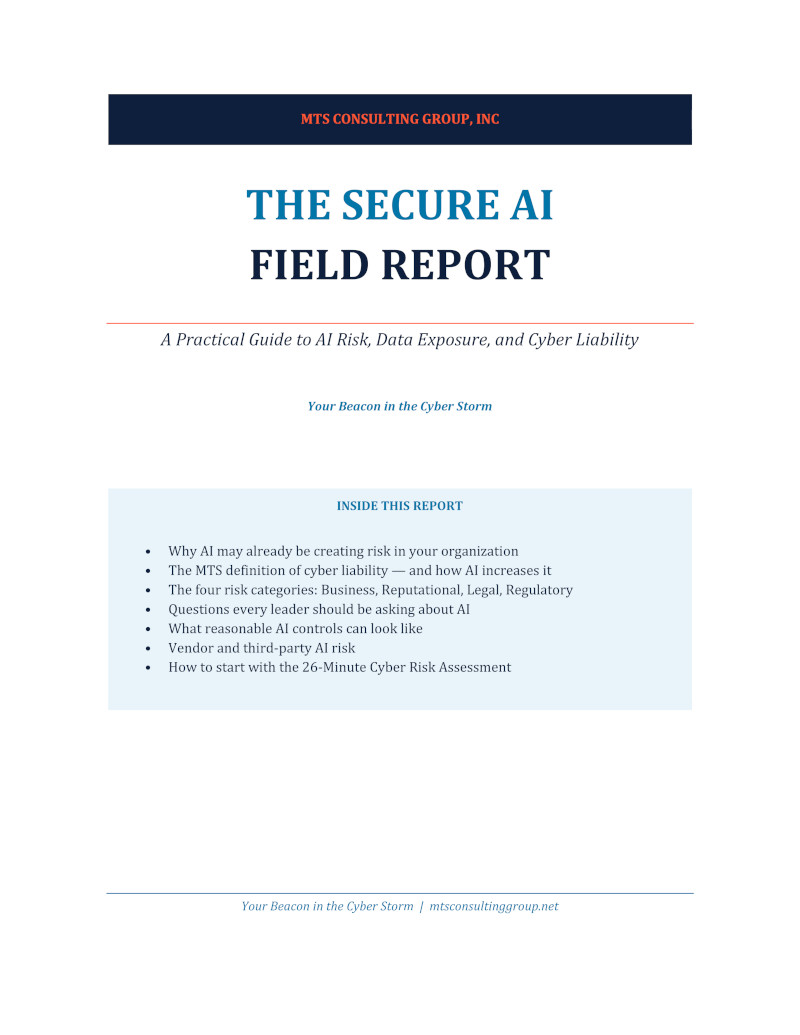
The Secure AI Field Report: A Practical Guide to AI Risk, Data Exposure, and Cyber Liability
AI risk is becoming a leadership issue.
That means business owners, executive directors, office managers, operations leaders, and decision-makers all need a shared understanding of what is at stake.
This educational report is designed to help leaders make informed decisions before AI risk becomes a larger problem.
Inside the report, you will learn:
- Why AI use can create cyber liability
- How sensitive information may be exposed through everyday AI use
- Why informal AI use is difficult to manage
- What leaders should ask before approving AI tools
- Why AI policies are becoming important for organizations
- How vendors may create AI-related exposure
- What reasonable AI controls can look like
- Why a Cyber Risk Assessment is a practical first step
Attend the Secure AI Briefing
MTS will offer a Secure AI Briefing to help organizations understand how AI can create cyber liability and what practical steps leaders can take to reduce exposure.
This session is designed for business and nonprofit leaders who want plain-English guidance, not technical confusion.
The briefing will cover:
- How AI is entering organizations
- Why employee AI use matters
- How sensitive data may be exposed
- What cyber liability means in the context of AI
- What should be included in an AI acceptable-use policy
- How vendors may create AI-related risk
- Why leadership should document reasonable controls
- How to begin building a Secure AI roadmap
Questions Leaders Are Asking About Secure AI
Is AI really a cybersecurity issue?
Yes. AI becomes a cybersecurity issue when it interacts with sensitive data, employees, vendors, business systems, or decision-making processes. If AI is used without proper boundaries, it can create data exposure and cyber liability.
What is cyber liability in relation to AI?
Cyber liability is the business exposure created when technology, data, people, vendors, or processes fail to properly protect information, operations, or obligations. AI can increase that exposure when sensitive information is entered into tools without proper approval, policy, training, or oversight.
What if we have not officially approved AI use?
That does not mean AI is not being used. Employees may already be using public AI tools, browser extensions, apps, or vendor-provided platforms. The first step is to gain visibility.
What kind of information should not be entered into public AI tools?
Employees should avoid entering client information, tax records, financial data, employee information, tenant records, donor lists, contracts, legal documents, credentials, internal procedures, or proprietary business information unless the organization has approved the tool and verified proper protections.
Does our organization need an AI policy?
Most organizations should have at least a basic AI acceptable-use policy. The policy should define approved tools, prohibited information, acceptable use, review requirements, employee responsibilities, and escalation steps.
How does the 26-minute Cyber Risk Assessment help?
The assessment helps your organization begin identifying where cyber liability may exist. It gives leadership a practical starting point for understanding AI-related exposure, cybersecurity gaps, policy concerns, vendor risks, and data protection issues.
Is this only for large companies?
No. Small and mid-sized organizations that handle sensitive information can all be affected by unmanaged AI use. Tax offices, accounting firms, property management firms, nonprofits, churches, and mission-driven organizations are especially important to consider.
You Cannot Manage AI Risk You Cannot See
AI may already be helping your organization. It may also be creating exposure.
The good news is that you do not have to navigate it alone.
MTS helps organizations understand where they are exposed to cyber liability and reduce that exposure before something bad happens.
Start with clarity. Start with the 26-minute Cyber Risk Assessment.