
The Quick Answer
Traditional managed IT is essential, but it does not, by itself, address the full Cyber Liability of an accounting or tax firm.
Managed IT typically focuses on keeping technology available, supported, maintained, and functioning. Cyber Liability asks a broader set of business questions across four areas: Operational, Legal, Reputational, and Regulatory risk.
The difference is not that managed IT is inadequate.
Managed IT is the foundation. It is not the full Cyber Liability program.
For accounting and tax firm leaders, that distinction matters. Your technology can be working while important business risks remain undocumented, unverified, or simply assumed to be someone else’s responsibility.
The goal is not to replace good IT support.
The goal is to build on that foundation so leadership can see the whole risk.
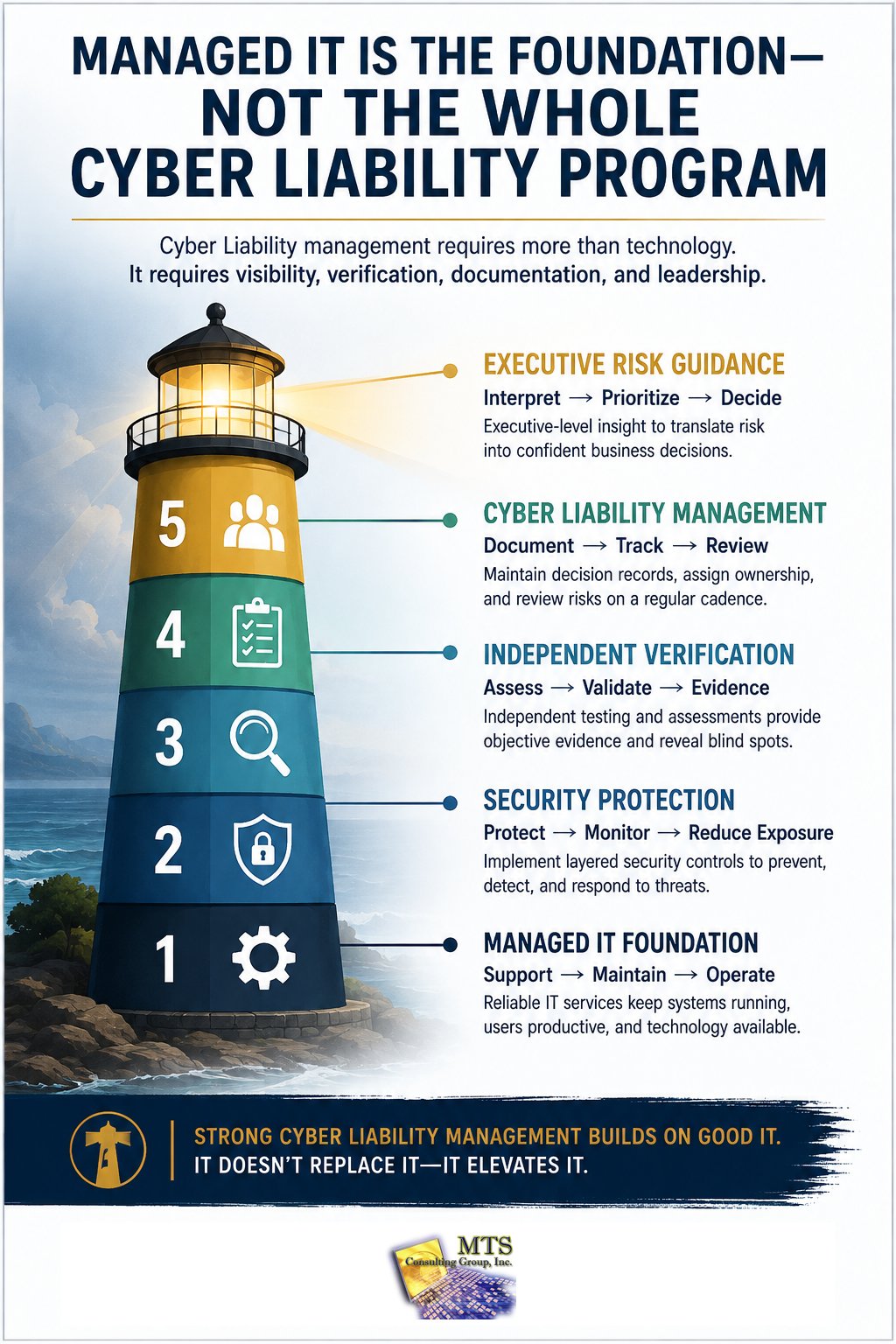
Managed IT is the foundation. It is not the full Cyber Liability program.
The goal is not to replace good IT support.
The goal is to build on that foundation so leadership can see the whole risk.
Good IT Support Is Still Essential
Let’s start by removing a misconception.
This chapter is not an argument against managed IT.
Reliable managed IT is one of the foundations of a resilient organization.
An accounting firm needs its technology to work.
Employees need access to applications.
Computers need to be maintained.
Users need support.
Microsoft 365 needs administration.
Devices need monitoring.
Networks need management.
Technical problems need resolution.
Systems need maintenance.
When those functions are handled well, they create a stable technology foundation for the organization.
The problem begins when leadership assumes:
“We have managed IT, so everything related to cyber risk must be covered.”
That assumption can create hidden Cyber Liability.
The issue isn’t whether your IT provider is doing a good job.
The issue is whether everyone clearly understands what the provider is responsible for, and what remains a leadership responsibility.
The MTS Perspective: Foundation Is Not the Same as the Whole Structure
Think about an accounting firm’s office building.
A strong foundation matters.
But you would never say:
“We have a foundation, so the entire building is complete.”
The foundation supports everything built on top of it.
Managed IT works the same way.
It establishes the technology foundation needed to operate effectively.
But managing Cyber Liability requires additional visibility into:
- business risk,
- security protections,
- leadership decisions,
- documentation,
- verification,
- employee behavior,
- recovery expectations,
- third-party dependencies,
- strategic planning,
- and the organization’s changing risk picture.
That is why the MTS approach separates these responsibilities instead of pretending everything belongs inside one vague bucket called “IT.”
Clarity protects both the client and the technology provider.
The Hidden Problem With the Phrase “Our IT Company Handles That”
Ask an executive who is responsible for cybersecurity and you may hear:
“Our IT company.”
Then ask a few more questions.
- Who determines the organization’s acceptable level of business risk?
- Who decides how long the firm can operate without a critical system?
- Who determines which information creates the greatest exposure?
- Who decides whether a recommendation should be accepted, deferred, or declined?
- Who maintains the evidence showing what leadership decided?
- Who coordinates the appropriate outside professionals if an incident creates legal questions?
- Who determines what the organization should communicate during a serious incident?
- Who verifies that the protections leadership believes exist actually work?
Those answers usually involve more than the IT provider.
That is not a failure.
It is the reality of Cyber Liability.
Technology providers have responsibilities.
Leadership has responsibilities.
Employees have responsibilities.
Other professional advisors may have responsibilities.
Third-party vendors have responsibilities.
The risk appears when everyone assumes someone else owns the decision.
False Confidence Creates Hidden Cyber Liability
In Chapter 2, we introduced false confidence as an important Cyber Liability problem.
Traditional managed IT can unintentionally contribute to false confidence when service boundaries are unclear.
Consider these statements:
- “We have backups.”
- “We have antivirus.”
- “We have MFA.”
- “We have an IT provider.”
- “We have policies.”
All five may be completely true.
But they don’t tell leadership enough.
The better questions are:
Backups
If the business had to recover tomorrow, what could actually be restored, and how long would recovery take?
Security protection
What systems and users are protected, what is being monitored, and what happens when suspicious activity is detected?
Multifactor authentication
Where is it enabled, where isn’t it enabled, and what important access paths remain?
Managed IT
What is actually included in the agreement?
Policies
Do the policies describe what the organization actually does?
This is the difference between having something and understanding what it means to the business.
Cyber Liability lives in that gap.
Five Layers Leaders Should Understand
A useful way to think about the relationship between managed IT and Cyber Liability is through five layers.
Layer 1: Technology Foundation
The first layer is reliable managed technology.
This may include functions such as:
- user support,
- device management,
- system maintenance,
- Microsoft 365 administration,
- network support,
- monitoring,
- patching,
- documentation,
- and ongoing technical management.
Without a stable foundation, everything above it becomes harder.
But stability alone does not tell leadership how much Cyber Liability the organization is carrying.
Layer 2: Security Protection
The next layer focuses more directly on reducing the likelihood and impact of security events.
Depending on the organization’s needs, this can involve:
- identity protection,
- endpoint security,
- access controls,
- threat monitoring,
- secure connectivity,
- email protections,
- security awareness,
- vulnerability management,
- and other safeguards.
These controls matter.
But once again, the existence of controls is not the final objective.
Leadership should understand which risk each control is intended to reduce.
Otherwise cybersecurity becomes a shopping list.
Layer 3: Verification and Evidence
Now we move beyond:
“We have it.”
to:
“How do we know?”
That distinction is central to the MTS approach.
An independent assessment can help identify vulnerabilities or assumptions the primary technology provider may not see.
That includes MTS.
If an independent assessment identifies something we missed, our responsibility is not to become defensive.
Our responsibility is to understand it, address it appropriately, and explain what it means.
Independent evidence creates a healthier conversation.
It allows leadership to compare belief with reality.
That matters because clients do not need perfection.
They need honesty, documentation, verification, and proactive action.
Layer 4: Cyber Liability Management
This layer connects the technical environment to the organization’s broader business responsibilities.
Leadership needs visibility into questions such as:
- What risks have been identified?
- What has been recommended?
- Which recommendations were accepted?
- Which were deferred?
- Which were declined?
- Who owns the next step?
- What evidence exists?
- When will the issue be reviewed again?
- How does the issue affect Operational, Legal, Reputational, or Regulatory risk?
This is where documentation becomes part of the protection system.
A technical fix solves a technical problem.
A documented decision creates organizational memory.
Both matter.
Layer 5: Executive Risk Guidance
The final layer belongs at the leadership level.
Executives should have someone capable of translating technology and cybersecurity findings into business decisions.
Not another technical report.
Not another list of vulnerabilities.
Not another dashboard filled with red and green indicators.
Leadership needs answers to questions such as:
- What are the three risks that matter most right now?
- Why do they matter?
- What could happen to the business?
- What do you recommend?
- What can reasonably wait?
- What decision does leadership need to make?
- What should we review next quarter?
That is a different conversation from traditional help desk support.
Both are important.
They serve different purposes.
Managed IT vs. Cyber Liability Management
The distinction becomes clearer when we put the two conversations side by side.
| Managed IT Question | Cyber Liability Question |
|---|---|
| Is the system working? | What happens to the business if it stops working? |
| Is the device managed? | What could this device expose? |
| Do backups exist? | Can we prove the business can recover? |
| Is MFA enabled? | What important access remains exposed? |
| Is security software installed? | What risk is the control reducing, and how do we know? |
| Was the ticket closed? | Was the underlying business risk resolved? |
| Is the environment documented? | Are leadership decisions and responsibilities documented? |
| Is the user supported? | Does the user understand their role in reducing risk? |
These are not competing questions.
The right-hand column builds on the left.
That is the point.
Where Traditional IT Support Usually Stops
The exact boundaries vary by provider and contract.
That is important.
We should not assume every managed IT company provides the same services.
Some providers deliver extensive cybersecurity and strategic guidance.
Others primarily provide technical support.
The problem is not the label “MSP.”
The problem is unclear scope.
Leadership should know exactly what its agreement includes.
For example, does the relationship include:
- security assessments,
- independent verification,
- executive security guidance,
- risk tracking,
- documented risk decisions,
- employee education,
- recovery planning,
- business impact discussions,
- security roadmap development,
- periodic risk reviews,
- AI governance,
- or ongoing Cyber Liability management?
Do not assume.
Verify.
That principle applies even when MTS is the technology provider.
Why MTS Separates the Service Layers
MTS has learned that clients often assume “managed services” includes everything.
That creates risk for everyone.
If an incident occurs, leadership may reasonably believe a responsibility belonged to MTS even when that responsibility was never included in the agreement.
The answer is not a longer sales pitch.
The answer is clarity.
MTS separates support, protection, verification, Cyber Liability management, and executive guidance so clients can understand what they have and what they do not have.
The objective is not to create more products for the sake of creating products.
The objective is to eliminate ambiguity.
Leadership should be able to say:
“I understand what is included. I understand what is not included. I understand the risk, and I understand the decision.”
That is informed leadership.
A Three-Question Scope Test for Your Current IT Relationship
You can begin evaluating your current relationship without changing providers or purchasing anything.
Ask your technology provider these three questions.
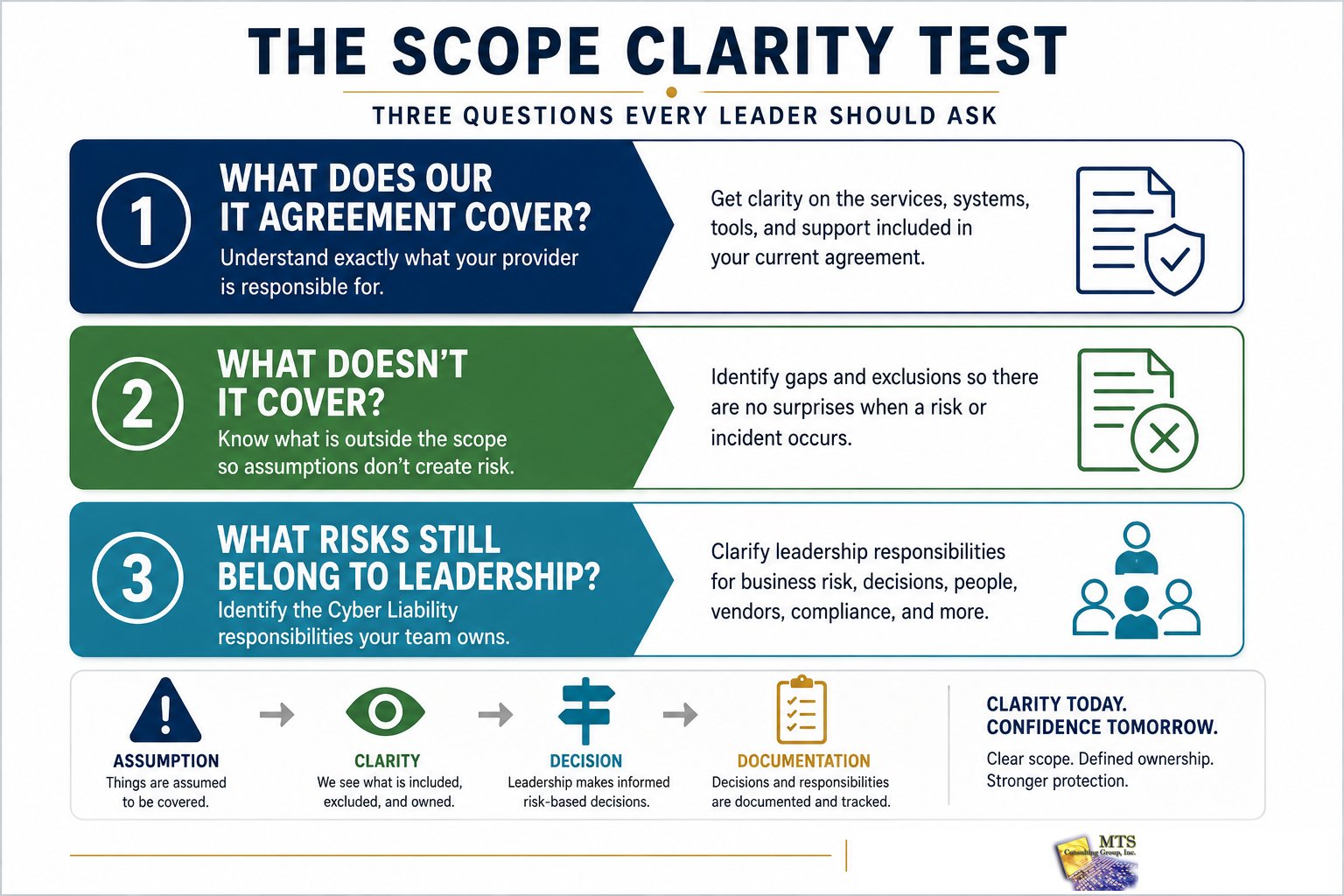
Question 1: What exactly are you responsible for?
Ask for the answer in plain English.
Not product names.
Not acronyms.
Not a 30-page contract.
What business and technology responsibilities does the provider actually own?
Question 2: What are you specifically NOT responsible for?
This may be the more valuable question.
A trustworthy provider should be willing to discuss boundaries.
Clarity about what is outside the agreement is not weakness.
It is responsible service.
Question 3: What risks do you see that leadership still owns?
This changes the conversation.
A good technology advisor should be able to explain where the organization’s responsibility begins.
The answer might involve:
- business decisions,
- employee behavior,
- documentation,
- recovery expectations,
- outside professional guidance,
- vendor decisions,
- risk acceptance,
- or strategic priorities.
The purpose is not to transfer every responsibility to the provider.
The purpose is to make ownership visible.
The Ticket Can Be Closed While the Risk Remains Open
This is one of the most important differences between IT support and Cyber Liability management.
Imagine an employee reports suspicious activity on an account.
The technical team investigates.
The password is reset.
Access is secured.
The ticket is closed.
From an IT service perspective, the work may be complete.
But leadership may still need answers.
What did the account have access to?
Was sensitive information involved?
Did the event expose a larger weakness?
Does another professional need to be involved?
Does the organization need to document a decision?
Could the same thing happen elsewhere?
Should another control be implemented?
Should leadership review the incident?
The ticket can be closed while the business risk remains open.
Cyber Liability management asks what happens after the technical resolution.
Another Example: “We Have Backups”
Backup is one of the easiest places for false confidence to develop.
A leadership team asks:
“Are we backed up?”
Someone says:
“Yes.”
Everyone moves on.
But the Cyber Liability conversation asks:
- What is backed up?
- What is not?
- How frequently?
- Where is it stored?
- Who monitors failures?
- What happens if the primary environment is compromised?
- How quickly does the business need systems restored?
- Has restoration actually been tested?
- Does leadership’s expectation match technical reality?
The distinction is simple:
Backup is a technology function.
Recovery is a business outcome.
Leadership cares about the outcome.
A Real MTS Lesson: When the Visible Technical Issue Wasn’t the Whole Risk
One of the experiences documented in the MTS Field Guide involved a publishing organization facing a serious cyber incident along with a major website need.
MTS could have approached the situation as a collection of technical tasks.
Repair the immediate problem.
Rebuild the website.
Complete the work.
Instead, the incident revealed a larger need.
Leadership needed to understand what was happening, what mattered most, how to move forward safely, and how to begin managing the organization’s broader Cyber Liability over time.
The response therefore became more than a technical fix.
It became an exercise in:
- creating clarity,
- guiding leadership through uncertainty,
- addressing the immediate technology need,
- and helping build a broader security and Cyber Liability plan.
That experience helped shape an important MTS operating principle:
See the Whole Risk.
The visible technical problem may only be the first evidence of a larger business exposure.
Case Study Confidence Score: 100/100
Classification: Verified MTS Client Experience
This example is documented in the MTS Field Guide. Naming the organization publicly should continue to follow MTS’s client-permission standards.
What Should Accounting-Firm Leadership Expect From a Technology Advisor?
Your technology advisor does not need to own every responsibility.
They should help make responsibilities clear.
A strong advisory relationship should help leadership understand:
1. What we know
Facts and verified information.
2. What we don’t know
Uncertainty should be visible.
3. What matters most
Do not bury executives under 40 technical findings.
Start with the three that matter most.
4. What is recommended
Explain the recommendation in business language.
5. Why it matters
Connect the recommendation to Operational, Legal, Reputational, or Regulatory risk.
6. What leadership needs to decide
Make the decision explicit.
7. What happens next
Assign ownership and a review date.
That is how technology advice becomes leadership guidance.
Five Warning Signs Your Firm May Have a Scope Gap
A scope gap does not automatically mean your provider is doing something wrong.
It means leadership needs more clarity.
Watch for these five signs.
1. Leadership says, “I thought IT handled that.”
That phrase should trigger a scope conversation.
2. Nobody can clearly explain what is included in the agreement.
If scope cannot be explained simply, assumptions will fill the gap.
3. Security recommendations are discussed but important decisions are not documented.
A recommendation without a decision trail can become tomorrow’s confusion.
4. Leadership receives technical reports without business interpretation.
Data is not the same as guidance.
5. Nobody periodically asks whether the organization’s risk picture has changed.
The business changes.
The Cyber Liability picture changes with it.
What Managed IT Should Be: A Strong Foundation
The answer is not to diminish managed IT.
It is to put it in the right place.
Strong managed IT should create a dependable foundation for:
- productive employees,
- maintained systems,
- responsive support,
- managed technology,
- documented environments,
- predictable operations,
- and better security.
Then additional Cyber Liability capabilities can build on that foundation.
Think of it as a progression:
Stable Technology
↓
Appropriate Security
↓
Independent Verification
↓
Documented Cyber Liability Management
↓
Executive Risk Guidance
The organization becomes stronger as leadership gains visibility across the layers.
Technology remains essential throughout.
But the conversation becomes bigger than technology.
Frequently Asked Questions
Does this mean our MSP is not doing enough?
Not necessarily.
Every provider has a defined scope.
Your first task is not to judge the provider.
It is to understand the agreement.
Ask what is included, what is excluded, and which responsibilities remain with leadership.
Clarity first.
Should an MSP be responsible for all cybersecurity?
That is the wrong starting question.
The better question is:
Who owns each responsibility?
Cyber risk can involve leadership, technology providers, employees, vendors, legal counsel, and other specialists.
The objective is clear ownership, not forcing every responsibility onto one provider.
If our IT provider installs security tools, doesn’t that address Cyber Liability?
It can reduce portions of the organization’s Cyber Liability.
But tools alone do not address leadership decisions, documentation, verification, business continuity expectations, employee responsibilities, third-party dependencies, or every potential business consequence.
Security controls are part of the system.
They are not the entire system.
Why does MTS recommend independent assessments if MTS already manages the technology?
Because independent evidence helps challenge assumptions.
If an outside assessment identifies something MTS missed, we want to know.
The objective is not to prove MTS is always right.
The objective is to help protect the client.
Does MTS guarantee that a business will never experience a cyber incident?
No.
No responsible technology provider should promise that.
Cyber Liability management is about understanding exposure, reducing meaningful risk, improving preparedness, documenting decisions, and creating a stronger ability to respond when something goes wrong.
Why does documentation matter so much?
Because organizations change and people forget.
Documentation creates organizational memory.
It can show what was identified, what was recommended, what leadership decided, what was implemented, and what still requires attention.
At MTS, documentation is part of the protection system.
What should I ask my current IT provider tomorrow?
Start with:
“Can you walk me through what our current agreement covers, what it does not cover, and which Cyber Liability responsibilities still belong to us?”
A good provider should welcome that conversation.
The Goal Is Not to Replace IT Support. It Is to Complete the Picture.
Traditional managed IT solves an important problem.
It helps keep technology working.
But Cyber Liability asks leadership to look beyond whether technology works today.
It asks:
What happens when it doesn’t?
What happens when a security control fails?
What happens when an employee makes a mistake?
What happens when leadership discovers an assumption was wrong?
What happens when the technical problem creates an operational, legal, reputational, or regulatory consequence?
And most importantly:
Who owns the next decision?
That is why managed IT is the foundation, not the full Cyber Liability program.
The objective is not more complexity.
It is greater clarity.
Your Next Step
Before buying another cybersecurity product, schedule a conversation with whoever manages your technology.
Ask three questions:
What do we currently have?
What is outside the scope?
What Cyber Liability responsibilities still belong to leadership?
Document the answers.
You may discover that your organization is better protected than you thought.
You may discover gaps.
Either result is valuable because you replaced assumption with evidence.
If you need help connecting those answers to the larger Cyber Liability picture, MTS’s 26-minute Cyber Liability Assessment is designed to start that conversation.
No technical lecture.
No fear.
No assumption that you need to buy something.
Just a clearer understanding of where the organization may be exposed and what leadership should consider next.
Create clarity before action.
Continue Through the Cyber Liability Knowledge Center
Previous Chapter:
What Are the Four Business Risks Every Accounting Firm Should Understand Before Investing in Cybersecurity?
Start Here:
What Is Cyber Liability, and How Is It Different from Cybersecurity?
Next Chapter:
How Much Should an Accounting Firm Budget for Managed IT and Cybersecurity in 2026?
Related chapters:
- What Should Managed IT Actually Do to Reduce an Accounting Firm’s Business Risk?
- How Does a Cyber Liability Assessment Help Business Leaders Make Better Decisions?
- What Should the First 90 Days of Reducing Cyber Liability Look Like?