The Quick Answer
The lowest-priced IT provider is not necessarily the least expensive choice.
For an accounting or tax firm, the real cost of technology includes more than the monthly invoice. It can also include employee downtime, partner time, unexpected project charges, deferred technology replacement, security gaps, slow recovery, unclear responsibilities, and business disruption.
A lower-priced provider may be an excellent choice if the scope matches what your firm actually needs.
The risk begins when leadership compares prices without first comparing responsibilities and outcomes.
At MTS Consulting Group, we believe the better question is:
What is the total business cost of this technology decision?
The goal is not to buy the most expensive IT.
It is not to buy the cheapest IT.
It is to understand what the firm needs, what it is buying, what risks remain, and whether the investment supports the business.
Create Clarity Before Action.
The problem isn’t cheap.
The problem is unclear.
The invoice is only one piece of evidence.
The Monthly Invoice Is Only One Technology Cost
When leadership evaluates IT providers, the monthly recurring fee is easy to compare.
Provider A costs $4,500 per month.
Provider B costs $6,500.
Provider C costs $8,000.
Those numbers are concrete.
The problem is that they tell leadership almost nothing about the total business cost of each relationship.
A lower monthly price can be genuine savings.
It can also be the beginning of additional costs that appear somewhere else.
Those costs might show up as:
- Lost employee productivity
- Partner and leadership time
- Additional project invoices
- Recurring technology problems
- Inadequate planning
- Delayed upgrades
- Security exposure
- Extended recovery time
- Responsibilities leadership assumed were included but were not
None of that means the lowest-priced provider is automatically the wrong provider.
It means the invoice is only one piece of evidence.
Leadership needs to See the Whole Risk.
Cheap Is Not the Problem. Unclear Is the Problem.
MTS does not believe that a high price automatically means high quality.
We also do not believe that a lower price automatically means poor service.
Both assumptions are shortcuts.
A $125-per-user relationship may be exactly what one organization needs.
Another organization may reasonably require an investment closer to $250, $300, or $400 per user.
As discussed in Chapter 4, the appropriate investment depends on the environment, scope, security requirements, recovery expectations, support requirements, and strategic guidance involved.
The important question is:
What does the price actually represent?
If leadership understands the scope and consciously decides it meets the firm’s needs, a lower price can represent excellent value.
If leadership assumes services and responsibilities are included when they are not, the apparent savings can become expensive.
The problem isn’t cheap.
The problem is unclear.
The MTS Total Business Cost Framework
When evaluating an IT decision, look beyond the monthly invoice and examine five areas:
Direct Technology Cost
The number everyone sees on the invoice.
Productivity Cost
The cost distributed across employees when technology does not work well.
Leadership Cost
Senior people spending time on technology coordination.
Risk Cost
Exposure that exists before money has actually been lost.
Change and Recovery Cost
What organizations pay when change is not planned.
Together, these create a more useful picture of what the technology relationship actually costs the business.
Cost #1: Direct Technology Cost
This is the number everyone sees.
It includes the recurring managed-services fee and potentially:
- Software licensing
- Security services
- Cloud services
- Backup
- Hardware
- Projects
- Consulting
- Onsite work
- After-hours work
- Other technology expenses
This is where normal price comparison belongs.
But leadership should normalize the proposals first.
For every provider, identify four categories.
Included
What is covered by the recurring fee?
Additional Cost
What routinely creates another invoice?
Not Provided
What does the provider not do?
Shared Responsibility
Where does the provider’s responsibility end and the firm’s begin?
Until those four categories are understood, comparing two monthly prices can be misleading.
Cost #2: Productivity Cost
Technology exists to help people work.
When technology does not work well, the cost is distributed across employees.
That makes it less visible than an invoice.
Consider a 30-person accounting firm.
Suppose a recurring technology problem causes each employee to lose an average of just 15 minutes per week.
That sounds small.
But:
30 employees × 15 minutes = 7.5 employee hours per week
Across 50 working weeks:
7.5 × 50 = 375 hours per year
If the blended value of employee time were $50 per hour:
375 × $50 = $18,750 per year
A small recurring inconvenience can therefore become a meaningful business cost.
This example does not prove that a more expensive IT provider would eliminate the problem.
It demonstrates something more important:
Small amounts of technology friction scale across an organization.
Cost #3: Leadership Cost
This cost is frequently ignored.
What is a partner’s time worth?
What about a managing partner?
A firm administrator?
An operations leader?
When technology relationships are poorly structured, senior people can become unpaid technology coordinators.
They may spend time:
- Escalating unresolved issues
- Coordinating vendors
- Researching products
- Approving emergency purchases
- Resolving recurring problems
- Trying to determine who is responsible
- Translating between multiple technology companies
Leadership involvement is sometimes necessary.
But leadership should be making business decisions, not repeatedly managing routine technology coordination.
Imagine two partners each spend two hours per month dealing with preventable technology coordination.
That equals:
2 partners × 2 hours × 12 months = 48 partner hours per year
The financial value of those hours depends on the firm.
But the opportunity cost is clear.
Those are hours not spent:
- Serving clients
- Developing staff
- Growing the firm
- Improving operations
- Leading the organization
The cheapest technology relationship can become expensive when leadership becomes part of the support process.
Cost #4: Risk Cost
Risk cost is more difficult to calculate because it often exists before money has actually been lost.
That does not make it imaginary.
Consider a few examples:
- A security recommendation has been deferred.
- A backup exists but recovery has not been verified.
- An old system remains in production.
- A vendor still has unnecessary access.
- An employee account has more privileges than required.
- A critical responsibility is assumed to belong to the IT provider, while the provider believes it belongs to the client.
None of those situations automatically means an incident will occur.
But each represents exposure.
That is where the MTS Cyber Liability Framework becomes useful.
Operational Risk
Could it interrupt the firm’s ability to work?
Legal Risk
Could it create responsibilities requiring qualified professional guidance?
Reputational Risk
Could it affect client confidence?
Regulatory Risk
Could it affect the responsibilities expected of the firm?
The purpose is not to attach a frightening dollar amount to every risk.
The purpose is to make the exposure visible enough for leadership to make a decision.
Cost #5: Change and Recovery Cost
Technology environments do not remain static:
- Computers age.
- Servers age.
- Applications change.
- Employees join and leave.
- Vendors change.
- Firms merge.
- Offices move.
- Remote-work patterns evolve.
- New technology is adopted.
- AI enters workflows.
If those changes are not planned, organizations often pay for them reactively.
Reactive technology spending
Tends to arrive as:
We need to do this now.
Planned technology spending
Sounds different:
This system will reach the end of its planned lifecycle next year. Here are the options, estimated investment, risks, and recommended timeline.
The expense may exist either way.
The difference is whether leadership had visibility before the decision became urgent.
This reflects another MTS principle:
Prepare Before the Crisis.
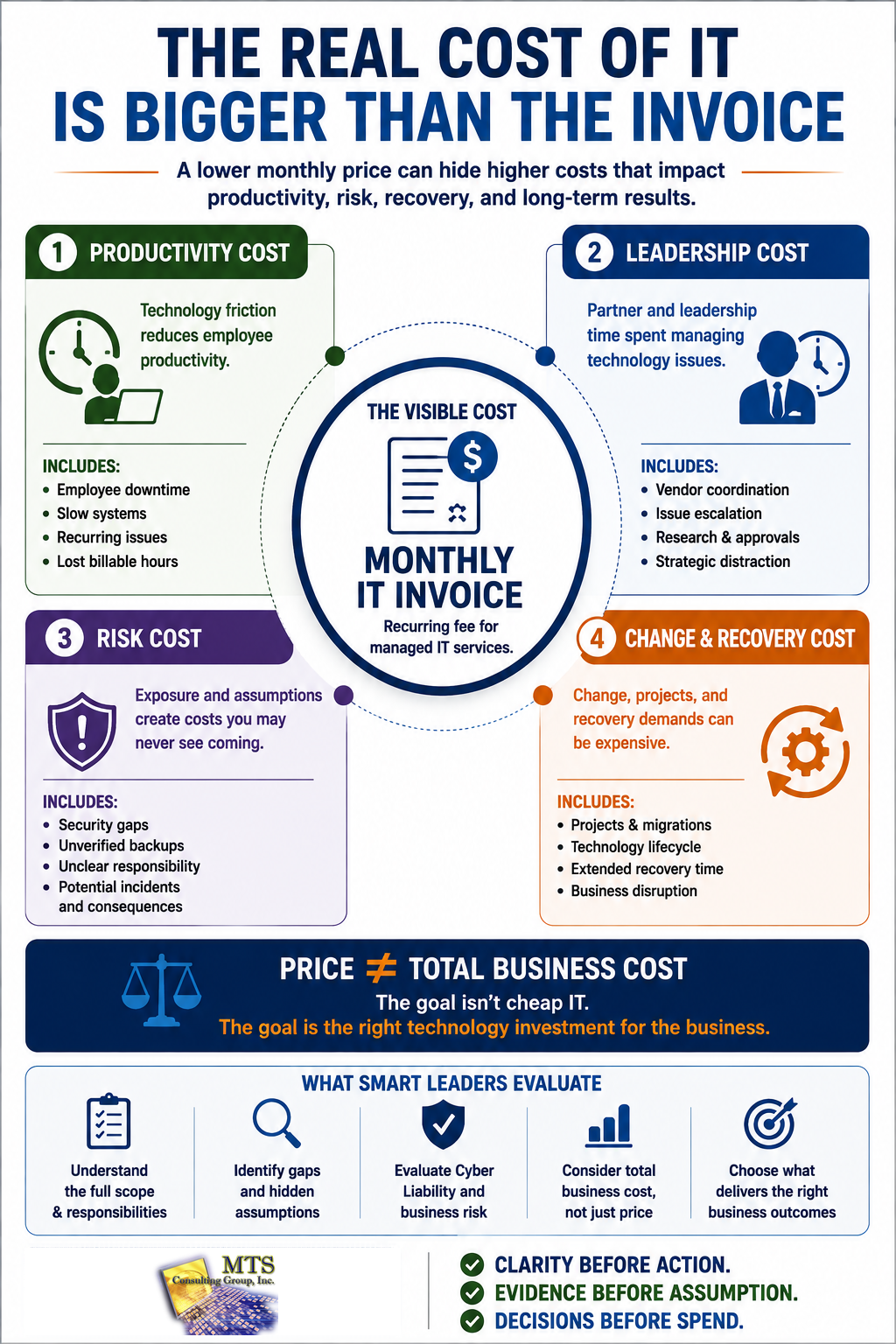
The Real Cost of IT Is Bigger Than the Invoice
PRICE ≠ TOTAL BUSINESS COST
The goal isn’t cheap IT. The goal is the right technology investment for the business.
The Cheapest Proposal Can Be the Right Proposal
This deserves its own section because technology marketing often gets this wrong.
Suppose an accounting firm receives three proposals:
$150 per user
$225 per user
$325 per user
There is nothing inherently wrong with selecting the $150 proposal.
If leadership has compared the scope and determined that it includes what the organization needs, that may be the smartest business decision.
The MTS standard is not:
Spend more.
It is:
Understand more before you decide.
If the $150 option fits the firm’s environment, requirements, support expectations, risk tolerance, and roadmap, choose it confidently.
If it does not, the apparent savings should not drive the decision.
Confidence, not dependency, is the objective.
Where False Savings Usually Hide
When evaluating a lower-priced technology relationship, leadership should investigate six areas.
1. Projects
What work is considered a project?
Examples may include:
- Migrations
- Office moves
- New systems
- Major application changes
- Server replacements
- Network upgrades
- Significant onboarding work
Projects are not inherently bad.
Unexpected projects are the problem.
2. Security
Do not accept:
Security is included.
Ask what that means.
What protections exist?
What is monitored?
What isn’t?
Who responds?
What requires additional services?
What responsibility remains with leadership?
3. Backup and Recovery
Do not confuse having backups with having a recovery strategy.
Ask:
- What is protected?
- What can be recovered?
- How long could recovery take?
- What has actually been tested?
Backup is a technology function. Recovery is a business outcome.
4. After-Hours and Emergency Support
Accounting firms can have periods when normal business hours do not reflect operational reality.
Understand what happens when an important issue occurs outside the provider’s standard support window.
5. Technology Lifecycle
Who tells leadership what needs replacement during the next 12, 24, and 36 months?
Without a roadmap, technology expenses can feel unpredictable even when they were predictable years in advance.
6. Executive Guidance
Who connects the technical environment to business decisions?
A report is not the same as guidance.
Leadership needs someone who can explain:
- What matters
- Why it matters
- What is recommended
- What can wait
- What decision comes next
The Cheapest Decision Can Also Be “Do Nothing”
Cost decisions do not only happen when selecting an MSP.
Leadership makes them every time a recommendation is deferred.
Sometimes deferral is completely reasonable.
Organizations have finite budgets.
Not everything can happen immediately.
The MTS approach does not require leadership to approve every recommendation.
Instead, decisions should be explicit.
Accepted
Leadership approves the recommendation.
Deferred
Leadership agrees the recommendation has value but intentionally schedules it for later.
Declined
Leadership consciously decides not to proceed.
The important part is that the decision is understood and documented.
The dangerous fourth category is:
Forgotten
A recommendation was discussed.
Nobody clearly decided.
Nobody documented ownership.
Everyone moved on.
Months later, leadership assumes someone handled it.
That is not a budget decision.
That is an accountability gap.
“No” Is an Acceptable Answer
This is important to the MTS philosophy.
A technology advisor should be willing to make a recommendation.
Leadership should be free to say no.
The advisor’s responsibility is to explain:
- What was found
- Why it matters
- What is recommended
- What could happen if the recommendation is deferred
- What decision needs to be made
Leadership owns the business decision.
Our job is not to create fear until the answer becomes yes.
Our job is to create enough clarity that the answer, yes, no, or later, is informed.
Teach Before We Act.
The Real Cost of Technical Debt
One way organizations reduce today’s technology budget is by postponing replacement.
Again, that is not always wrong.
A device or system does not need to be replaced merely because someone wants to sell a new one.
But repeated deferral can create technical debt.
Technical debt can show up as:
- Aging hardware
- Unsupported software
- Unreliable systems
- Difficult integrations
- Inconsistent configurations
- Slower performance
- Increased support requirements
- Security limitations
The organization effectively borrows from the future to reduce today’s cost.
Eventually the debt needs to be paid.
Often with interest.
The MTS approach is to make lifecycle decisions visible early enough for leadership to plan.
A roadmap turns:
Why do we suddenly need $40,000?
into:
We knew this was coming, we understand why, and it is already in the plan.
A Five-Step Framework for Comparing IT Providers
Step 1: Normalize the Scope
Put each provider’s services into the same categories.
Do not compare package names.
Compare responsibilities.
Step 2: Identify the Gaps
What is not included?
Who owns those responsibilities?
Will another provider be needed?
Step 3: Estimate the Total Business Cost
Consider:
- Monthly services
- Additional projects
- Internal employee time
- Leadership time
- Lifecycle spending
- Realistic operational dependencies
You do not need false precision.
You need visibility.
Step 4: Examine Cyber Liability
Ask how the relationship helps the organization understand and reduce:
- Operational
- Legal
- Reputational
- Regulatory risk
Step 5: Document Why You Chose
Leadership should be able to explain:
We selected this provider because…
If the only answer is:
They were cheapest.
the evaluation probably needs another step.
A Simple Total-Cost Comparison
Instead of comparing providers only by monthly price, use a broader framework:
| Question | Provider A | Provider B |
|---|---|---|
| Monthly recurring cost | $ | $ |
| Security scope | Defined? | Defined? |
| Projects included/excluded | Defined? | Defined? |
| Recovery expectations | Defined? | Defined? |
| After-hours support | Defined? | Defined? |
| Lifecycle planning | Defined? | Defined? |
| Executive guidance | Defined? | Defined? |
| Client responsibilities | Defined? | Defined? |
| Known gaps | Documented? | Documented? |
The table does not choose the provider for you.
It makes the decision more informed.
That is the point.
What Does “Value” Actually Mean?
Value is not synonymous with inexpensive.
It is also not synonymous with expensive.
A useful definition is:
Value is the business outcome received relative to the resources invested.
For managed technology, those outcomes might include:
- Productive employees
- Reliable systems
- Fewer recurring disruptions
- Appropriate security
- Clearer responsibilities
- Predictable technology planning
- Recoverability
- Documented decisions
- Leadership confidence
Those outcomes can be discussed.
They can often be measured.
And they provide a much better foundation for evaluating a provider than the number of products listed on a proposal.
Three Questions Before Choosing the Lowest Bid
If one proposal is significantly less expensive than the others, do not automatically reject it.
Ask three questions.
1. Why is it less expensive?
There may be a perfectly good answer.
Find out.
2. What responsibility moves back to us?
A lower price sometimes means the organization retains more responsibility.
That can be acceptable.
Leadership simply needs to know.
3. What happens when something goes wrong?
Understand escalation, recovery, support boundaries, and decision ownership before the crisis.
Frequently Asked Questions
Is the cheapest MSP usually the worst MSP?
No.
Price alone tells you very little about quality.
A lower-priced provider can be an excellent fit. A higher-priced provider can be a poor fit.
Evaluate scope, outcomes, responsibilities, evidence, and business needs.
Does spending more guarantee better cybersecurity?
No.
More spending does not automatically produce better security.
Technology investments should be connected to actual risks and business requirements.
The objective is appropriate investment, not maximum investment.
How can I tell whether an MSP proposal is too cheap?
Do not begin with the number.
Examine what is included, what costs extra, what is excluded, and what responsibilities remain with your firm.
If the scope supports your needs, the price may represent excellent value.
How should an accounting firm compare IT providers?
Normalize the proposals first.
Compare responsibilities and outcomes across consistent categories, then compare price.
Should we choose an MSP based on cybersecurity tools?
Tools matter, but a long list of products is not a strategy.
Ask what risks the tools reduce, how they are managed, what is verified, what happens when an issue is detected, and how leadership receives guidance.
What if we cannot afford every recommendation?
Prioritize.
Start with the three risks that matter most.
Some recommendations can be deferred.
The important thing is that leadership understands the consequence and documents the decision.
The Better Question
The wrong question is:
Who is cheapest?
The opposite question is not much better:
Who is most expensive?
The better question is:
Which option gives our organization the right combination of support, protection, recovery, guidance, and accountability for the investment we’re making?
Then ask:
What remains our responsibility?
Those two questions create a much healthier buying process.
The MTS Perspective
Technology should create business value.
Cybersecurity should reduce meaningful risk.
Documentation should create organizational memory.
Advisors should create clarity.
Leadership should own decisions.
Those ideas matter more than whether an MSP’s price sits at the top, middle, or bottom of a comparison spreadsheet.
MTS does not believe every organization should buy the most comprehensive technology package available.
We believe leaders should understand what they need and why they need it.
Then make the decision deliberately.
Clarity before action.
Evidence before assumption.
Business outcomes before products.
That is a better way to buy technology.
Your Next Step
Take your current managed IT agreement, or the proposals you are considering, and create four columns:
- Included: What are you paying for?
- Additional: What generates another charge?
- Excluded: What does the provider not do?
- Client Responsibility: What still belongs to your organization?
Then identify the three areas where you have the least clarity.
Start there.
You may discover that your current provider offers excellent value.
You may discover services you assumed were included are not.
Either outcome is useful.
The goal is not to prove that your IT provider is too expensive or too cheap.
The goal is to replace assumption with clarity.
If you need help understanding the total business cost of your technology decisions, MTS’s 26-minute Cyber Liability Assessment is designed to start that conversation.
No technical lecture.
No fear.
No assumption that you need to buy something.
Just a clearer understanding of where the organization may be exposed and what leadership should consider next.
Create clarity before action.
Continue Through the Cyber Liability Knowledge Center
Previous Chapter:
How Much Should an Accounting Firm Budget for Managed IT and Cybersecurity in 2026?
Start Here:
What Is Cyber Liability, and How Is It Different from Cybersecurity?
Next Chapter:
What Should Managed IT Actually Do to Reduce an Accounting Firm’s Business Risk?
Related chapters:
- What Are the Four Business Risks Every Accounting Firm Should Understand Before Investing in Cybersecurity?
- Why Doesn’t Traditional IT Support Fully Address Cyber Liability?
- How Does a Cyber Liability Assessment Help Business Leaders Make Better Decisions?
Explore MTS services: