
The Quick Answer
For a small to midsize accounting or tax firm, a reasonable planning range for managed IT and cybersecurity is approximately $125-$400 per user per month, depending on the firm’s technology environment, security requirements, services included, risk profile, and level of strategic guidance.
For a 25-user firm, that represents roughly $3,125-$10,000 per month.
For a 50-user firm, the same planning range represents approximately $6,250-$20,000 per month.
Those numbers are useful for budgeting.
But they do not tell leadership whether a proposal is appropriate.
At MTS Consulting Group, we believe the better question is:
“What business risk are we asking this investment to reduce?”
Price matters.
So do scope, evidence, accountability, recovery expectations, employee education, security protections, and leadership guidance.
The objective should not be to find the lowest per-user price.
It should be to understand what you are buying, what you are not buying, and what Cyber Liability remains with the firm.
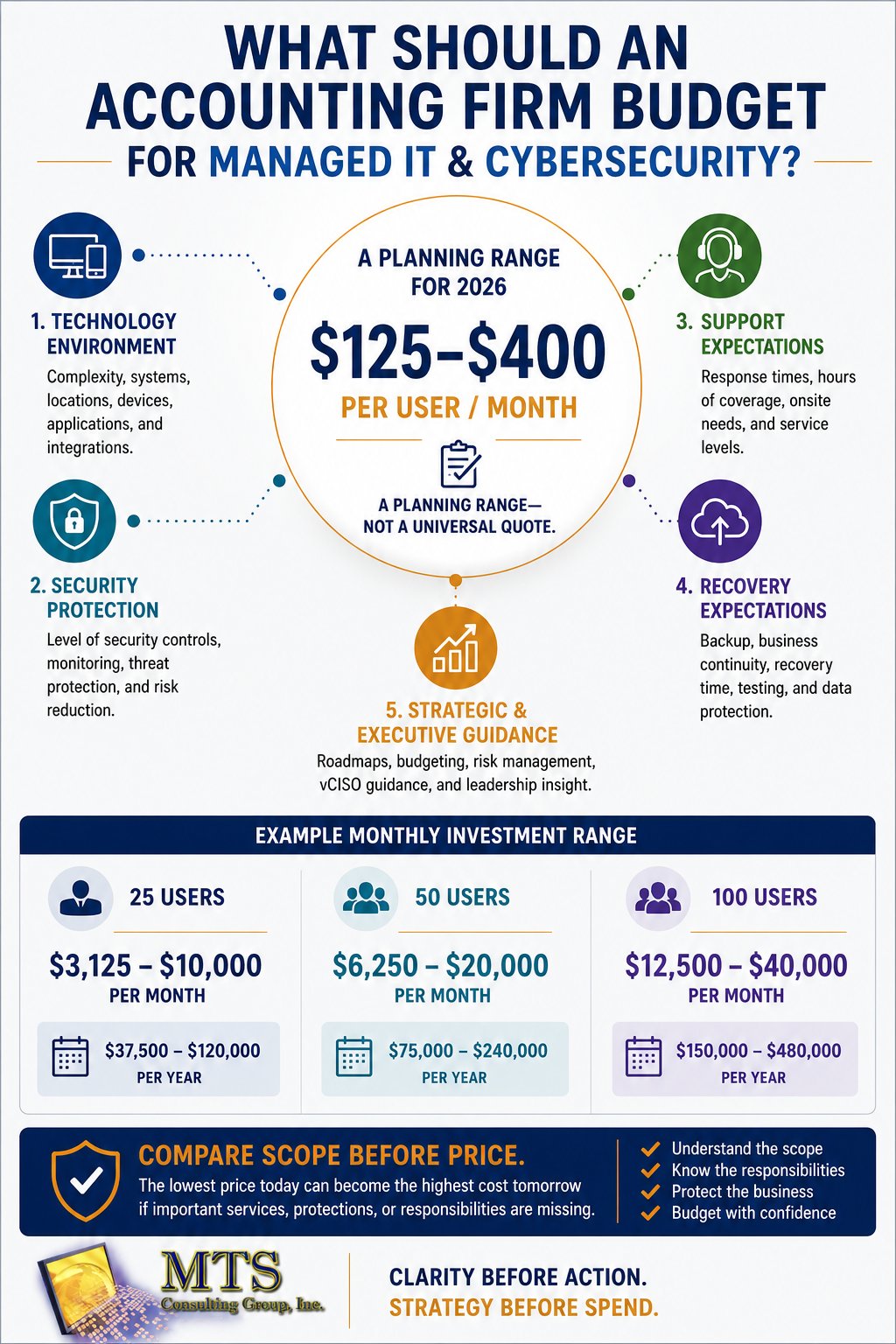
Compare scope before price.
The objective should not be to find the lowest per-user price.
It should be to understand what you are buying, what you are not buying, and what Cyber Liability remains with the firm.
Why Managed IT Pricing Is So Difficult to Compare
Accounting-firm leaders often ask:
“What should managed IT cost?”
It sounds like a straightforward question.
Unfortunately, the marketplace makes comparison difficult.
One provider might quote $125 per user.
Another might quote $200.
Another might quote $300 or more.
The natural reaction is to compare the numbers.
But those three proposals may describe very different services.
One may primarily cover support and maintenance.
Another may include a more extensive security stack.
Another may include security monitoring, employee education, backup services, strategic planning, documentation, and executive guidance.
Even the term “fully managed” does not have a universal definition.
That creates a dangerous possibility:
Leadership compares price before comparing responsibility.
A $150-per-user proposal is not necessarily less expensive than a $250-per-user proposal if the lower-priced agreement leaves important services, protections, projects, or responsibilities outside the contract.
Before comparing price, compare scope.
A Practical 2026 Budget Range
For planning purposes, MTS typically works within a broad range of approximately:
$125-$400 per user per month
That range should not be interpreted as a published quote for every organization.
It is a budgeting framework.
The actual investment depends on what the organization needs and what is included.
Here is what that means mathematically:
| Firm Size | $125/User | $250/User | $400/User |
|---|---|---|---|
| 10 users | $1,250/mo. | $2,500/mo. | $4,000/mo. |
| 25 users | $3,125/mo. | $6,250/mo. | $10,000/mo. |
| 50 users | $6,250/mo. | $12,500/mo. | $20,000/mo. |
| 75 users | $9,375/mo. | $18,750/mo. | $30,000/mo. |
| 100 users | $12,500/mo. | $25,000/mo. | $40,000/mo. |
These numbers are useful for establishing an initial budget.
They should not be used to decide whether a provider is expensive or inexpensive.
Two firms with 25 employees can require very different technology environments.
The number of users is only one variable.
The MTS Perspective: Don’t Start With “How Cheap Can We Make IT?”
There is nothing wrong with controlling costs.
Leadership has a responsibility to spend responsibly.
But there is a difference between managing an investment and minimizing a number.
When technology supports nearly every part of an accounting firm’s operation, IT is no longer simply an office expense.
It affects:
- employee productivity,
- access to client information,
- communication,
- security,
- business continuity,
- client experience,
- and the firm’s Cyber Liability.
That changes the budgeting conversation.
Instead of beginning with:
“What’s the cheapest IT company we can find?”
begin with:
“What does our firm depend on technology to accomplish, and what happens if those capabilities fail?”
Then build the technology investment around those answers.
Create clarity before action.
The Five Factors That Drive Managed IT and Cybersecurity Cost
There are dozens of variables in technology pricing, but leadership can simplify the conversation into five major factors.
Factor 1: The Technology Environment
Start with what needs to be managed.
A 25-user accounting firm with a relatively simple cloud environment may have different needs from a 25-user firm operating:
- multiple offices,
- legacy applications,
- local servers,
- complex tax software,
- remote access systems,
- multiple cloud platforms,
- specialized integrations,
- or numerous third-party vendors.
User count alone does not describe complexity.
Ask:
- How many locations do we have?
- How many devices?
- Which critical applications do we depend on?
- Are applications cloud-based, local, or both?
- Do employees work remotely?
- Are there legacy systems?
- How many outside vendors interact with our environment?
Complexity affects both support requirements and Cyber Liability.
Factor 2: The Level of Security Protection
“Cybersecurity included” is not specific enough.
Leadership should understand what protections are actually included.
Depending on the firm’s needs, security services may address areas such as:
- endpoint protection,
- identity protection,
- multifactor authentication,
- email security,
- threat monitoring,
- vulnerability management,
- secure remote access,
- security awareness education,
- backup protection,
- and other safeguards.
Do not begin by asking how many tools are included.
Ask:
“What risks are these protections intended to reduce?”
More products do not automatically create better security.
The goal is appropriate protection based on the organization’s actual exposure.
Factor 3: Support Expectations
Support models vary significantly.
Leadership should understand:
- when support is available,
- what types of support are included,
- whether onsite service is included,
- what happens outside normal hours,
- how emergencies are handled,
- whether projects are included,
- whether onboarding and offboarding are included,
- and what generates additional charges.
Accounting firms should pay particular attention to seasonal business realities.
A technology problem during a quieter period and the same problem during a major filing deadline may create very different operational consequences.
The support model should reflect how the business actually operates.
Factor 4: Recovery and Business Continuity Expectations
This is where price comparisons can become misleading.
Two proposals may both say:
“Backup included.”
But what does that mean?
Leadership needs to know:
- What is protected?
- How often is data backed up?
- Where is it stored?
- Who monitors failures?
- How long is data retained?
- How quickly can systems be restored?
- What happens during a major outage?
- Has recovery been tested?
The important distinction is:
Backup is a technology function. Recovery is a business outcome.
If your firm needs to recover quickly, that expectation may require additional technology, planning, testing, and investment.
The price should reflect the outcome the business expects.
Factor 5: Strategic and Executive Guidance
Some managed IT relationships focus primarily on keeping technology functioning.
Others include broader planning and advisory services.
Leadership should understand whether the agreement includes conversations around:
- technology roadmaps,
- budgeting,
- lifecycle planning,
- Cyber Liability,
- risk prioritization,
- documentation,
- security strategy,
- business continuity,
- vendor decisions,
- and executive-level technology planning.
A quarterly meeting filled with technical statistics is not automatically strategic guidance.
Leadership should leave advisory meetings knowing:
What matters?
Why does it matter?
What do you recommend?
What can wait?
What decision do we need to make?
That is guidance.
What Should Be Included in the Price?
There is no universal managed-services package.
That makes the scope conversation essential.
Before approving a proposal, ask the provider to identify which services fall into each of these categories.
Included
- Services covered by the recurring agreement.
Additional Cost
- Services available but billed separately.
Not Provided
- Responsibilities the provider does not perform.
Shared Responsibility
- Areas where both the provider and client have defined responsibilities.
This simple exercise can expose differences between proposals that a per-user number hides.
The $150 Proposal and the $250 Proposal May Not Be Comparable
Consider a hypothetical 30-user accounting firm comparing two providers.
Provider A
- $150 per user per month.
- Monthly cost:
- $4,500
Provider B
- $250 per user per month.
- Monthly cost:
- $7,500
At first glance, Provider B costs $3,000 more every month.
That is $36,000 more per year.
The obvious conclusion might be:
“Provider A saves us $36,000.”
But leadership does not yet have enough information to make that statement.
Suppose Provider A excludes several services that Provider B includes.
Perhaps some security services are separate.
Perhaps projects are billed additionally.
Perhaps recovery testing is not included.
Perhaps strategic planning is limited.
Perhaps onsite support costs extra.
Perhaps employee education is outside the agreement.
The point is not that Provider B is automatically better.
Provider A could be the better choice.
The point is that leadership cannot determine value from the per-user price alone.
You have to normalize the scope first.
The Better Comparison: Cost Per Business Outcome
Instead of comparing only cost per user, consider what the investment is expected to produce.
Outcome 1: Productive employees
- Can employees reliably use the technology they need?
Outcome 2: Stable systems
- Is the environment maintained and managed proactively?
Outcome 3: Appropriate protection
- Are meaningful security risks being reduced?
Outcome 4: Recoverability
- Can the organization restore critical operations when something fails?
Outcome 5: Leadership clarity
- Does leadership understand what it has, what it does not have, what risks remain, and what decisions come next?
These outcomes provide a much better framework for comparing technology partners.
Cheap IT Can Become Expensive in Ways That Never Appear on the Invoice
The monthly invoice is visible.
Other technology costs are less obvious.
Consider:
Employee downtime
- If 20 employees each lose two productive hours, the business has lost 40 hours of productive capacity.
Leadership time
- Partners and executives should not spend hours coordinating routine technology issues.
Project surprises
- A lower monthly agreement can become less attractive when normal business changes consistently generate separate invoices.
Technical debt
- Deferring lifecycle investments may lower this year’s cost while increasing future complexity and risk.
Unclear responsibilities
- If leadership assumes something is covered and discovers during an incident that it isn’t, the cost may be far greater than the monthly savings.
This does not mean expensive IT is automatically good IT.
It means invoice price and business cost are different measurements.
How Much Should a 25-Person Accounting Firm Budget?
Using MTS’s planning range, a 25-user accounting firm might initially model:
Lower planning range
- 25 × $125 = $3,125 per month
- Approximately $37,500 annually.
Middle planning point
- 25 × $250 = $6,250 per month
- Approximately $75,000 annually.
Upper planning range
- 25 × $400 = $10,000 per month
- Approximately $120,000 annually.
That is a wide range.
It should be.
Without understanding the environment and scope, pretending there is one “correct” number would create false precision.
The purpose of the range is to help leadership begin planning.
The next step is to determine what the organization actually requires.
How Much Should a 50-Person Accounting Firm Budget?
Using the same framework:
Lower planning range
- 50 × $125 = $6,250 per month
- Approximately $75,000 annually.
Middle planning point
- 50 × $250 = $12,500 per month
- Approximately $150,000 annually.
Upper planning range
- 50 × $400 = $20,000 per month
- Approximately $240,000 annually.
Again, these are planning numbers.
They are not recommendations for a specific firm.
A 50-person organization with a relatively simple environment could have very different requirements from another firm of identical size with multiple offices, significant legacy infrastructure, complex workflows, or higher support and recovery expectations.
Seven Questions to Ask Before Comparing MSP Pricing
When reviewing proposals, ask every provider the same seven questions.
1. What exactly is included in the monthly fee?
Ask for plain English.
2. What will generate an additional invoice?
- Projects?
- Onsite work?
- After-hours support?
- New computers?
- Security services?
3. What security responsibilities are included?
Do not accept “cybersecurity” as the entire answer.
Ask what the provider actually does.
4. What are you explicitly not responsible for?
This question helps uncover assumptions.
5. What happens when we have a serious outage or security event?
Understand the process before you need it.
6. How do you help leadership prioritize technology and Cyber Liability decisions?
Listen for business guidance rather than a list of reports and tools.
7. How will we know whether the relationship is producing the outcomes we expect?
Good service should produce evidence.
The Three-Bucket Budget
Accounting firms can also think about technology spending in three buckets.
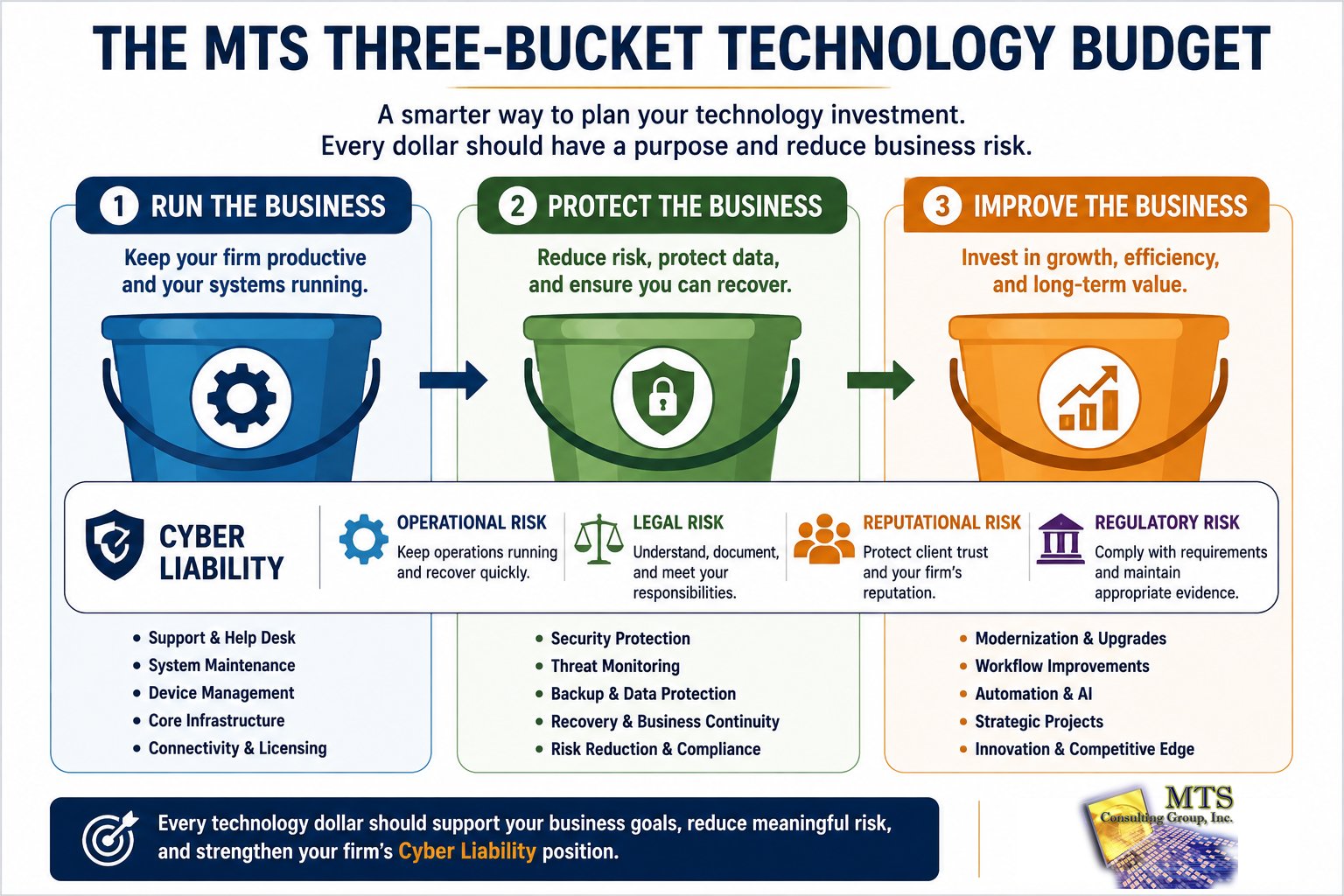
Bucket 1: Run the Business
This is the technology foundation.
Examples may include:
- support,
- maintenance,
- licensing,
- device management,
- connectivity,
- and core infrastructure.
Bucket 2: Protect the Business
This includes investments intended to reduce meaningful security and recovery risks.
The exact controls should depend on the firm’s environment and exposure.
Bucket 3: Improve the Business
This is where leadership considers:
- modernization,
- workflow improvements,
- automation,
- AI,
- replacement of aging systems,
- strategic projects,
- and technology that creates measurable business improvement.
Separating the budget this way helps leadership understand why technology spending exists.
Not every dollar serves the same purpose.
Where Does Cyber Liability Fit Into the Budget?
Cyber Liability should not simply become a fourth bucket labeled “security.”
It should influence decisions across all three.
When evaluating an investment, ask how it affects:
Operational Risk
- Does this help the firm remain productive or recover?
Legal Risk
- Does this help the organization understand, document, or reduce responsibilities that could arise?
Reputational Risk
- Does this help protect the trust clients place in the firm?
Regulatory Risk
- Does this help leadership meet applicable responsibilities and maintain evidence?
That is how Cyber Liability becomes part of technology strategy rather than another product category.
What About Regulatory Requirements?
Accounting and tax firms have real responsibilities regarding sensitive information and security.
Those responsibilities should influence technology planning.
But the goal should not be to ask:
“What is the cheapest way to check the required boxes?”
At MTS, we use a different standard:
Compliance is the minimum; Cyber Liability is the truth.
A requirement may tell you that a control or process is expected.
Leadership still needs to ask whether it works, whether it fits the organization, and what business risk remains.
The budget should support actual protection and preparedness, not simply the appearance of it.
Why MTS Doesn’t Start With a Package
A predefined package is convenient.
But organizations are not identical.
MTS begins by trying to understand:
- how the organization operates,
- what technology it depends on,
- what leadership is trying to accomplish,
- where meaningful risk may exist,
- what protections already exist,
- what has been verified,
- and what decisions deserve attention first.
Only then does the technology conversation become useful.
That reflects a core MTS operating principle:
Teach Before We Act.
A recommendation should make sense to leadership before leadership is asked to approve it.
If we cannot explain why something matters in plain English, we have more work to do.
A Better Way to Build the Annual Technology Budget
Instead of asking your technology provider for one number and approving it, use a five-step process.
Step 1: Understand the current environment
What do we have?
What does it cost?
What depends on it?
Step 2: Identify the three risks that matter most
Do not begin with 40 technical findings.
Start with three meaningful business exposures.
Step 3: Identify known lifecycle needs
Which systems, devices, applications, or infrastructure will require investment during the next 12-36 months?
Step 4: Separate recurring services from projects
Know what belongs in the monthly operating budget and what requires planned capital or project spending.
Step 5: Document the roadmap
Leadership should know:
- what happens now,
- what happens later,
- why,
- approximately what it will cost,
- and who owns the next decision.
A technology budget should not be a surprise that arrives one proposal at a time.
It should be a roadmap.
Frequently Asked Questions
What is a reasonable managed IT cost per user for an accounting firm?
For MTS’s target market, approximately $125-$400 per user per month is a useful initial planning range.
The actual investment depends heavily on scope, complexity, security, recovery expectations, support requirements, and strategic services.
Compare what is included before comparing the number.
Why is the range so wide?
Because “managed IT” does not describe a standardized product.
A basic support relationship and a comprehensive technology, security, Cyber Liability, and executive-guidance relationship are not equivalent services.
The environment also matters.
Is $400 per user too expensive?
You cannot answer that from the price alone.
If the agreement includes services the organization genuinely needs and would otherwise purchase separately, the number could represent strong value.
If the organization does not need those services, or the provider cannot demonstrate the value, the same number could be excessive.
Scope first. Price second.
Is $125 per user too cheap?
Not necessarily.
A provider may have an efficient model that fits the organization’s needs.
But leadership should understand what is included, what is excluded, and what responsibilities remain with the firm.
Low price is not automatically bad.
Unclear scope is the bigger problem.
Should cybersecurity be included in managed IT?
Some cybersecurity capabilities may be integrated into managed services.
Others may be separate.
Rather than focusing on the label, ask what protections are included, what risks they address, who monitors them, what happens when something goes wrong, and what responsibilities remain outside the agreement.
Should we budget separately for projects?
Often, yes.
Organizations should anticipate lifecycle and strategic projects rather than assuming every future technology change belongs inside the monthly fee.
Ask the provider specifically what constitutes a project.
How often should we review our technology budget?
At minimum, leadership should review the technology roadmap and budget annually.
For organizations undergoing significant change, more frequent reviews may be appropriate.
The objective is to reduce surprises.
The Real Question Isn’t “What Does IT Cost?”
The better question is:
“What outcomes are we expecting from our technology investment?”
For an accounting firm, those outcomes should include some combination of:
- productive employees,
- dependable systems,
- appropriate security,
- recoverability,
- documented decisions,
- leadership visibility,
- and a technology roadmap aligned with the business.
Once leadership understands those outcomes, price becomes easier to evaluate.
A $125-per-user agreement may be appropriate.
A $400-per-user agreement may be appropriate.
Or neither may be appropriate.
The number only makes sense after the scope and business requirements are clear.
Your Next Step
Before approving your next IT budget or managed-services proposal, create a simple comparison with four columns:
What is included?
What costs extra?
What is not provided?
What responsibility still belongs to us?
Then ask one final question for every major expense:
“What business risk or business outcome does this investment address?”
If nobody can answer that clearly, do not start with the purchase.
Start with the conversation.
Create clarity before action.
If you need help deciding what your firm should actually budget for managed IT and cybersecurity, MTS’s 26-minute Cyber Liability Assessment is designed to start that conversation.
No technical lecture.
No fear.
No assumption that you need to buy something.
Just a clearer understanding of where the organization may be exposed, what the technology investment should cover, and what leadership should consider next.
Create clarity before action.
Continue Through the Cyber Liability Knowledge Center
Previous Chapter:
What Are the Four Business Risks Every Accounting Firm Should Understand Before Investing in Cybersecurity?
Start Here:
What Is Cyber Liability, and How Is It Different from Cybersecurity?
Next Chapter:
Why Can the Cheapest IT Provider Become the Most Expensive Business Decision?
Related chapters:
- What Should Managed IT Actually Do to Reduce an Accounting Firm’s Business Risk?
- How Does a Cyber Liability Assessment Help Business Leaders Make Better Decisions?