
A nonprofit evaluating an IT and cybersecurity partner should look beyond help desk response times and monthly price.
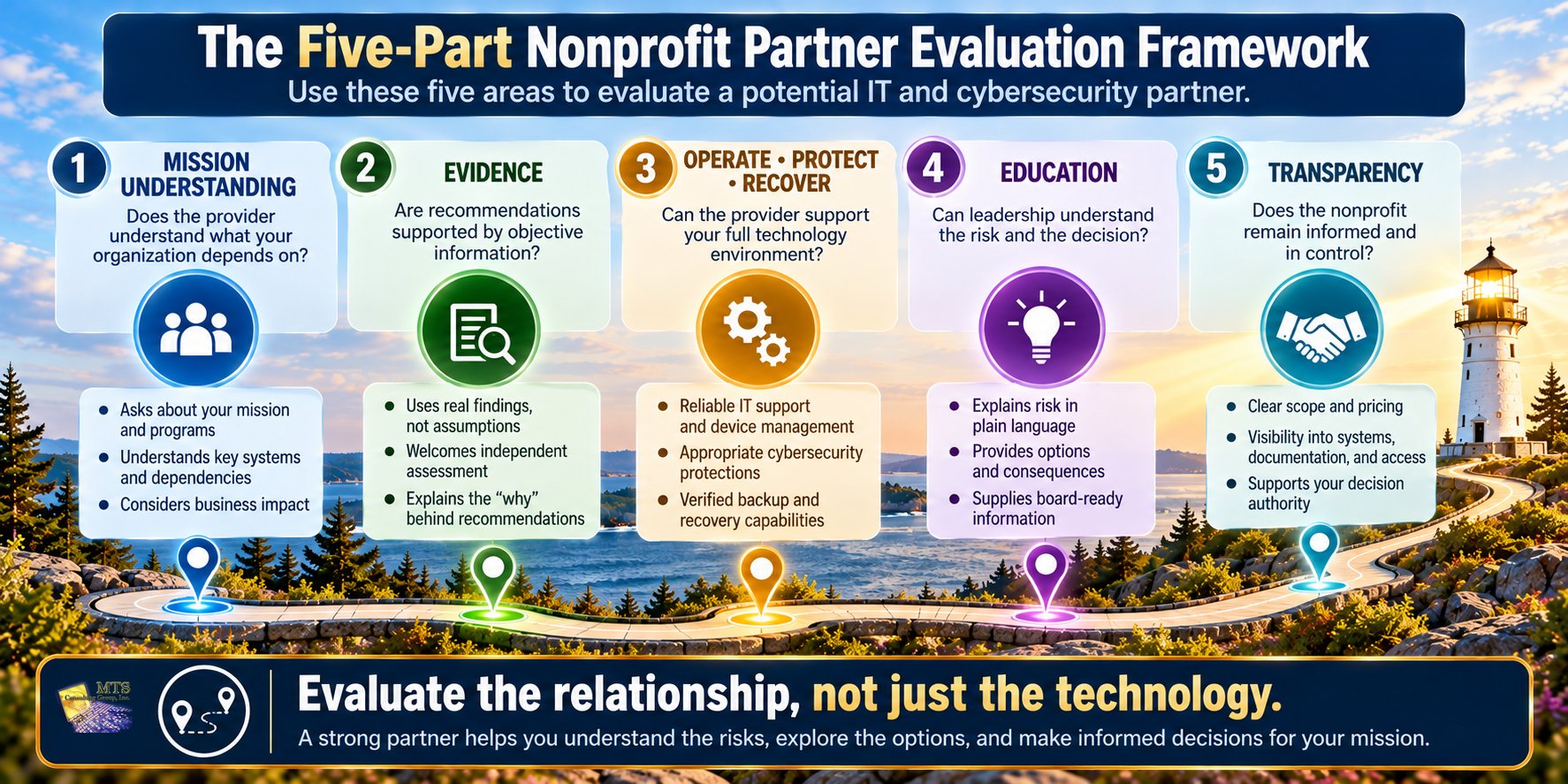
A useful evaluation can be built around five areas:
- Does the partner understand what your mission depends on?
- Does it use evidence before making recommendations?
- Can it support, protect, and help you recover your environment?
- Can it explain risk in language leadership and the board can use?
- Is the relationship transparent enough for you to remain the decision-maker?
A strong partner should help leadership understand the environment, the risks, the options, and the consequences of those options.
The nonprofit should not have to surrender responsibility in order to get help.
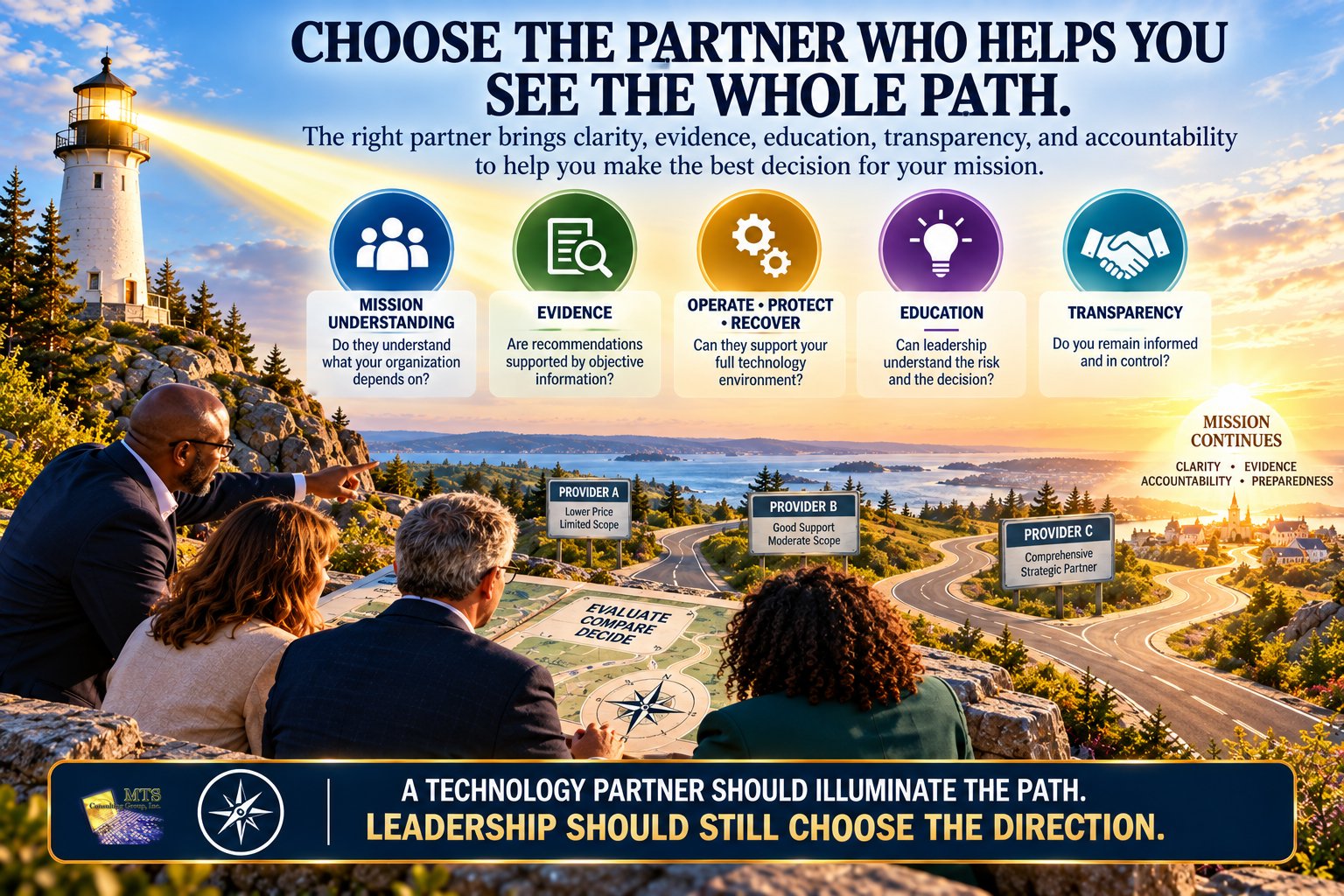
Why Choosing an IT Partner Is Bigger Than Choosing a Help Desk
For many organizations, the first questions during an IT-provider search sound like this:
- How fast do you answer the phone?
- What tools do you use?
- How much does it cost per user?
Those questions matter.
But they are not enough.
A technology partner may influence:
- employee productivity
- access to sensitive information
- backup and recovery
- vendor relationships
- cybersecurity protection
- incident response
- technology purchasing
- insurance requirements
- regulatory responsibilities
- board reporting
- long-term planning
That means leadership is not simply choosing someone to fix computers.
It is choosing an organization that may help shape decisions affecting the nonprofit’s mission, data, resources, and reputation.
The evaluation should reflect that responsibility.
Start With Your Own Requirements
Before comparing providers, define what the organization actually needs.
Otherwise, the evaluation can become a contest between sales presentations.
Begin with the mission.
Ask:
- Which activities must continue for us to serve?
- Which systems support those activities?
- What sensitive information do we maintain?
- Which vendors are mission-critical?
- How quickly would important systems need to recover?
- What regulatory or contractual responsibilities apply?
- What current risks already require attention?
- What does leadership need to understand and report?
This gives the organization its own evaluation criteria.
Without that step, each provider gets to define the problem for you.
That makes comparison much harder.
The Five-Part Partner Evaluation Framework
The following framework can help leadership evaluate more than technical capability.
It looks at the relationship as a whole.
1. Does the Partner Understand the Mission Before Recommending Technology?
A provider should be able to explain how technology connects to the organization’s work.
That means asking questions before prescribing solutions.
For example:
- What programs are most important?
- Which systems support those programs?
- Which employees or departments would be most affected by downtime?
- What information would be most damaging to lose or expose?
- Which systems create the greatest dependency?
- What level of disruption can the organization tolerate?
The provider does not need to become an expert in every nonprofit program.
It does need enough understanding to connect technology recommendations to business and mission impact.
Listen to the Questions the Provider Asks
The questions a provider asks during discovery can reveal a great deal.
Compare these two approaches.
Approach A
“How many users do you have?”
“What Microsoft licenses do you use?”
“How many computers do you have?”
Those questions are useful.
But they mostly describe the technology.
Approach B
“How many users do you have?”
“What does your mission depend on?”
“What happens if your donor platform is unavailable?”
“Which systems would leadership need restored first?”
“What sensitive information do you maintain?”
“What risks are currently concerning leadership?”
Now the conversation includes the organization.
That distinction matters.
Educational Example: Same Technology, Different Mission Impact
Imagine two nonprofits use the same cloud application.
For the first organization, the application is used occasionally for internal administration.
For the second, the same application supports a program used by hundreds of constituents every week.
A technical outage might look identical on a monitoring dashboard.
The mission impact is not identical.
A useful partner should understand that difference before deciding how much protection, recovery capability, or monitoring the system requires.
2. Does the Partner Use Evidence Before Making Recommendations?
Recommendations should have a reason.
Leadership should be able to ask:
“What evidence supports this recommendation?”
and receive a clear answer.
Evidence might come from:
- vulnerability findings
- configuration reviews
- recovery testing
- monitoring
- access reviews
- technology lifecycle information
- insurance requirements
- vendor documentation
- regulatory requirements
- an independent cybersecurity assessment
The point is not to demand a 50-page report before every decision.
The point is to distinguish:
“You should buy this because we sell it.”
from:
“Here is the evidence showing why this matters in your environment.”
Ask Who Evaluates the Provider’s Own Work
This is an important question.
If the same organization:
- installs the protection
- evaluates the protection
- decides whether the protection worked
- recommends additional work
leadership should understand that relationship.
That does not automatically make the evaluation wrong.
It does create a reasonable question about independence.
For significant Cyber Liability decisions, outside evidence can add value because it separates evaluation from implementation.
A nonprofit can ask:
- “Who independently validates our security environment?”
- “Can someone outside your organization challenge the protections you have implemented?”
- “If an independent assessment finds a problem with your work, how is that handled?”
Those are fair governance questions.
A Strong Partner Should Be Comfortable With Independent Evidence
Independent evidence should not be treated as a threat.
It should be useful.
If an independent assessment confirms that protections are working, leadership gains confidence.
If it identifies a weakness, leadership gains information.
Either result is valuable.
The purpose is not to catch the IT provider doing something wrong.
The purpose is to improve the quality of the decision.
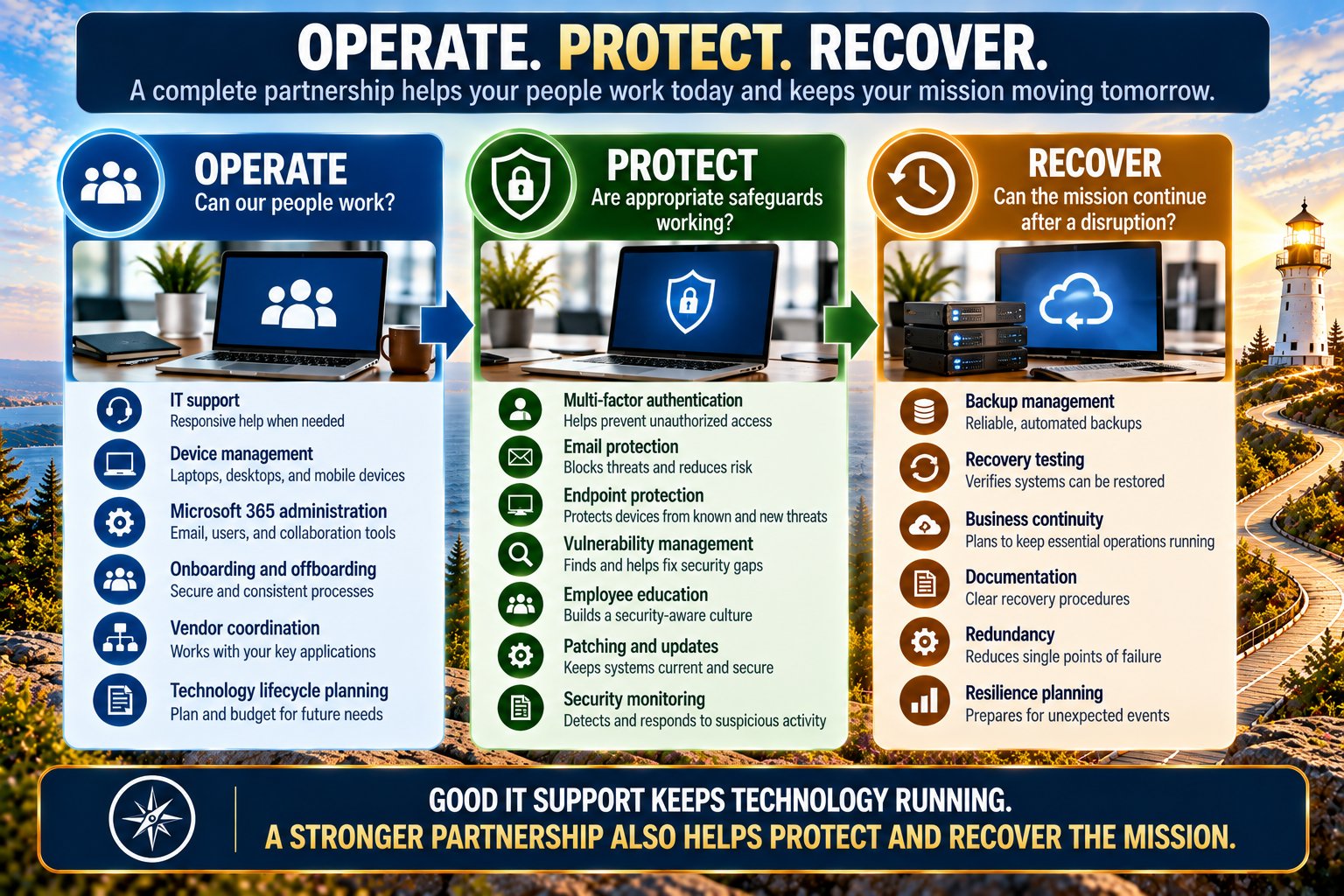
3. Can the Partner Help You Operate, Protect, and Recover?
A partner should be evaluated across more than support.
Think about three responsibilities.
Operate
Can employees reliably use the technology they need?
Look at areas such as:
- support
- device management
- onboarding
- offboarding
- Microsoft 365 administration
- network management
- technology lifecycle planning
- vendor coordination
Protect
Are appropriate safeguards being operated and reviewed?
Consider:
- MFA
- endpoint protection
- email protection
- security monitoring
- vulnerability management
- patching
- access management
- employee education
Recover
Can important systems and information be restored after a disruption?
Ask about:
- backup
- recovery testing
- recovery expectations
- documentation
- redundancy
- continuity planning
The third category is often where important differences appear.
A provider may say:
“Your backup succeeded.”
Leadership should also ask:
“When was recovery last tested?”
A backup report tells you whether a copy was created.
A recovery test helps answer whether the organization can use that copy when it matters.
Ask What Happens When Something Falls Outside the Agreement
Scope gaps create confusion.
Ask:
- What is included?
- What is excluded?
- What is considered a project?
- What happens after hours?
- Who manages third-party vendors?
- Who owns recovery testing?
- Who manages cybersecurity incidents?
- Who helps with insurance requirements?
- Who helps leadership understand significant findings?
There is nothing inherently wrong with having services outside the agreement.
The problem is discovering the gap during an incident.
Educational Example: The Backup Question
Imagine a nonprofit asks a prospective provider:
“Do you manage backup?”
The answer is:
“Yes.”
That sounds complete.
Then leadership asks:
“How often do you verify that our most important systems can actually be restored?”
The answer is less clear.
That second question changes the conversation.
The organization is no longer buying:
backup management
It is evaluating:
recovery confidence
That is a much more meaningful outcome.
4. Can the Partner Teach Leadership Instead of Just Reporting to Leadership?
A nonprofit leader should not have to become a cybersecurity expert.
But leadership still needs enough understanding to make decisions.
A useful partner should be able to explain:
- what happened
- why it matters
- what evidence exists
- what options are available
- what happens if the organization waits
- what decision leadership needs to make
That is different from delivering a technical report.
Technical Information Should Be Translated Into Leadership Information
Consider these two statements.
Technical Statement
“Several critical CVSS findings are present across endpoints.”
Leadership Translation
“Several vulnerabilities could expose systems used by employees. The most important two affect systems supporting daily operations. Here are the options, expected effort, and potential consequence of waiting.”
The second explanation does not hide the technical facts.
It translates them into a decision.
That is what leadership needs.
Ask How the Provider Communicates With the Board
Not every provider needs to attend every board meeting.
But the provider should be able to produce information leadership can use.
Useful reporting may include:
- the 3 to 5 most important risks
- current evidence
- improvements completed
- risks still open
- accepted or deferred risks
- recovery concerns
- upcoming decisions
- roadmap priorities
A board usually does not need every security alert.
It needs enough visibility to exercise oversight.
Education Should Happen Before the Decision
A provider should not have to rely on fear to create urgency.
Leadership should understand why something matters before deciding what to do.
That means the conversation should sound like:
- “Here is what we found.”
- “Here is what it could affect.”
- “Here are the available options.”
- “Here is what waiting may mean.”
Then leadership decides.
That is different from:
“You need this immediately because cyber threats are everywhere.”
Urgency should come from evidence.
Not pressure.
5. Is the Relationship Transparent Enough for You to Remain the Decision-Maker?
A strong technology relationship should increase leadership clarity.
It should not create dependence on information only the provider understands.
Ask whether the organization has visibility into:
- its systems
- its documentation
- its licenses
- its administrative access
- its vendors
- its backups
- its security tools
- its risk decisions
- its technology roadmap
The organization should know what it owns and what the provider manages.
Who Owns the Accounts, Licenses, and Data?
This is especially important.
Ask:
- Who owns the Microsoft 365 tenant?
- Who owns domain registrations?
- Who controls administrative credentials?
- Who owns backup data?
- Who owns security-tool accounts?
- What happens to documentation if the relationship ends?
- Can another provider take over without rebuilding everything from scratch?
A healthy partnership should make a future transition possible.
No provider relationship should depend on making departure unnecessarily difficult.
Ask How the Partner Handles Disagreement
At some point, leadership may decide not to approve a recommendation.
That does not automatically make the organization irresponsible.
A good partner should be able to:
- explain the recommendation
- document the risk
- explain the likely consequence of waiting
- record the decision
- revisit the issue when appropriate
The provider advises.
The client decides.
That distinction should remain clear.
What About Pricing?
Price matters.
Chapter 11 established a practical planning range of:
$100 to $400 per user per month
for the service model discussed in this Knowledge Center.
But price should be evaluated after scope is understood.
Two providers can quote the same amount and include very different:
- support
- security
- recovery
- strategic guidance
- vendor management
- reporting
- risk-management capability
Similarly, a more expensive provider is not automatically better.
Ask:
“What does the additional investment accomplish?”
The provider should be able to answer.
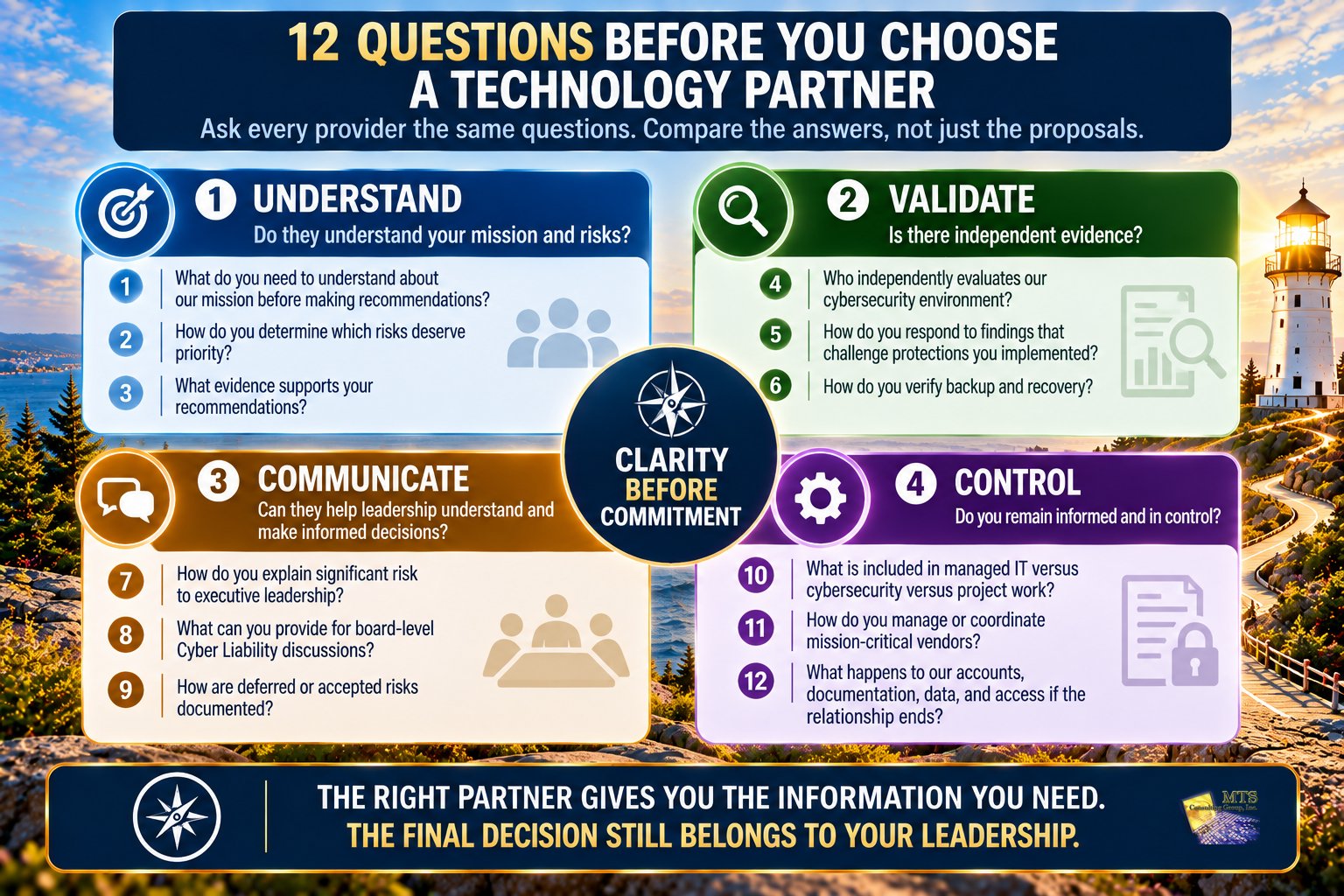
A 12-Question Partner Evaluation Checklist
Before choosing a provider, leadership can ask these 12 questions.
1. What do you need to understand about our mission before making recommendations?
2. How do you determine which risks deserve priority?
3. What evidence supports your recommendations?
4. Who independently evaluates our cybersecurity environment?
5. How do you handle findings that challenge protections you implemented?
6. What is included in managed IT versus cybersecurity versus project work?
7. How do you verify backup and recovery?
8. How do you manage or coordinate mission-critical vendors?
9. How do you communicate significant risk to executive leadership?
10. What would you provide for a board-level Cyber Liability discussion?
11. How are deferred or accepted risks documented?
12. What happens to our accounts, documentation, data, and access if the relationship ends?
The answers will tell leadership much more than a product list.
A Simple Partner Evaluation Scorecard
A nonprofit can score each provider from 1 to 5 in five categories.
| Evaluation Area | Score 1 | Score 5 |
|---|---|---|
| Mission understanding | Mostly technical questions | Clearly connects technology to mission |
| Evidence and independence | Recommendations rely mainly on provider opinion | Recommendations are grounded in evidence and allow independent validation |
| Operate, protect, recover | Primarily support focused | Addresses operations, security, and recovery |
| Leadership education | Technical reporting | Explains risk, options, business impact, and decisions |
| Transparency and accountability | Provider retains most visibility/control | Client has clear ownership, documentation, and decision authority |
A perfect numerical score is not the objective.
The purpose is to create a consistent way to compare providers.
Educational Example: The Lowest Proposal Is Not Automatically the Best Fit
Imagine a nonprofit receives three proposals.
Provider A
Lowest price.
Strong help desk offering.
Limited discussion of recovery, risk, or board reporting.
Provider B
Middle price.
Strong technical support and security tools.
Good recovery services.
Most recommendations come from the same team responsible for implementation.
Provider C
Higher price.
Strong support, cybersecurity, recovery, strategic planning, independent evidence, and leadership reporting.
Should leadership automatically choose Provider C?
No.
The organization should determine which capabilities it actually needs.
Perhaps Provider B is an excellent fit.
Perhaps Provider A fits a smaller, simpler environment.
Perhaps Provider C's broader scope is justified by regulatory complexity and current evidence-based operational risk.
The framework helps leadership compare the relationship.
Not simply rank the price.
Watch for These Warning Signs
No single answer automatically disqualifies a provider.
But leadership should ask more questions when it hears statements like:
“You Don't Need to Understand That”
Leaders do not need every technical detail.
They do need enough information to make responsible decisions.
“We Handle All of Your Cyber Risk”
No technology provider can take ownership of all organizational Cyber Liability.
Leadership still makes decisions.
“Everything Is Included”
Ask for the scope.
“You Don't Need Independent Validation”
Ask why not.
“Your Backups Are Fine”
Ask when recovery was last tested.
“This Is Our Standard Stack for Everyone”
Ask how the provider adjusts for your mission, regulatory responsibilities, and current evidence.
“You Need This Because Everyone Is Getting Hacked”
Ask for the evidence relevant to your environment.
Fear is not a risk assessment.
Trust Signals Worth Looking For
Credentials are useful.
But they should support the relationship, not substitute for it.
Depending on the services being evaluated, leadership may consider:
- cybersecurity certifications
- Microsoft or vendor credentials
- documented security practices
- cyber insurance
- relevant professional experience
- experience supporting organizations of similar size or complexity
- documented onboarding and offboarding processes
- written service agreements
- recovery procedures
- incident-response processes
- references
- evidence of continuing education
- third-party security validation
The most impressive credential list still does not answer:
“Will this partner help us make better decisions?”
That is why credentials belong inside a broader evaluation.
The Best Relationship Should Create More Clarity Over Time
After a year with a good partner, leadership should understand the environment better than it did at the beginning.
You should have greater clarity about:
- what the mission depends on
- which risks matter most
- what protections are working
- which risks remain
- what has been accepted or deferred
- what technology needs replacement
- what vendors matter most
- how recovery works
- what the next priorities are
- why the technology budget looks the way it does
If leadership becomes less informed as the relationship continues, something is wrong.
A partner should reduce unnecessary uncertainty.
Not create more of it.
The Partner Should Not Be the Only Source of Truth
This is worth emphasizing.
The provider may know your environment extremely well.
That is valuable.
But important decisions should not depend entirely on:
“Trust us.”
For significant Cyber Liability decisions, leadership benefits from:
- documented evidence
- clear reporting
- outside validation where appropriate
- decision records
- transparent ownership
Trust is strongest when it is supported by visibility.
What Should a Nonprofit Leader Take Away From This Chapter?
The best IT and cybersecurity partner is not necessarily:
- the cheapest
- the most expensive
- the largest
- the most technical
- the provider with the longest tool list
The better question is:
“Which partner helps us understand what matters and make responsible decisions about it?”
A strong relationship should help the organization:
- Understand the mission dependencies.
- Use evidence instead of assumptions.
- Operate reliably.
- Protect appropriately.
- Recover when something goes wrong.
- Understand significant Cyber Liability.
- Communicate with leadership and the board.
- Document decisions.
- Plan ahead.
And throughout that process:
The nonprofit remains the decision-maker.
That is what turns an outsourced technology service into a useful leadership partnership.
Applying the Education: How MTS Approaches the Relationship
MTS's role is to help nonprofit leaders understand the technology and Cyber Liability decisions in front of them.
That begins with clarity.
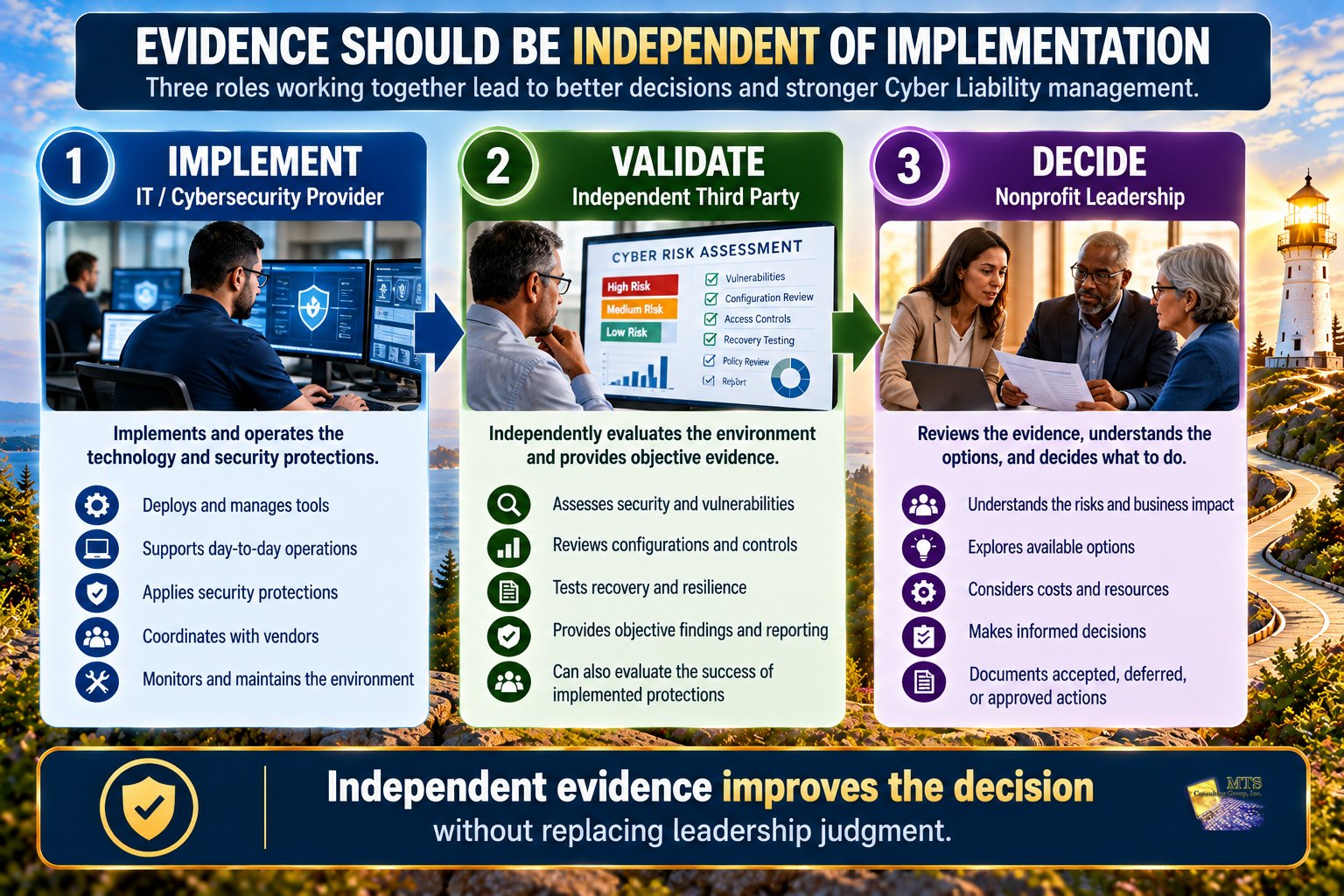
Where objective evidence is needed, an Independent Cyber Risk Assessment is performed by an unaffiliated third-party security company.
That distinction matters.
The independent third party evaluates the environment and provides evidence.
MTS then helps leadership:
- understand the findings
- connect technical issues to Cyber Liability
- identify meaningful priorities
- understand available options
- build a practical roadmap
- document important risk decisions
- review progress over time
- communicate significant issues in leadership language
The independent third party can also challenge protections MTS has implemented.
That creates an important separation between:
the organization implementing protections
and
the organization independently evaluating them.
MTS does not replace leadership judgment.
The nonprofit decides:
- what to approve
- what to schedule
- what to investigate
- what to monitor
- what risk to accept
MTS helps illuminate the path.
The nonprofit chooses the direction.
A Practical Next Step
Before interviewing your next IT or cybersecurity provider, choose five questions from the 12-question checklist in this chapter.
Ask every provider the same questions.
Then compare the answers.
Do not score only:
price
or
technical features.
Listen for:
- clarity
- evidence
- education
- transparency
- accountability
Those qualities are much harder to evaluate from a proposal.
They are also some of the qualities that matter most after the contract is signed.
The End of the Knowledge Center Is the Beginning of the Process
This is Chapter 12.
But Cyber Liability does not end here.
The concepts throughout this Knowledge Center work together.
You now have a framework for asking:
- What is Cyber Liability?
- Where does it come from?
- What evidence do we have?
- What matters most?
- What should leadership and the board see?
- Can we recover?
- What risks do vendors create?
- How should we govern AI?
- What should happen in the first 90 days?
- What should we budget?
- What should we expect from a technology partner?
You do not need to answer every question today.
Start with the one that creates the most clarity.
Then keep moving.
- Specificity creates understanding.
- Evidence improves decisions.
- Preparation creates options.
And informed leadership helps protect the mission.