More cybersecurity tools do not automatically make an accounting or tax firm more secure.
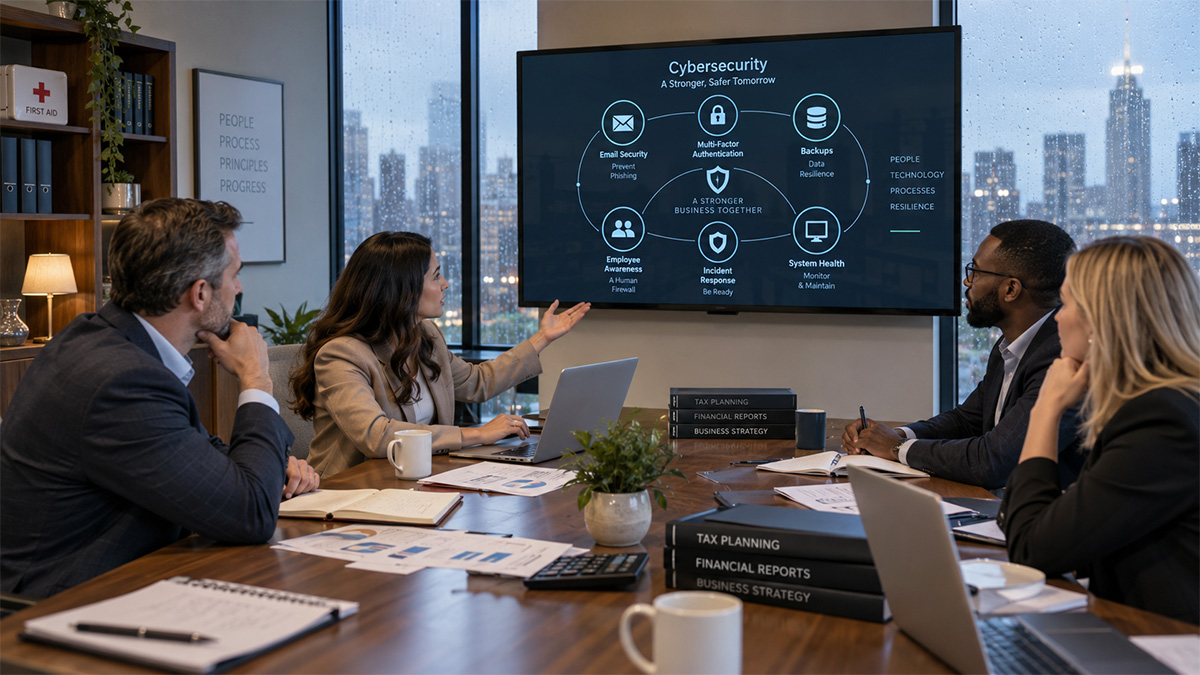
A strong cybersecurity strategy works more like an immune system: different safeguards, people, and processes work together to recognize risk, respond to problems, and protect the firm.
That distinction matters because many firms have added security products over time without stepping back to ask whether those tools still fit the business, work together, or reduce the firm’s actual cyber liability.
Every autumn, the medicine cabinet gets a little more crowded.
There is cold medicine left over from last winter.
Vitamins bought in bulk.
Half-used bottles of cough syrup.
Maybe even a prescription that should have been thrown away months ago.
There may be plenty of medicine in the cabinet.
But a full cabinet has never been proof of good health.
Cybersecurity can start to look the same way inside an accounting or tax firm.
A new threat leads to one purchase.
A cyber insurance question leads to another.
A vendor recommends a different security product.
A client questionnaire creates pressure to add something else.
Over time, the list grows.
Antivirus.
MFA.
Endpoint protection.
Email security.
Backup software.
Security awareness training.
Monitoring tools.
Password managers.
Policies.
Reports.
Each item may serve a purpose.
But a longer list of cybersecurity products does not automatically mean your firm is better protected.
The more useful question is:
Do the protections you have actually work together to reduce the cyber liability your firm is responsible for?
Cyber liability is the business, legal, regulatory, operational, and reputational responsibility your firm carries when cybersecurity risks are not properly understood, managed, or documented.
The goal is not to collect more tools.
The goal is to understand what you are protecting, why each safeguard exists, how the pieces work together, and what evidence shows they are doing the job.
Cybersecurity Myth: More Tools Mean Better Protection
It is easy to assume that more cybersecurity tools equal better security.
If one security product helps, then adding another should make the firm safer.
Sometimes it does.
Layered cybersecurity can be valuable.
But only when each layer has a clear purpose.
A second product may strengthen protection in an important area.
Or it may duplicate something you already have.
A new platform may close a real security gap.
Or it may create additional alerts, complexity, and another system nobody is clearly responsible for managing.
That is where the difference between having security tools and having a cybersecurity strategy becomes important.
Do more cybersecurity tools make an accounting firm safer?
Not necessarily.
The better questions are:
- What risk does this tool reduce?
- Why do we have it?
- Who manages it?
- What happens when it detects a problem?
- How does it work with the rest of our security program?
- What evidence shows it is working?
Those questions create clarity.
Strong cybersecurity is not about filling every shelf in the cabinet.
It is about making sure the right safeguards are in place, properly managed, and working together around the risks your accounting or tax firm actually faces.
Healthy Cybersecurity Works Like a System
A healthy cybersecurity program should work like a coordinated system.
Your immune system is not a collection of unrelated remedies sitting on a shelf.
Different parts have different jobs.
They recognize problems.
They respond.
They communicate.
They adapt.
Your firm’s cybersecurity should work in a similar way.
But that does not always happen naturally.
Security environments often grow one decision at a time.
A tool is purchased to solve one problem.
A policy is written because someone requested it.
Training is added after a suspicious email.
Another safeguard is introduced after an insurance renewal.
A new cloud application appears because a team needs it.
Each decision may make sense on its own.
But over time, those individual pieces can become disconnected.
What should a coordinated cybersecurity system include?
For an accounting or tax firm, cybersecurity can involve:
- People
- Processes
- Devices
- User accounts
- Client data
- Cloud applications
- Vendors
- Remote work
- Backups
- Incident response
- Employee education
- Leadership decisions
The important question is whether those pieces support one another.
For example:
Does your email protection connect to a clear incident response process?
If endpoint security generates an alert, who reviews it?
If MFA is enabled, does leadership know which accounts are covered?
If backups are running, when was recovery last tested?
If employees complete cybersecurity training, do they know what to do during a real phishing attempt?
If a vendor can access sensitive client information, who reviews that access?
If one security tool stops reporting, would anyone notice?
Those are system questions.
And system questions tell you much more than a list of products.
Why Cybersecurity Tools Need Clear Ownership
A security product is only as useful as the process around it.
A tool can generate alerts 24 hours a day.
That does not help much if nobody is responsible for reviewing them.
A backup can run every night.
That does not prove anyone can restore the data.
A policy can exist.
That does not prove employees understand what to do.
That is why ownership matters.
Who should own cybersecurity outcomes?
Different responsibilities may belong to different people.
Technology professionals may manage systems, alerts, access controls, and incident response.
Employees may be responsible for following security procedures and reporting suspicious activity.
Leadership may be responsible for understanding major risks, approving priorities, and deciding which risks the firm will accept.
The important thing is clarity.
Someone should be able to answer:
Who owns the result?
If everyone assumes someone else is watching, the firm may have a blind spot.
Give Your Accounting Firm’s Cybersecurity a Check-Up
You do not need to understand every technical detail of every cybersecurity product your firm uses.
You do need clear answers to a few basic questions.
1. What Cybersecurity Tools Are We Using, and Why?
Someone should be able to explain your major cybersecurity safeguards in plain language.
Not just product names.
Not acronyms.
Not a list copied from an invoice.
You should understand:
- What the safeguard protects
- Why your firm needs it
- Who manages it
- What happens when it finds a problem
- What evidence shows it is working
For example, if your firm pays for endpoint protection, someone should be able to explain what it watches for and who responds to an alert.
If you use MFA, someone should be able to tell you where it is enabled.
If you have backups, someone should be able to explain what is protected and how recovery works.
If the answer is simply:
“IT handles that.”
keep asking.
You are not trying to become the IT department.
You are trying to understand the responsibilities connected to the firm you lead.
2. Where Do Our Cybersecurity Protections Overlap, and Where Are the Gaps?
Overlap is not automatically bad.
Sometimes it is intentional.
Multiple layers may be used because one safeguard can catch something another may miss.
That can be good design.
But duplication without a clear reason can create complexity without improving protection.
At the same time, an accounting firm can have many cybersecurity tools and still have important gaps.
For example:
You may have strong endpoint protection but weak employee verification procedures.
You may have backups but no tested recovery process.
You may have MFA on email but not on another critical application.
You may have written security policies but no clear reporting process.
You may have multiple alerting tools but no one clearly responsible for reviewing them.
How can accounting firms identify cybersecurity gaps?
Start by comparing the protections you believe are in place with evidence of what is actually working.
Ask:
Where are we protected?
Where are we exposed?
What evidence supports that answer?
That is more useful than simply counting products.
3. Who Is Making Sure Our Cybersecurity Tools Are Working?
Cybersecurity requires active management.
A dashboard with green indicators may look reassuring.
But someone needs to know what those indicators mean.
Someone should know:
- Which alerts matter
- Who reviews them
- Who investigates suspicious activity
- Who communicates with leadership
- What happens after an alert
- How unresolved issues are tracked
- When an event becomes part of incident response
The same question applies to:
- Backups
- MFA
- Security awareness training
- Vendor access
- Email security
- Incident response
- Policies
A safeguard without ownership may exist without producing the protection leadership assumes it provides.
That is why this question matters:
Who owns the outcome?
4. When Did We Last Review Our Cybersecurity Strategy?
Cybersecurity should change as the accounting firm changes.
Employees join.
Employees leave.
Seasonal staff come and go.
New cloud applications are introduced.
Tax software changes.
Remote work expands.
Vendors change.
AI tools enter the workplace.
Clients ask new security questions.
Cyber insurance expectations change.
Cyber threats change too.
A cybersecurity strategy that made sense three years ago may no longer match the firm you operate today.
How often should an accounting firm review cybersecurity?
There is no single review schedule that fits every firm, but leadership should review the overall security picture regularly and whenever major business or technology changes occur.
Ask:
- What has changed?
- What new applications do we depend on?
- What information are we handling differently?
- What safeguards are no longer needed?
- What risks have become more important?
- What controls have never been tested?
- What does the evidence show?
The goal is not to replace everything.
The goal is to make sure your cybersecurity still matches the business.
Cybersecurity Tools Should Support Decisions, Not Replace Them
One risk of having many security products is that leadership can begin to assume the tools themselves equal protection.
You may see:
Dashboards.
Reports.
Green check marks.
Successful scan messages.
Compliance reports.
Those things can be useful.
But they still need context.
A green check mark tells you something passed a particular test.
It does not automatically tell you the whole firm is prepared.
A backup success message does not prove the business can recover.
An MFA license does not prove every important account is protected.
A security awareness platform does not prove employees know how to respond to a real phishing attack.
A policy document does not prove anyone is following it.
What should accounting firm leaders ask for instead?
Ask for evidence.
If someone says MFA is protecting the firm, ask which accounts are covered.
If someone says backups are working, ask when a restore was last tested.
If someone says employees are prepared for phishing, ask when they were last trained or tested.
If someone says alerts are monitored, ask who responds and what happens next.
Do not stop with:
“The tool says we're fine.”
Ask:
“What exactly does this evidence prove?”
“What does it not prove?”
“What decision should leadership make from this?”
That is the difference between information and understanding.
Cybersecurity Should Reduce Cyber Liability, Not Just Add Products
Cybersecurity tools matter because of what they help protect.
Your clients.
Your staff.
Sensitive financial information.
Tax records.
Business systems.
Operations.
Your professional reputation.
Your ability to recover after something goes wrong.
That is why cybersecurity should be evaluated through the broader lens of cyber liability.
What is cyber liability for an accounting firm?
Cyber liability is the business, legal, regulatory, operational, and reputational responsibility a firm carries when cybersecurity risks are not properly understood, managed, or documented.
Reducing that exposure may require:
- Appropriate technical safeguards
- Employee cybersecurity education
- Clear responsibilities
- Tested backups and recovery
- Vendor oversight
- Incident response planning
- Leadership review
- Ongoing monitoring
- Evidence that important safeguards are working
No single tool handles all of that.
That is why the system matters.
What Does “Evidence Before Opinion” Mean in Cybersecurity?
It means leadership should not have to rely only on statements such as:
“We should be fine.”
“Our IT company says it's covered.”
“The dashboard is green.”
“We've never had a problem.”
Those statements may be reassuring.
But reassurance is not proof.
Evidence may include:
- MFA coverage reports
- Backup restore test results
- Endpoint protection coverage
- Security awareness training records
- Phishing simulation results
- Incident response exercises
- Access reviews
- Alert response records
- Documented risk decisions
Evidence gives leadership something concrete to work with.
It helps you move from:
“I think we're protected.”
to:
“Here is what we have verified, here is what remains uncertain, and here is the decision in front of us.”
That is a much stronger position.
Get a Clearer View of Your Accounting Firm’s Cybersecurity
If your firm has added security tools over the years, that does not automatically mean anything is wrong.
It does mean it may be worth stepping back and looking at the full picture.
Start with a few simple questions.
What do we have?
Why do we have it?
What risk does it reduce?
Who owns it?
What has been tested?
What evidence shows it is working?
Where are the gaps?
You do not need to answer every question in one meeting.
First, understand where you stand.
Then decide what deserves attention.
If you would like help making sense of the cybersecurity protections already in place, MTS Consulting Group helps accounting and tax firm leaders understand their cyber liability, interpret the evidence in front of them, and build a clearer, more coordinated plan for what comes next.
No scare tactics.
No product pile.
No technical lecture.
Just education, evidence, and a clearer picture of how your people, processes, and technology work together.