
If your roof is leaking and your kitchen is showing its age, both may need attention.
But only one is likely to ruin your week.
Your technology budget can create the same problem.
A few laptops are getting older.
A software renewal is approaching.
A security improvement deserves attention.
Employees are frustrated with a system that slows them down.
And a client, insurer, or business change may have created another technology question that was not on the list six months ago.
Every one of those items may be important.
That does not mean they all need funding at the same time.
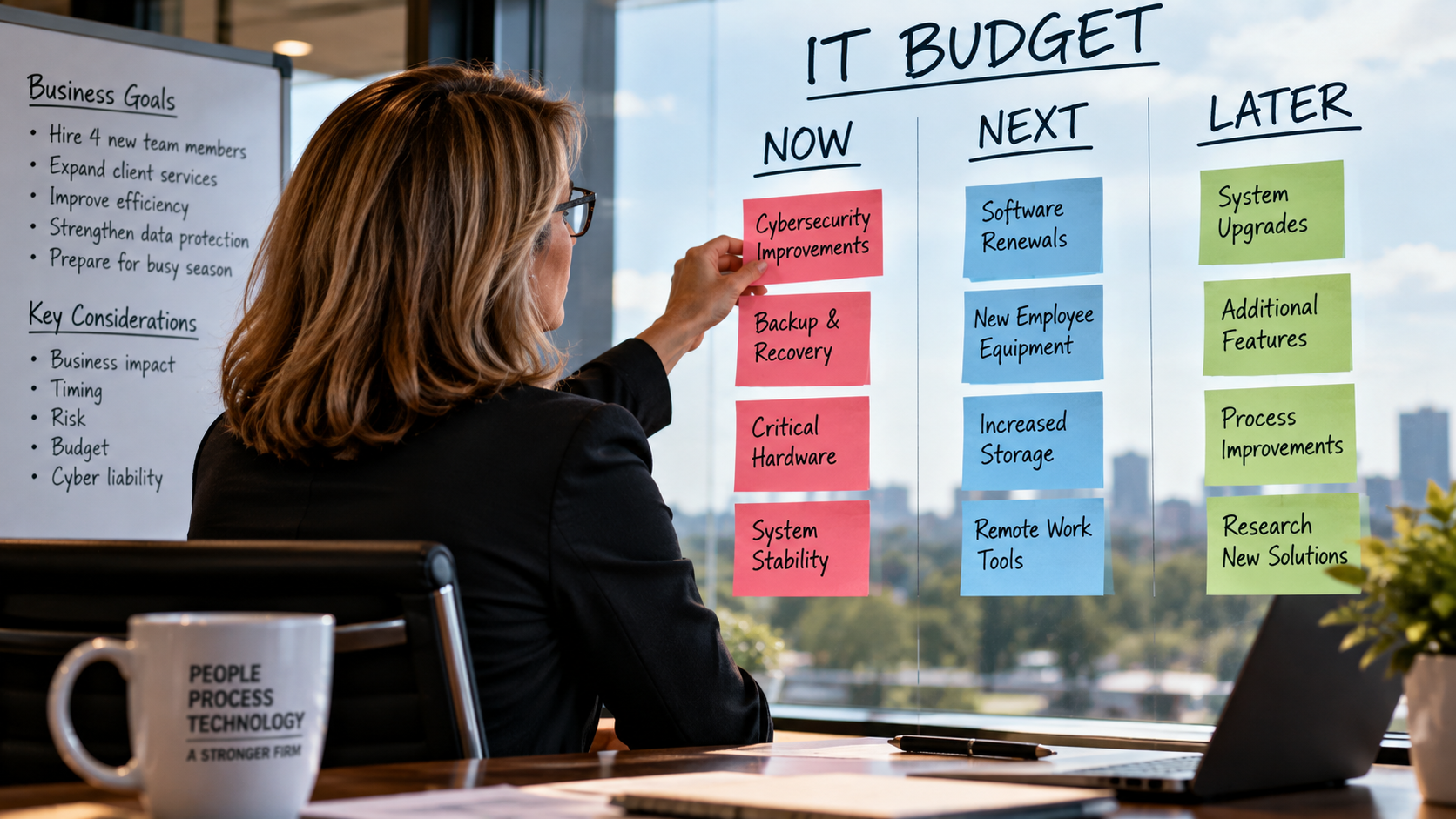
For accounting and tax firms, the real challenge of IT budgeting is deciding what needs attention now, what should be planned for next, and what can reasonably wait.
That decision should consider more than price.
Technology choices can affect staff productivity, sensitive client data, busy-season continuity, recovery, insurance questions, and your firm's broader cyber liability.
Cyber liability is the business, legal, regulatory, operational, and reputational exposure your firm carries when cybersecurity responsibilities are not properly understood or managed.
So when everything on the technology list feels important, how do you decide what comes first?
Start with three questions.
1. What Happens If We Wait?
The first question should not be:
“How long has this been on the list?”
A better question is:
“What happens if we wait another three or six months?”
That shifts the conversation from age to impact.
An older laptop may be slower than it used to be, but if it is still reliable, supported, and able to do the job, replacing it may not be the highest priority today.
An untested backup is different.
So is a system that regularly goes down.
So is a security weakness that affects sensitive client information.
So is a technology gap that makes it difficult to answer a cyber insurance or client security questionnaire.
The difference is the consequence of waiting.
How should an accounting firm measure the cost of delaying an IT expense?
Ask:
- Will employees lose productive time?
- Could this interrupt client work?
- Could waiting increase downtime?
- Could the problem become more expensive later?
- Could sensitive information be exposed?
- Does the issue increase our cyber liability?
- Would waiting reduce our options later?
- Could this become an emergency during busy season?
These questions help separate irritation from actual business exposure.
That matters because the loudest technology problem is not always the most important one.
A slow application may generate complaints every week.
An untested recovery process may generate none.
Until you need it.
Good IT budgeting looks at the whole risk, not simply the issue getting the most attention.
2. What Do We Already Know Is Coming?
Many technology expenses are predictable long before an invoice arrives.
Software renewals have dates.
Warranties expire.
Computers age.
Employees get hired.
Storage grows.
Contracts change.
Planned projects require new tools.
If you know something is coming, it belongs in the planning conversation even if you are not paying for it today.
Suppose your accounting firm plans to hire four people later in the year.
Those employees may need:
- Computers
- Microsoft 365 or other software licenses
- Email accounts
- Secure access
- Data storage
- Security tools
- Multifactor authentication
- Training
- Support
You may not be paying those costs yet.
But they are still part of the future IT budget.
Knowing that gives you choices.
You can spread purchases across quarters.
You can reserve money.
You can review license needs early.
You can prepare secure access before the employees arrive.
And you can delay a less important project if necessary.
Why should IT renewals be reviewed before the renewal date?
Because a renewal date should be a decision point, not simply a payment date.
Reviewing early gives you time to ask:
- Do we still need this service?
- Has pricing changed?
- Are we paying for licenses nobody uses?
- Does the service still fit the firm?
- Would changing it affect operations or security?
- Is another tool already doing the same job?
Good planning gives you time to decide before urgency limits your options.
That is the difference between managing technology costs and reacting to them.
3. What Is Changing in the Firm?
An IT budget should not be built separately from the firm's business plan.
Growth changes technology needs.
So does hiring.
Remote work.
New services.
Larger clients.
A new office.
Changes in how employees access and share information.
Every business decision can create a technology decision behind it.
How does growth affect an accounting firm's IT budget?
Consider a firm planning to add remote employees.
That decision may create needs for:
- New computers
- Secure remote access
- Additional software licenses
- More cloud storage
- Collaboration tools
- Security controls
- Backup considerations
- Employee training
- Support capacity
Or maybe the firm plans to pursue larger clients.
Those clients may ask more questions about how their information is protected.
They may ask for evidence of security controls.
They may send vendor security questionnaires.
That can create technology and cyber liability decisions that were not part of the previous year's budget.
Opening another office creates another set of questions.
Internet.
Wi-Fi.
Networking.
Phones.
Computers.
Security.
Access.
Support.
Backup.
If those decisions begin during opening week, the firm has fewer options and less time to compare costs.
The better question is:
“What is our firm planning to do next, and what technology will we need to support it?”
Then ask one more:
“What new risk does that change create?”
Growth should not be treated as a reason for fear.
It should be treated as something to prepare for.
How Should an Accounting Firm Prioritize IT Spending?
A simple way to prioritize IT spending is to divide potential expenses into three categories.
Priority 1: What needs attention now?
These are items where waiting may create meaningful operational, financial, security, or cyber liability consequences.
Examples might include:
- Unsupported systems
- Serious backup or recovery gaps
- Security weaknesses affecting sensitive data
- Repeated outages
- Critical hardware approaching failure
- Access-control problems
- Technology issues already affecting client work
These deserve attention because the cost of waiting may be higher than the cost of acting.
Priority 2: What should we prepare for next?
These are known expenses or changes that are not emergencies but can be anticipated.
Examples include:
- Planned hiring
- Upcoming software renewals
- Computer replacements
- Office expansion
- New service lines
- Increasing storage needs
- Technology projects tied to business growth
These items belong in the budget because you already know they are coming.
Priority 3: What can reasonably wait?
Some improvements are useful but do not create a larger problem if delayed.
That does not mean they are unimportant.
It means leadership can make an informed decision to defer them.
The key is understanding why they can wait and when they should be reviewed again.
A deferred decision should still be a conscious decision.
What Should Come First: Productivity or Cybersecurity?
This question does not always have a simple answer.
A frustrating system can waste a significant amount of employee time.
A cybersecurity weakness may create serious exposure even if nobody notices it during the workday.
The right priority depends on the business impact of each issue.
Ask:
- How much work is being lost?
- What happens if the system fails?
- What information could be affected?
- Is there a workaround?
- Does the issue affect client service?
- Does it increase cyber liability?
- Is there a deadline connected to the problem?
- Can the issue be safely deferred?
The purpose is not to automatically put “security” above every other business need.
The purpose is to understand the consequences clearly enough to make a responsible decision.
That is better than prioritizing based on fear.
And it is better than prioritizing based only on who complains the loudest.
A Good IT Budget Does Not Treat Everything Like an Emergency
The roof and the kitchen may both need work.
The difference is knowing which one can wait.
The same thinking belongs in your technology budget.
Some expenses address problems that could interrupt the firm, expose sensitive information, or become much more expensive if ignored.
Some prepare the firm for changes you already know are coming.
And some can stay on the list for another quarter without creating meaningful additional exposure.
That is what prioritization is supposed to accomplish.
A good budget does not fund everything.
It creates clarity around what comes first.
For accounting and tax firms, that matters because technology touches nearly every part of the business.
It affects:
- Client service
- Staff productivity
- Sensitive client data
- Remote access
- Busy-season continuity
- Business recovery
- Cyber insurance readiness
- Cyber liability
The goal is not to spend more.
The goal is to understand the impact of each decision before deciding where the money goes.
Questions to Ask Before Approving an IT Expense
Before approving or delaying a technology expense, ask:
What happens if we wait?
Understand the consequence of doing nothing.
What do we already know is coming?
Look for expenses with known dates, planned hires, renewals, and expected business changes.
What is changing in the firm?
Connect your technology plan to where the business is going.
Then ask:
What evidence supports this priority?
That last question matters.
A decision should be based on what is actually happening in the environment, not simply an opinion that something feels urgent.
Good technology planning should create clarity before spending.
IT Budgeting FAQ for Accounting and Tax Firms
How should an accounting firm prioritize its IT budget?
Prioritize spending based on the consequence of waiting, known future expenses, business changes, and cyber liability. Items that could cause significant downtime, data exposure, or operational disruption generally deserve attention before lower-impact improvements.
What IT expenses should accounting firms plan for?
Common expenses include hardware replacement, software licensing, cloud storage, cybersecurity, backup and recovery, remote access, communications, employee onboarding, support, and technology projects tied to growth.
Should every cybersecurity recommendation be treated as urgent?
No. Cybersecurity recommendations should be prioritized based on the actual exposure they address, the potential business impact, available evidence, and the consequences of delaying action. Some issues require immediate attention; others can be planned.
How far ahead should an accounting firm plan its IT budget?
An annual budget is useful, but firms should also review technology needs throughout the year. Looking 12 to 24 months ahead for major equipment replacement, software renewals, hiring, growth, and security needs can reduce surprise expenses.
How does cyber liability affect technology budgeting?
Cyber liability includes the business, legal, regulatory, operational, and reputational exposure created when cybersecurity responsibilities are not properly understood or managed. Technology budgeting should consider whether delayed investments increase that exposure.
What technology expenses can safely wait?
An expense may be reasonable to defer when delaying it does not create significant additional downtime, security exposure, client impact, or operational risk. The decision should still be documented and reviewed later.
Why should business planning and IT planning happen together?
Business changes such as hiring, remote work, new services, larger clients, or expansion often create technology needs. Connecting these discussions early gives leadership more time to understand costs, risks, and options.
Clarity Makes Prioritization Easier
You should not have to treat every technology decision like an emergency.
Start with the list you already have.
Then ask:
What happens if we wait?
What do we already know is coming?
What is changing in the firm?
Those three questions can turn a long list of competing priorities into a more manageable plan.
You may discover that something you thought was urgent can wait.
You may also discover that something quiet in the background deserves attention sooner than you realized.
Either outcome is useful.
Because the goal is not to make every technology decision today.
The goal is to understand enough about the impact, timing, and risk to decide what comes first.
If you want help sorting out what needs attention now, what should be planned for next, and what can reasonably wait, schedule a Discovery Call with MTS.
We’ll help you look at the business impact, timing, and cyber liability behind the items on your list so you can make a more informed decision about what comes next.