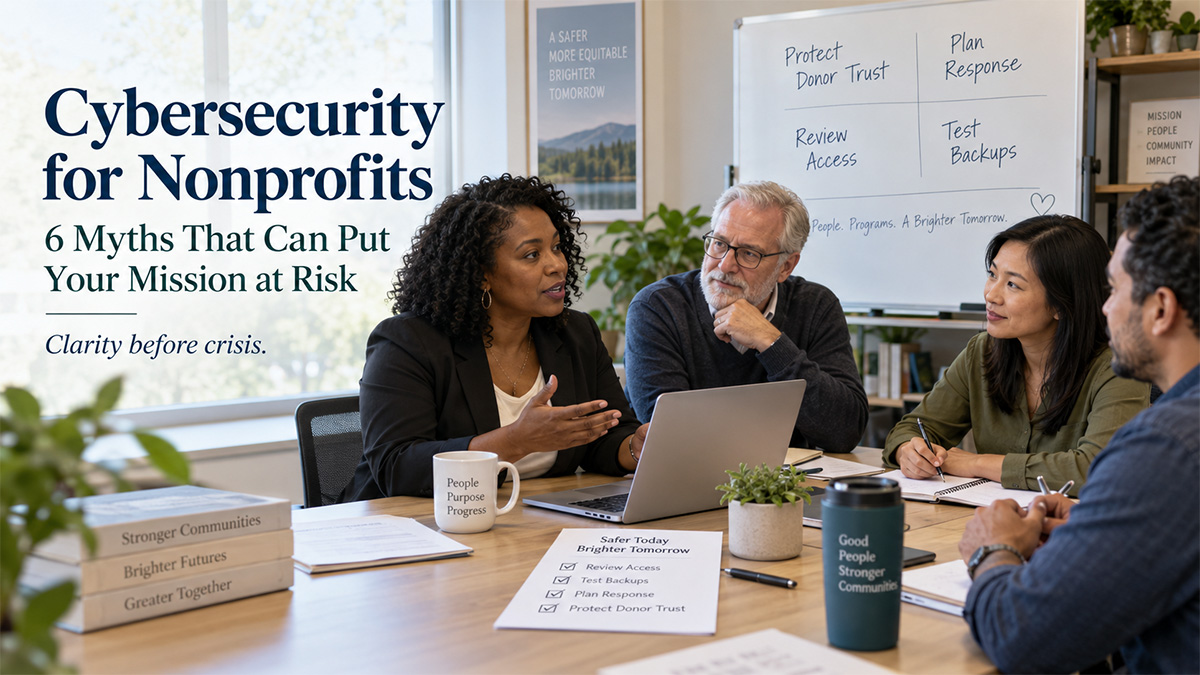
Cybersecurity for nonprofits is about more than protecting computers.
It is about protecting donor trust, keeping programs running, safeguarding sensitive information, and helping nonprofit leaders understand the cyber liability their organizations carry.
That is why Cybersecurity Awareness Month is a useful time to look at the difference between what your nonprofit thinks is protecting it and what you can actually verify.
Many organizations rely on assumptions that sound reasonable:
“We’re too small to be targeted.”
“Our employees know what phishing looks like.”
“We use MFA, so our accounts are safe.”
“We have backups.”
Those statements may sound reassuring.
But reassurance is not the same as evidence.
And when an assumption creates a blind spot, the issue can grow beyond IT.
For nonprofits, cybersecurity gaps can create cyber liability across the organization, including business, legal, regulatory, operational, and reputational exposure.
The goal is not to make nonprofit leaders afraid of technology.
The goal is to help you understand where risk may exist so you can make informed decisions before a cyber incident puts your mission under pressure.
Here are six common nonprofit cybersecurity myths—and what leaders should understand instead.
Myth 1: Our Nonprofit Is Too Small for Cybercriminals to Target
Small nonprofits sometimes assume attackers are focused only on large corporations, hospitals, banks, or government agencies.
But cybercriminals do not always choose targets based on size.
They often choose based on opportunity.
An exposed email account, stolen password, outdated system, vulnerable device, or poorly protected cloud application may provide the opening an attacker needs.
And nonprofits can hold valuable information, including:
- Donor names and contact information
- Employee records
- Financial information
- Online giving information
- Banking access
- Member or client information
- Grant documentation
- Credentials connected to vendors and partners
A better question is not:
“Are we large enough to be targeted?”
It is:
“Where could someone find an opportunity in our environment?”
That question helps move the conversation away from fear and toward understanding.
Fact: A nonprofit’s size does not determine its cyber risk. Its exposure does.
Myth 2: Our Employees Will Recognize a Phishing Email
Phishing emails have become much harder to identify by appearance alone.
Today, a fraudulent message can look polished, professional, and familiar.
It may appear to come from:
- An executive director
- A board member
- A donor
- A financial institution
- A vendor
- A coworker
- A technology provider
AI has also made it easier to create messages that sound natural and believable.
That means employees should not rely only on spelling mistakes, strange wording, or suspicious-looking email addresses.
Instead, nonprofit cybersecurity awareness training should teach people to recognize unusual behavior.
Before responding, ask:
- Would this person normally make this request?
- Are they changing payment instructions unexpectedly?
- Are they asking for donor, employee, or financial information?
- Are they sending an unfamiliar login link?
- Are they asking us to bypass the normal approval process?
- Are they creating unusual urgency or pressure?
If something feels different, verify the request through another trusted method.
That simple habit can prevent a costly mistake.
Cybersecurity awareness training is not about making employees afraid to use email.
It is about helping good people recognize when to stop and ask.
Fact: A professional-looking message can still be fraudulent. Your people need a clear way to verify unusual requests.
Myth 3: MFA Completely Protects Our Accounts
Multi-factor authentication, or MFA, is an important cybersecurity control for nonprofits.
But MFA alone does not make an account impossible to compromise.
Attackers may use techniques such as repeated authentication requests, fake login pages, stolen browser sessions, or other methods designed to get around weaker forms of authentication.
One example is sometimes called MFA fatigue or prompt bombing.
An employee receives repeated login approval notifications until they eventually approve one simply to make the requests stop.
That is why nonprofit cybersecurity should never depend on one tool.
MFA works best when supported by other protections, including:
- Strong passwords
- Appropriate access controls
- Employee education
- Secure devices
- Account monitoring
- Endpoint protection
- Clear incident response procedures
For nonprofit leaders, the important question is not simply:
“Do we have MFA?”
It is:
“How does MFA fit into the rest of our protection strategy?”
That question gives leadership a better view of the organization’s cyber liability.
Fact: MFA is an important layer of protection, but it is not the entire cybersecurity plan.
Myth 4: Our Nonprofit Backups Have Us Covered
Many nonprofit leaders have been told their organization has backups.
That sounds reassuring.
But there is a more important question:
Can your organization actually recover from those backups when the mission depends on them?
Imagine your nonprofit loses access to critical information tomorrow morning.
That might include:
- Donor records
- Program documents
- Accounting data
- Employee information
- Grant files
- Shared documents
- Operational systems
Would you know what can be restored?
Would you know how old the latest usable backup is?
Would you know who begins the recovery process?
Would you know how long your organization might be unable to operate normally?
And has anyone actually tested the recovery process?
This is where cybersecurity becomes an operational issue.
A backup may store information.
A recovery plan helps the organization understand how it will continue serving people when systems fail.
That difference matters because downtime can affect fundraising, payroll, programs, donor communication, and community services.
For nonprofit leaders, backup and disaster recovery should be discussed in mission terms—not just technical terms.
Fact: Having a backup is not the same as knowing your nonprofit can recover.
Myth 5: Cybersecurity Is the IT Provider’s Responsibility
A managed IT provider plays an important role in nonprofit cybersecurity.
But cybersecurity decisions happen throughout the organization every day.
They happen when someone:
- Opens an email attachment
- Shares a file
- Creates a password
- Gives a volunteer system access
- Approves a payment change
- Signs up for a new cloud application
- Uses a public AI tool
- Sends sensitive information
- Gives a vendor access to organizational systems
That means cybersecurity is not only an IT responsibility.
It is an organizational responsibility.
Leadership sets expectations.
Technology providers put safeguards in place.
Employees and volunteers learn how to recognize risk.
Boards understand the organization’s responsibilities.
Everyone has a role.
That does not mean every employee needs to become a cybersecurity expert.
It means everyone should understand the decisions they are responsible for making and when they should stop and ask for help.
This is especially important for nonprofits because cybersecurity decisions can affect donor trust, operational continuity, grant relationships, insurance readiness, and reputation.
Fact: Technology provides safeguards. Informed people help those safeguards work.
Myth 6: We Know What to Do If a Cyber Incident Happens
Many organizations believe they will figure out what to do when something happens.
Then something happens.
Imagine it is Tuesday morning.
Several employees suddenly cannot open their files.
Someone notices unusual behavior on a workstation.
Another employee reports strange activity in their email account.
People begin asking questions.
- Should employees shut down their computers?
- Should devices be disconnected?
- Who calls the IT provider?
- Who informs leadership?
- What happens if email is unavailable?
- When should cyber insurance be contacted?
- Does legal counsel need to be involved?
- Who communicates with the board?
- Who communicates with donors or partners?
- Who is authorized to make decisions?
Those questions are much harder to answer when the organization is already under pressure.
That is why a nonprofit incident response plan matters.
An incident response plan gives your organization a clear path to follow when time matters and emotions are high.
The plan does not need to predict every possible cyber incident.
It should help answer the most important questions ahead of time.
That includes who has responsibility, how communication works, where decisions are documented, and what steps happen first.
Preparation turns panic into process.
Fact: Your nonprofit’s incident response plan should be familiar before you ever need it.
What Does Cyber Liability Mean for a Nonprofit?
Cyber liability is broader than cyber insurance.
Cyber liability describes the exposure an organization carries when its cybersecurity responsibilities are not properly understood or managed.
That exposure can include:
Business risk: Financial loss, interrupted fundraising, or unexpected recovery costs.
Legal risk: Obligations that may arise when sensitive information is compromised.
Regulatory risk: Requirements connected to the information, payments, services, or systems your organization manages.
Operational risk: The possibility that technology problems prevent your staff from delivering programs or serving your community.
Reputational risk: Damage to the trust you have worked hard to build with donors, funders, boards, employees, volunteers, and the people you serve.
That is why nonprofit cybersecurity should not begin with fear or a list of products.
It should begin with understanding.
How Can Nonprofit Leaders Improve Cybersecurity?
A nonprofit cybersecurity strategy becomes easier to manage when leaders follow a clear process.
That process is simple:
1. Understand Where You Stand
Begin with objective evidence about the vulnerabilities and risks that exist in your environment today.
You cannot make an informed plan around risks you cannot clearly see.
2. Build an Informed Plan
Use that evidence to understand what matters most, why it matters, and what decisions are available to your organization.
Not every risk has the same urgency.
Not every nonprofit has the same budget.
A good plan helps leadership prioritize resources responsibly.
3. Stay Prepared Together
Cybersecurity is not a one-time project.
Your people change.
Technology changes.
Threats change.
Your organization changes.
Regular reviews help leadership stay informed and adjust the plan as the environment changes.
That is how preparation becomes part of responsible stewardship.
Cybersecurity Awareness Starts With Clarity
Cybersecurity Awareness Month should not leave nonprofit leaders feeling more afraid.
It should leave them better informed.
Because one of the biggest risks an organization can carry is believing something has already been handled when nobody has verified it.
Evidence before opinion.
You should be able to understand where your organization stands.
You should know which risks deserve attention.
You should understand the choices available to you.
And you should be able to explain those decisions to your board without having to speak IT.
You do not need to become a cybersecurity expert to be a responsible steward of your organization.
You need clarity.
You need a plan.
And you need people who can help you see the path before the storm arrives.
Frequently Asked Questions About Cybersecurity for Nonprofits
Are nonprofits common targets for cyberattacks?
Nonprofits can be attractive to cybercriminals because they may hold donor information, employee records, financial data, login credentials, and access to outside partners. Attackers often look for vulnerable systems and accounts rather than choosing organizations based only on size.
What is cyber liability for a nonprofit?
Cyber liability is the business, legal, regulatory, operational, and reputational exposure a nonprofit may face when its cybersecurity responsibilities are not adequately understood or managed. It is broader than cyber insurance.
What cybersecurity protections should a nonprofit have?
The right protections depend on the organization, but common areas include multi-factor authentication, endpoint protection, employee cybersecurity awareness, account monitoring, backups and recovery planning, access controls, incident response planning, and regular risk reviews.
Why is cybersecurity important for nonprofit boards?
Boards have a stewardship role. Cyber incidents can affect donor trust, finances, operations, sensitive data, reputation, and the nonprofit’s ability to carry out its mission. Board members do not need to become technical experts, but they should understand the organization’s major risks and how leadership is addressing them.
Is cyber insurance enough to protect a nonprofit?
Cyber insurance may help manage some financial consequences after an incident, but it does not replace cybersecurity controls, employee education, recovery planning, or risk management. Insurance is one part of the larger cyber liability picture.
How often should a nonprofit review its cybersecurity risks?
Cyber risk should be reviewed regularly because technology, staff, vendors, systems, and threats change over time. Significant organizational changes or new risks may also justify an additional review.
Not Sure Where Your Nonprofit Stands?
You do not need to guess.
And you do not need to wait for an incident to discover what your organization was responsible for protecting.
A Discovery Call with MTS is a simple first conversation about your concerns, your organization, and where you may need greater clarity.
No scare tactics.
No pressure.
Just a conversation designed to help you understand the path forward.
Schedule Your Discovery Call With MTS
Because the best time to understand the storm is before you are standing in the middle of it.