
A nonprofit board does not need to become a cybersecurity team.
It does need enough visibility to understand whether technology and cyber risk could affect the mission, the organization’s responsibilities, or the trust others place in it.
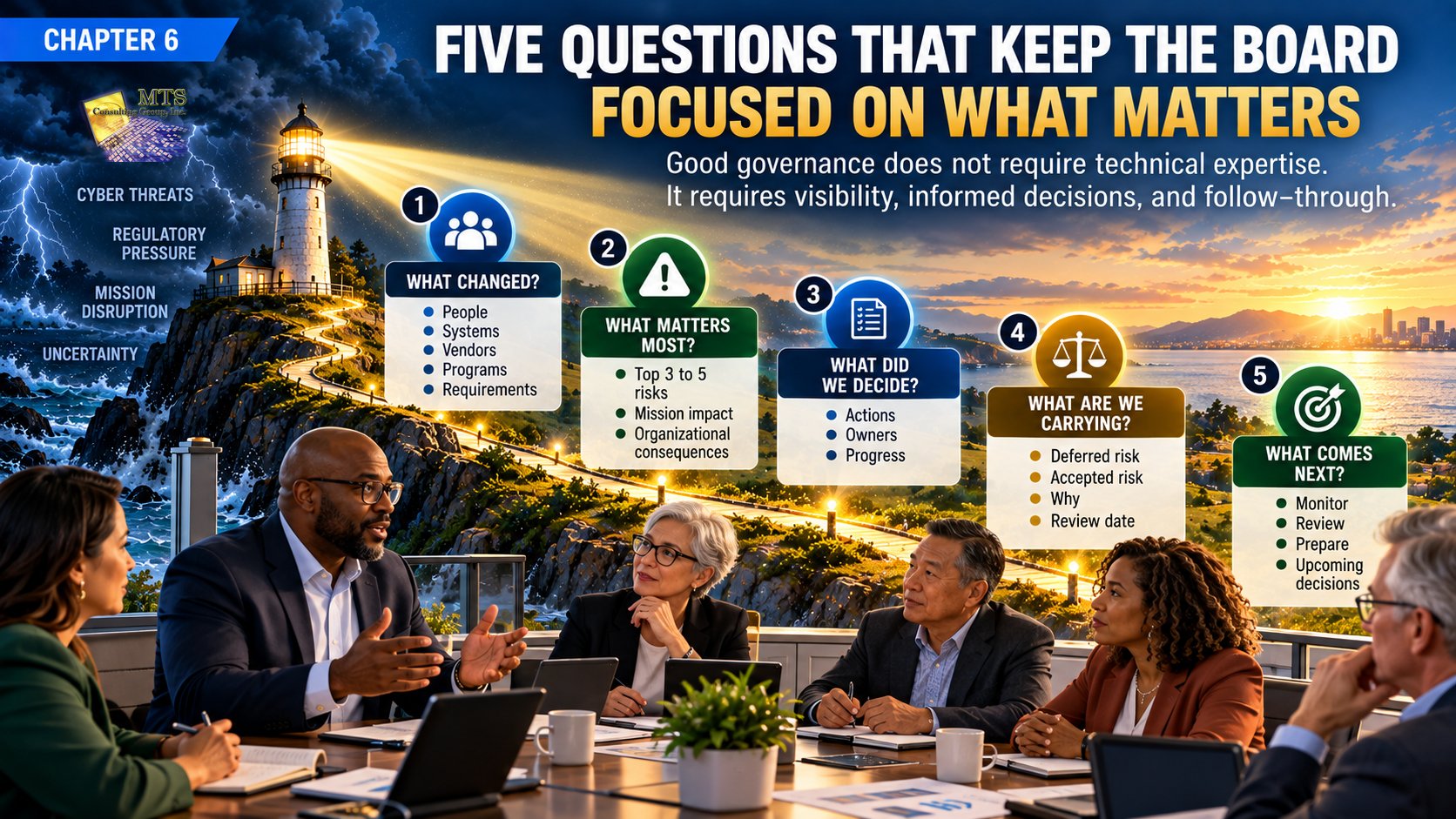
A useful board-level Cyber Liability discussion can focus on five questions:
- What has changed since our last review?
- What are the 3 to 5 risks that matter most right now?
- What has leadership decided to do about them?
- What risks have we deferred or consciously accepted?
- What should remain on our radar before the next review?
These questions give the board a practical way to exercise oversight without asking directors to manage technology.
The goal is clarity, not technical expertise.
The Board Needs the Right Information, Not All the Information
Cybersecurity can generate enormous amounts of data.
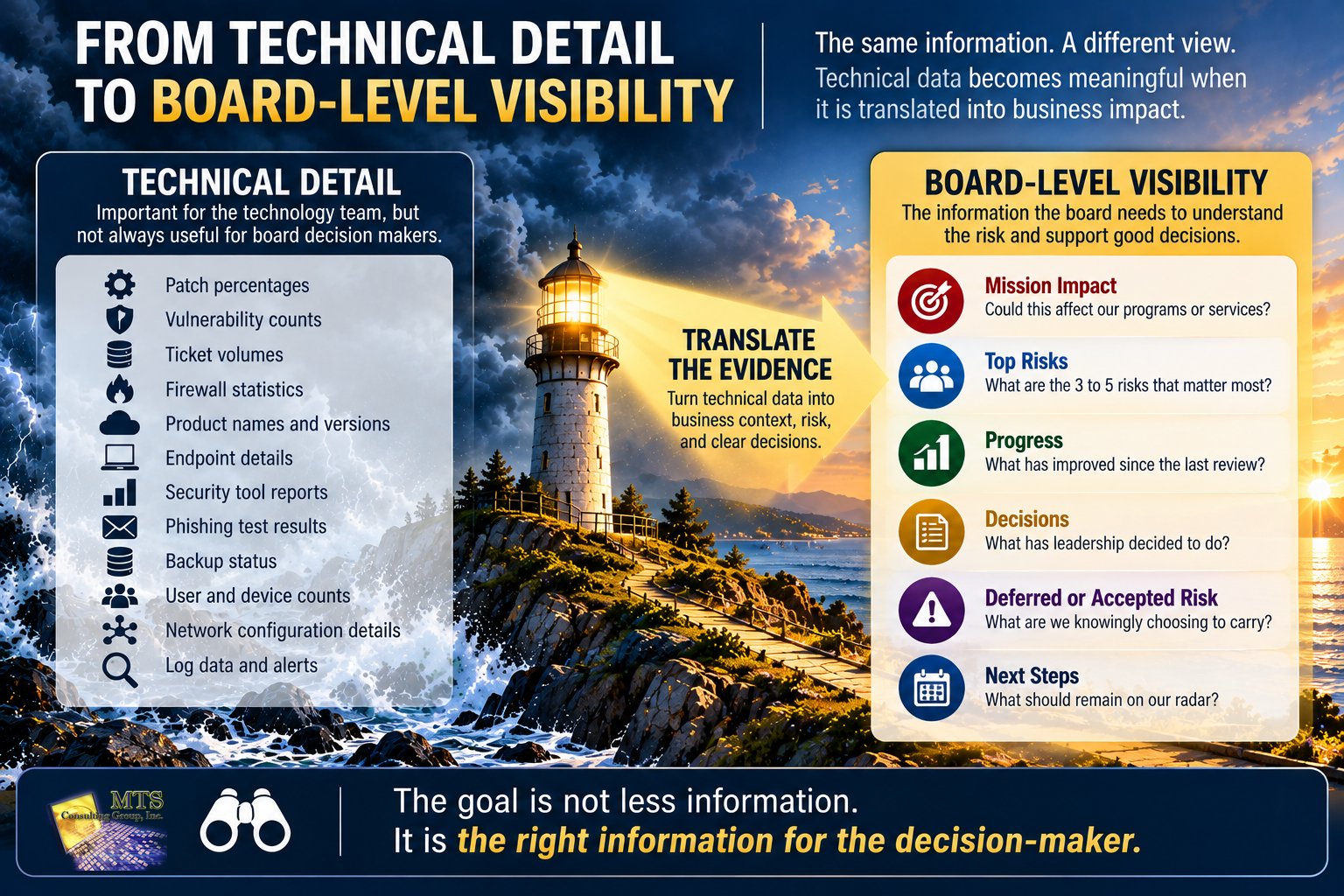
A board could receive reports showing:
- vulnerability counts
- patch percentages
- blocked threats
- firewall activity
- support tickets
- endpoint statistics
- phishing-test results
- backup status
- application inventories
Some of that information is important to the people operating the technology.
But more data does not automatically create better board oversight.
A director may receive 20 pages of cybersecurity statistics and still leave the meeting unable to answer:
What could most seriously affect our organization?
That is the question board reporting should help answer.
A useful board discussion translates technical information into organizational context.
Instead of focusing primarily on the technology itself, directors should understand:
- what has changed
- what matters most
- why it matters
- what leadership has decided
- what risk remains
- what needs to happen next
That is the level where cybersecurity becomes governance.
1. What Has Changed Since Our Last Review?
Cyber Liability changes because organizations change.
Since the last discussion, your nonprofit may have:
- hired new employees
- lost employees
- adopted new software
- changed vendors
- opened a location
- launched a new program
- changed payment systems
- expanded remote work
- begun using AI tools
- renewed cyber insurance
- received new contract requirements
- experienced a security event
- completed a major technology project
None of these changes automatically creates a serious problem.
They do change the environment.
That makes a simple question surprisingly powerful:
“What is different today from the last time we reviewed our Cyber Liability?”
It gives the board context before discussing risk.
Educational Example: A New Program Changes More Than the Program
Imagine a nonprofit launches a new service for families in its community.
The program requires:
- five new employees
- a new cloud application
- an outside software vendor
- remote access
- participant information
- new user accounts
The program may be successful from day one.
There may be no cybersecurity incident at all.
But the organization has still changed.
It now has more users, more data, another vendor, another system, and additional access that leadership depends on.
That means its Cyber Liability picture has changed too.
The board does not need to understand how the application is configured.
It should understand that the organization created new dependencies and responsibilities when it launched the program.
2. What Are the 3 to 5 Risks That Matter Most Right Now?
A board should not need to review every open cybersecurity issue.
Some technical findings belong with the people responsible for operating the environment.
The board needs visibility into the smaller number of risks that could have a meaningful effect on the organization.
A practical benchmark is 3 to 5 priority risks.
That does not mean the organization only has five issues.
It means leadership has done the work of deciding which issues deserve executive and board attention right now.
Examples might include:
- recovery capability for mission-critical systems
- access to sensitive donor or constituent information
- a significant vulnerability that remains unresolved
- an important regulatory or contractual requirement
- a major vendor dependency
- a security weakness that requires significant funding
- an accepted risk that leadership believes the board should understand
A focused discussion helps directors see what matters without getting lost in everything else.
What Makes a Cyber Risk Important Enough for the Board?
One useful test is to ask whether the issue could materially affect one or more of these areas.
Mission
Could programs or services be interrupted?
Trust
Could donors, constituents, employees, funders, or partners lose confidence?
Responsibility
Could the issue involve regulatory, contractual, insurance, or legal obligations?
Resources
Could the organization face a significant financial decision or loss?
Governance
Does the issue require leadership judgment, funding, risk acceptance, or board awareness?
A routine software update usually does not require board discussion.
A known weakness that could prevent the organization from recovering its primary systems may.
The difference is not how technical the problem is.
The difference is the organizational consequence.
3. What Has Leadership Decided to Do?
Identifying risk is only part of the conversation.
Boards also need to understand the decisions being made about important risks.
For each significant issue, the board should be able to understand:
- what was identified
- why it matters
- what leadership decided
- who owns the next step
- whether work is underway
- what risk remains
- when the issue will be reviewed again
This moves the conversation from:
“We have a problem.”
to:
“We understand the problem, we made a decision, and here is what happens next.”
That is a much stronger governance position.
Educational Example: Translating Backup Risk for the Board
Suppose the technology team learns that the nonprofit has backups, but no recent recovery test can be confirmed.
A technical presentation could include backup schedules, storage locations, software versions, and server information.
The board probably does not need all of that.
A board-level explanation could be:
What We Learned
We cannot currently confirm how quickly several mission-critical systems could be restored after a serious disruption.
Why It Matters
An extended outage could interrupt programs and prevent employees from accessing important information.
What Leadership Decided
Management approved a recovery test and asked the technology team to document realistic recovery expectations.
What Happens Next
The results will be reviewed at the next Cyber Liability discussion.
That tells the board what it needs to know.
4. What Risks Have We Deferred or Consciously Accepted?
This may be one of the most valuable questions a board can ask.
No organization fixes every known risk immediately.
Nonprofits especially have to balance cybersecurity with:
- programs
- employees
- facilities
- fundraising
- technology replacement
- insurance
- compliance
- community needs
Leadership may reasonably decide to defer a recommendation.
What matters is whether the organization understands the decision.
There is an important difference between:
“We never addressed it because we forgot about it.”
and:
“We understand the risk, decided not to address it yet, documented why, and will review the decision again.”
The second is risk management.
What Should Be Documented When a Risk Is Deferred?
When a meaningful cybersecurity recommendation is postponed or declined, a simple record can preserve important context.
Document:
- what was recommended
- what evidence supported the recommendation
- the potential business impact
- the decision that was made
- who made or approved the decision
- why it was deferred
- any safeguards already reducing the risk
- what risk remains
- when the decision should be reviewed again
This does not need to become a complicated legal document every time.
The goal is organizational memory and accountability.
The value becomes clearer six months later.
If leadership changes, budgets change, or another issue makes the risk more important, the organization does not have to reconstruct the original conversation from memory.
A decision record gives future leaders context.
Educational Example: A Planned Technology Replacement
Imagine leadership learns that an important application should eventually be replaced.
The application is still supported.
Current safeguards are functioning.
Replacement would cost a significant amount and interfere with an important program if completed during the busiest part of the year.
Leadership decides to schedule the replacement for the next budget cycle.
A useful decision record might state:
Risk: Aging application will require replacement.
Current status: Still supported and operating.
Decision: Defer replacement until next fiscal year.
Reason: Timing and budget.
Current safeguards: Existing protections remain in place.
Review date: Revisit during annual budget planning or sooner if support status changes.
That is not ignoring the risk.
It is managing it.
5. What Should Remain on Our Radar?
Not every open issue needs immediate board action.
Some issues need continued visibility.
That might include:
- a system approaching replacement
- a major vendor dependency
- an insurance requirement
- an emerging regulatory issue
- a deferred security project
- a new AI initiative
- an upcoming cybersecurity assessment
- an accepted risk
- a recovery improvement
- a long-term technology roadmap item
This gives the board another simple question:
“What do we not need to act on today, but should still be talking about next quarter?”
That keeps important issues from disappearing simply because they are not urgent today.
A Good Quarterly Review Should Show Movement
If every quarterly Cyber Liability discussion looks identical, the board should ask why.
A useful review should help directors see what changed.
For example:
Completed
What recommendations or projects were finished?
Improved
Where did the risk picture get better?
Open
What still needs attention?
New
What has emerged since the last review?
Deferred
What has leadership consciously decided to postpone?
Next
What decisions or projects are coming?
This creates continuity.
The board can see whether the organization is making progress rather than receiving a new collection of cybersecurity information every few months.
Boards Should Ask About the Mission, Not the Firewall
Board questions become much more useful when they focus on outcomes.
Instead of asking:
“Is our firewall up to date?”
ask:
“What technology failure could most seriously interrupt our programs?”
Instead of:
“How many vulnerabilities do we have?”
ask:
“Which vulnerabilities could have the greatest effect on our organization?”
Instead of:
“Did employees complete training?”
ask:
“Do we have evidence that employees understand how to recognize and report common threats?”
Instead of:
“Do we have backups?”
ask:
“Could we restore the systems our mission depends on within a timeframe we can tolerate?”
Instead of:
“Are we compliant?”
ask:
“What requirements apply to us, and what evidence shows how we are addressing them?”
The technical information still matters.
The board simply needs it translated into questions directors can govern.
The Four Cyber Liability Risks Give the Board a Common Language
The four areas introduced earlier in this Knowledge Center can help directors organize the conversation.
For any significant issue, ask:
Operational
Could this prevent us from carrying out the mission?
Reputational
Could this affect the trust others place in us?
Regulatory
Could this affect a requirement or responsibility we are expected to meet or demonstrate?
Legal
Could this create obligations or exposure beyond the technology itself?
One technical problem may affect more than one area.
That is why boards should see the whole risk rather than receive only a description of the technical finding.
Educational Example: One Risk Viewed Through Four Lenses
Imagine a nonprofit depends heavily on a third-party system to manage donor information and online giving.
Leadership learns that the vendor relationship needs additional review.
The board could consider the issue through four questions.
Operational
Could fundraising or donor operations continue if the platform became unavailable?
Reputational
Could an incident involving donor information affect confidence in the organization?
Regulatory
Are there privacy, payment, contractual, or other requirements that apply to the information or service?
Legal
Could an incident create notification, contractual, insurance, or other legal responsibilities?
The board does not need to audit the vendor.
It needs to understand why the relationship matters to the organization.
How Much Technical Detail Does the Board Actually Need?
Usually less than the technical team.
But not zero.
A useful rule is:
Give the board enough evidence to understand the risk and the decision, but not so much technical detail that the decision disappears.
For a significant risk, the board may need six things:
- The issue
- The evidence
- The potential organizational impact
- Leadership’s response
- The remaining risk
- The next review point
That structure gives directors enough information to ask meaningful questions.
Educational Example: Two Very Different Board Reports
Consider two possible cybersecurity reports.
Report A
The board receives:
- 19 pages of technical findings
- vulnerability statistics
- endpoint counts
- patch percentages
- firewall information
- support statistics
- product names
Everything may be accurate.
But directors still cannot tell which problem matters most.
Report B
The board receives one page showing:
- Top 4 Cyber Liability risks
- What changed since last quarter
- What leadership completed
- What leadership deferred
- What risk was accepted
- What needs attention next
Report B contains less data.
But it may create more useful oversight because the information has been organized around decisions.
Should Every Nonprofit Board Discuss Cyber Liability Every Quarter?
Not necessarily.
The right cadence depends on the organization.
Some may need monthly visibility during major remediation, a significant technology project, or elevated regulatory activity.
Some may find quarterly review appropriate.
A smaller, lower-complexity nonprofit may reasonably use a less frequent formal review.
Factors that can influence cadence include:
- Cyber Liability exposure
- complexity of the environment
- regulatory requirements
- insurance pressure
- active security projects
- prior incidents
- board reporting expectations
- sensitive data
- AI governance
- backup and recovery concerns
- significant organizational change
The important principle is not:
“Every nonprofit must review Cyber Liability every three months.”
It is:
“Review Cyber Liability often enough that leadership and board decisions remain current.”
For many organizations, quarterly is a practical rhythm because enough time has passed to see progress without allowing significant decisions to disappear for an entire year. The appropriate review schedule should reflect the organization’s risk, complexity, active projects, regulatory pressures, and leadership needs.
A Simple Five-Question Board Framework
If your organization wants a starting point, put these five questions on the agenda.
1. What Changed?
What new people, systems, vendors, programs, risks, or requirements have appeared?
2. What Matters Most?
What 3 to 5 risks currently deserve leadership and board visibility?
3. What Did We Decide?
What has management approved, started, completed, or changed?
4. What Are We Choosing to Carry?
What has been deferred, monitored, or consciously accepted?
5. What Comes Next?
What should leadership or the board expect to review before the next meeting?
This is simple enough to use consistently.
Consistency matters because governance becomes stronger when the board can compare one review with the next.
A One-Page Cyber Liability Dashboard
A nonprofit does not necessarily need a sophisticated reporting system to improve board visibility.
One page can be enough.
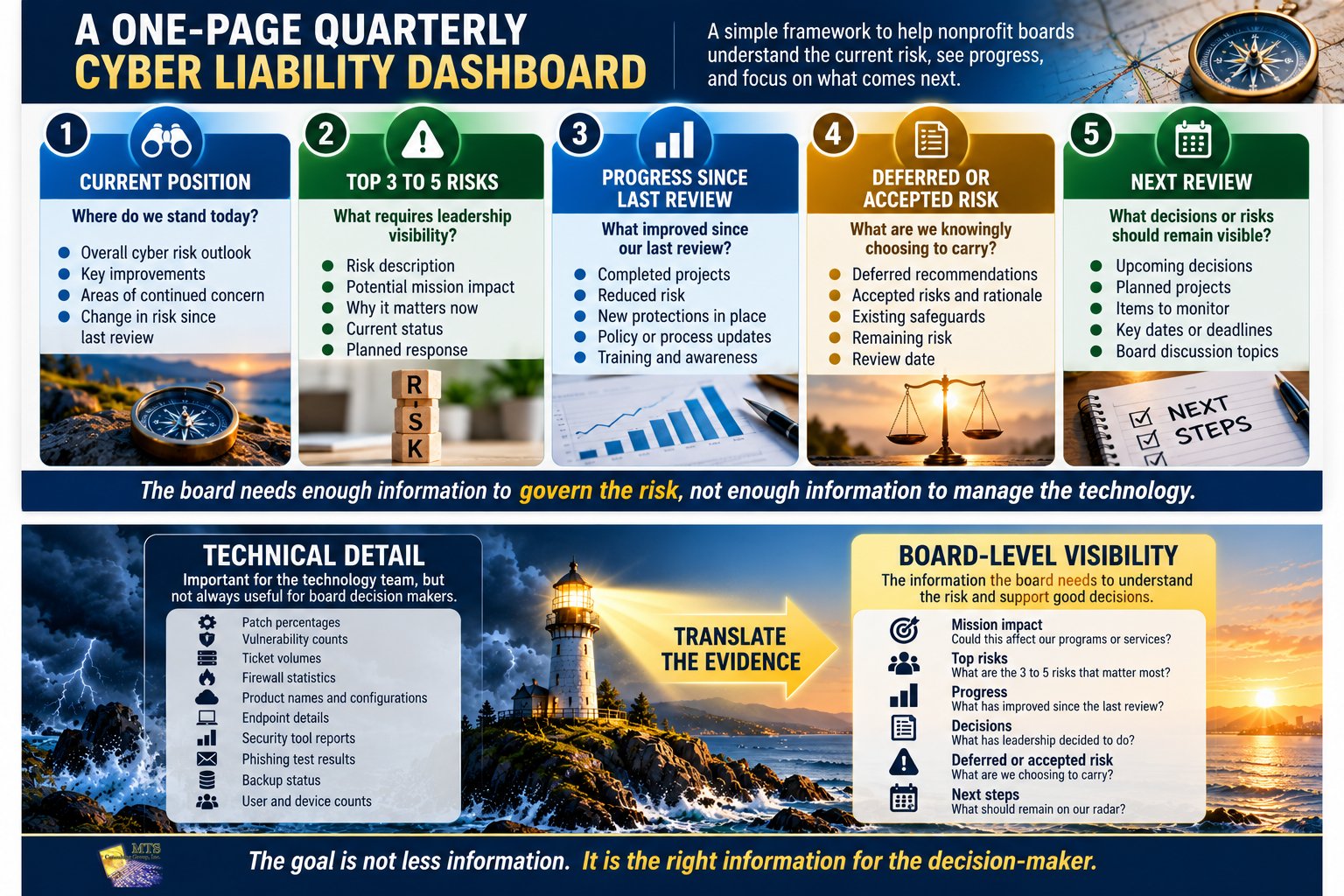
Consider using five sections.
Current Position
A short statement describing where the organization stands.
Top 3 to 5 Risks
Only issues that deserve leadership or board attention.
Progress Since Last Review
What improved or was completed?
Deferred or Accepted Risk
What is the organization knowingly choosing to carry?
Next Review
What decisions, projects, or risks should remain visible?
Over time, the dashboard creates a story.
The board can see where the organization started, what it changed, what remains unresolved, and where leadership is going next.
The Board’s Job Is Oversight, Not Cybersecurity Management
Board engagement matters.
So does knowing where the board’s role ends.
Directors generally should not:
- choose cybersecurity software
- configure security systems
- manage the IT provider
- troubleshoot incidents
- approve routine patches
- administer user access
Those are operating responsibilities.
Board oversight is different.
The board should be asking whether:
- leadership understands meaningful risk
- the organization has evidence supporting its conclusions
- important risks are being prioritized
- leadership is making informed decisions
- resources are reasonably aligned with risk
- deferred decisions remain visible
- management is making measurable progress
That keeps responsibility where it belongs.
Technical professionals manage technology.
Management manages the organization.
The board provides oversight.
What Should a Nonprofit Leader Take Away From This Chapter?
Board oversight of Cyber Liability does not require directors to become cybersecurity experts.
It requires the right questions.
Start with five:
- What changed?
- What 3 to 5 risks matter most?
- What did leadership decide?
- What risks are we choosing to carry?
- What should remain visible before the next review?
Those questions do something important.
They turn cybersecurity from a collection of technical reports into an ongoing leadership conversation.
They make decisions visible.
They make deferred risks harder to forget.
They help the board see progress.
And they keep the conversation centered on what the board is ultimately responsible for helping protect:
the mission,
the organization,
its resources, and
the trust others place in it.
Applying the Education: How MTS Helps Leaders Prepare for Board-Level Cyber Liability Conversations
MTS applies these principles through a process called the Strategic Security Briefing.
The briefing is not intended to be a traditional technology review centered on ticket counts or a long list of products.
It is designed for decision-makers such as an Executive Director, CEO, CFO, administrator, or other leader responsible for organizational risk and budget decisions.
A Strategic Security Briefing can bring together:
- current evidence
- progress since the previous review
- remaining Cyber Liability gaps
- 3 to 5 priority findings
- organizational impact
- recommendations
- decisions
- declined or deferred items
- documented risk acceptance
- next steps
- next review date
That creates a paper trail of what leadership knew, what was recommended, what was decided, and what remains open.
MTS uses the briefing to help translate cybersecurity information into decisions leadership can understand and explain.
The goal is not to make the client dependent on MTS.
The goal is to create clarity so leadership can make informed decisions.
That is consistent with the MTS operating principles of:
Create Clarity Before Action,
Guide Through the Storm,
Teach Before We Act, and
See the Whole Risk.
The client remains responsible for the decision.
A Practical Next Step
Before your next board meeting, try answering these questions on a single page:
- What changed since our last review?
- What are the 3 to 5 Cyber Liability risks that matter most today?
- What has leadership decided about each one?
- What have we deferred or accepted?
- What should the board expect to hear about next time?
If you can answer those five questions clearly, you already have the foundation for a stronger Cyber Liability conversation.
Continue Learning
Previous Chapter
Chapter 5: How Should a Nonprofit Prioritize Cyber Risks When Every Dollar Matters?
Next Chapter
Chapter 7: What Do Backup and Recovery Have to Do With a Nonprofit’s Mission Continuity?
Chapter 7 will explore one of the most important Operational Cyber Liability questions:
If your technology stopped working today, how quickly could your mission recover?
We will look at:
- backup versus recovery
- mission-critical systems
- recovery expectations
- recovery testing
- acceptable downtime
- acceptable data loss
- leadership responsibilities
- how backup and recovery affect Cyber Liability