Cybersecurity for accounting firms is not just an IT responsibility.
Technology providers can manage security tools, monitor systems, protect devices, and respond to alerts. But many of the decisions that affect an accounting or tax firm’s cyber risk happen during normal business activity.
They happen when an employee opens an email.
When someone approves a login request.
When a client sends a document.
When a vendor changes payment instructions.
When a staff member works remotely.
When someone has to decide whether an unusual request is legitimate.
That is why cybersecurity works best when everyone understands their role.
Consider this situation.
It’s 4:17 on a Friday afternoon.
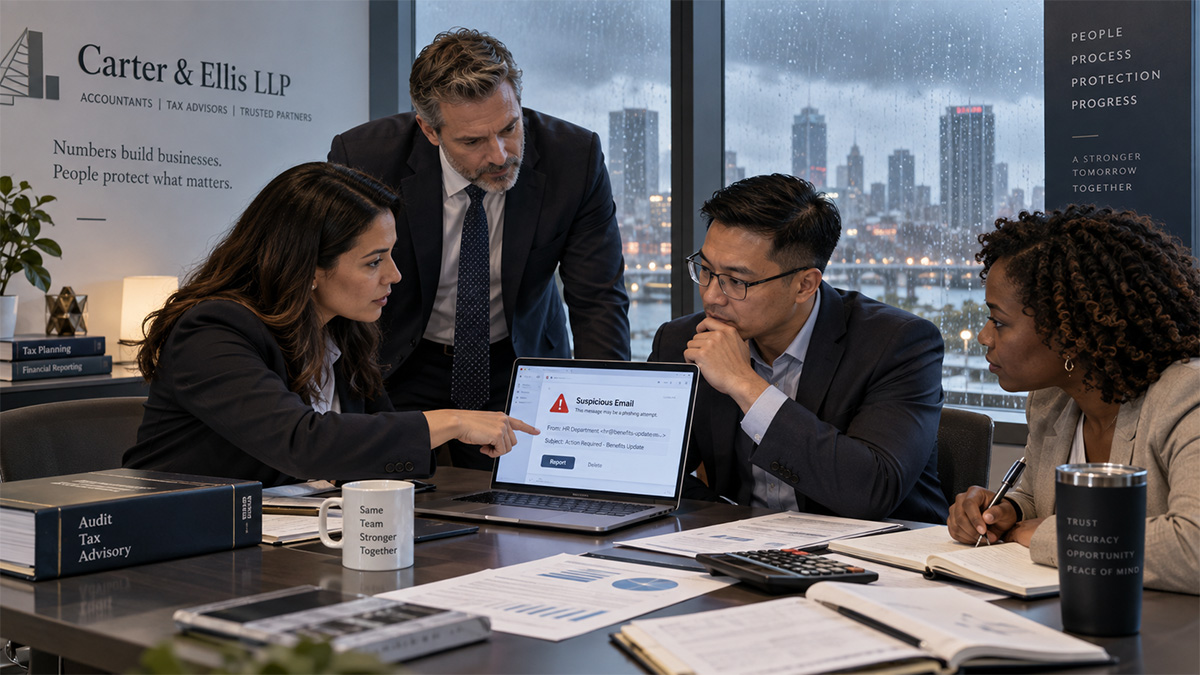
A team member at an accounting firm receives an email that appears to be from a managing partner:
“Can you send me the updated banking information before you leave?”
The name is right.
The tone sounds familiar.
The request feels urgent.
And everyone is trying to finish the week.
There is only one problem.
The managing partner never sent it.
Your technology provider may have strong protections in place, but technology cannot make every judgment call for your people.
Sometimes the final decision belongs to the person sitting at the keyboard.
That is why cybersecurity is part of your firm’s broader cyber liability.
Cyber liability is the business, legal, regulatory, operational, and reputational responsibility your firm carries when cybersecurity risks are not properly understood, managed, or documented.
Your employees do not need to become cybersecurity experts.
They do need to know what to do when something does not look right.
Why Cybersecurity Is Not Just IT’s Responsibility
It is easy to think cybersecurity happens somewhere behind the scenes.
Your IT provider manages security tools.
Your computers have protection.
Someone handles software updates.
Multifactor authentication is enabled.
Backups are running.
So cybersecurity feels handled.
But technology is only part of your protection.
Your defenses are also tested every time someone in your firm decides whether to trust an email, approve a request, open a document, send sensitive information, or change a business process.
Those decisions happen every day.
They happen with:
- Partners
- Administrative staff
- Tax preparers
- Bookkeepers
- Seasonal employees
- Remote employees
- Contractors
- Vendors
And they often happen when people are busy.
That matters in an accounting or tax firm because busy season creates pressure.
Deadlines are closer.
People move faster.
Inbox volume increases.
Clients are waiting.
Employees may be more likely to act quickly instead of slowing down to verify something unusual.
That is exactly why your cybersecurity strategy cannot depend on technology alone.
Employees need a clear process for what to do when something does not fit the normal pattern.
Can Technology Stop Every Cyberattack?
No cybersecurity technology can prevent every attack or make every decision for an employee.
Good security tools can block a large amount of malicious activity before your team ever sees it.
That is important.
But attackers also understand how people work.
Modern phishing attacks may imitate:
- A client
- A partner
- A bank
- Microsoft
- A payroll provider
- A tax software company
- A document-sharing service
- A trusted vendor
- Another employee
The message may look professional.
The writing may sound normal.
The sender name may look familiar.
And AI has made it easier to create convincing messages that do not contain the obvious spelling and grammar mistakes people once associated with phishing.
That means employees need to look beyond appearance.
What should employees look for in a suspicious email?
Instead of asking only:
“Does this email look fake?”
Teach employees to ask:
“Does this request make sense?”
For example:
- Would this partner normally request banking information through email?
- Is this the usual way this client shares documents?
- Why am I suddenly being asked to log in again?
- Has the normal payment process changed?
- Would this person normally ask for sensitive information without speaking to me first?
- Is there unusual urgency?
- Am I being asked to bypass a normal procedure?
Those questions shift the employee from simply judging the appearance of the message to thinking about normal business behavior.
That is a stronger habit.
If something is unusual, verify it.
Call a known phone number.
Contact the person through a trusted method.
Visit the vendor website directly instead of clicking the email link.
Ask a manager.
Slow the process down.
A brief verification step can be much easier than dealing with fraudulent payments, compromised accounts, exposed client information, or business disruption later.
Why “Be Careful” Is Not a Cybersecurity Plan
Many accounting firms tell employees:
“Be careful with suspicious emails.”
That is reasonable advice.
But it is not enough.
What does “be careful” mean when an employee is staring at a message that looks legitimate?
Every employee should know the next step.
What should employees do when they suspect phishing?
Your process should clearly explain:
- Who the employee should contact
- How to verify whether a request is legitimate
- When not to click a link
- When not to download an attachment
- What to do if they already clicked
- What to do if they entered a password
- How to report the incident
- What information to include when reporting it
That turns a warning into a usable process.
And usable processes reduce hesitation.
Hesitation can make a cyber incident worse.
An employee may think:
“Maybe this isn't serious.”
“I don't want to bother anyone.”
“I clicked it already. Maybe nothing happened.”
“I don't want to get blamed.”
Every minute spent debating whether to report an incident can increase the amount of time an attacker has to work.
That is why good security awareness education should not be based on blame.
If employees believe they will be embarrassed or punished for reporting mistakes, they may hide those mistakes.
If they know quick reporting is the right action, the firm has a much better chance to respond while the incident is still manageable.
A person who reports suspicious activity quickly is helping protect the firm.
How Leadership Shapes Cybersecurity Culture
Cybersecurity culture starts with leadership.
Employees learn from what leaders actually do.
If a managing partner skips verification procedures because they are in a hurry, employees notice.
If managers share passwords or work around security controls, employees notice.
If leadership complains when someone stops to verify an unusual request, employees may stop asking.
And if an employee makes a mistake and gets publicly embarrassed, other employees may learn to keep quiet.
The opposite is also true.
When leadership follows verification procedures, employees see that the process matters.
When someone questions an unusual request and a manager responds with:
“Good catch. Thanks for checking.”
the team learns that speaking up is valued.
When partners follow the same security processes they expect employees to follow, those processes become part of normal business operations.
What does a strong cybersecurity culture look like?
It creates permission to stop and ask.
Employees understand that cybersecurity is not about never making a mistake.
It is about:
- Following good habits
- Recognizing unusual situations
- Verifying unexpected requests
- Reporting problems quickly
- Knowing where to go for help
Leadership creates the environment where those behaviors become normal.
Cybersecurity Works Better When Everyone Knows Their Role
Return to the employee staring at that email at 4:17 on Friday afternoon.
The goal is not to make them paranoid.
It is not to make employees suspicious of every message.
And it is not to turn them into cybersecurity analysts.
The goal is simpler.
When something feels wrong, they should know:
Stop.
Verify.
Ask.
Report.
That is a process people can actually remember.
What is the employee’s role in cybersecurity?
Employees may be responsible for:
- Following verification procedures
- Protecting passwords
- Using approved systems
- Reporting suspicious emails
- Reporting unusual account activity
- Completing security awareness education
- Following established data-handling processes
What is the IT provider’s role in cybersecurity?
Technology professionals may be responsible for:
- Managing security tools
- Monitoring systems
- Protecting devices and accounts
- Managing access controls
- Investigating alerts
- Supporting incident response
- Helping restore systems after an outage or attack
What is leadership’s role in cybersecurity?
Firm leaders may be responsible for:
- Setting expectations
- Approving policies
- Understanding major risks
- Deciding which risks require action
- Deciding which risks will be accepted
- Supporting employee education
- Making sure incident response plans exist
- Asking for evidence that important security controls are actually working
Those roles are different.
That is the point.
Shared responsibility should not mean shared confusion.
Everyone should know what belongs to them.
What Does Cybersecurity Have to Do With Cyber Liability?
For an accounting or tax firm, cybersecurity decisions can affect much more than computers.
They can affect:
- Client confidentiality
- Business operations
- Legal exposure
- Regulatory responsibility
- Cyber insurance
- Professional reputation
- Revenue
- Client trust
- Business continuity
That is why looking only at individual security tools gives leadership an incomplete picture.
A technical safeguard may reduce risk.
Employee training may reduce risk.
A verification procedure may reduce risk.
An incident response plan may reduce risk.
Leadership oversight may reduce risk.
But the strongest position comes when those pieces support one another.
That is what it means to look at the whole cyber liability picture.
The question is not simply:
“Do we have cybersecurity tools?”
The better question is:
“Do our people, processes, and technology work together to reduce the risks our firm is responsible for?”
Security Awareness Training Should Build Confidence, Not Fear
Security awareness training is important.
But the purpose should not be to scare employees with stories about everything that could go wrong.
Training should help people make better decisions.
What should cybersecurity awareness training teach accounting firm employees?
Useful training should help employees answer questions such as:
- What does an unusual request look like?
- How do I verify a request?
- Who should I contact?
- What should I do if I click something?
- What should I do if I enter my password on a suspicious page?
- How quickly should I report an issue?
- What happens after I report something?
- Will I get in trouble for reporting a mistake?
Those are practical questions.
And practical education builds confidence.
An employee should be able to think:
“I'm not sure this is legitimate, but I know exactly what to do next.”
That is far better than:
“I hope this is okay.”
How Often Should Accounting Firms Provide Cybersecurity Training?
Cybersecurity culture cannot be built through one annual training session alone.
Threats change.
Employees change.
Seasonal staff come and go.
New applications are introduced.
Attackers change their techniques.
Training should be reinforced through normal business activity.
That may include:
- Formal security awareness training
- Phishing simulations
- Short reminders
- New-employee orientation
- Seasonal staff training
- Incident response exercises
- Leadership discussions
- Clear reporting procedures
- Follow-up education after suspicious events
The goal is repetition.
Good security habits become stronger when employees practice them.
Cybersecurity Is a Business Habit
Cybersecurity becomes stronger when it is part of how the firm operates.
Not just something IT handles behind the scenes.
The culture is built through:
- Leadership behavior
- Clear processes
- Regular education
- Good security tools
- Fast reporting
- Calm responses
- Verification habits
- Ongoing review
That matters because accounting and tax firms hold information clients expect them to protect.
Cybersecurity is connected to that trust.
It is also connected to whether your firm can keep operating.
Can employees work?
Can clients communicate with you?
Can you reach tax and accounting systems?
Can you access client documents?
Can you recover from an incident?
Can you explain what happened?
Can you demonstrate what safeguards were in place?
Those are business questions.
And they are part of your cyber liability.
Evidence Matters More Than Assumptions
One of the best ways leadership can improve cybersecurity is by asking for evidence.
If employees receive security awareness training, when was the last session?
If phishing simulations are being performed, what are the results?
If MFA protects accounts, which accounts are covered?
If unusual activity is monitored, what happens when something is detected?
If an incident response plan exists, when was it last reviewed?
If employees are supposed to report suspicious activity, do they know how?
The purpose is not to catch people doing something wrong.
The purpose is to understand where the firm actually stands.
Evidence before opinion.
That is how leaders move from:
“I think we're covered.”
to:
“Here is what we know, here is what we have verified, and here is what still needs attention.”
The Next Step Is Yours
If cybersecurity still feels like something that belongs mostly to your IT provider, start with the roles around it.
Ask:
Do employees know how to verify unusual requests?
Do they know who to call?
Do they know what to do after clicking something suspicious?
Does leadership reinforce those habits?
Does your technology provider understand its role during an incident?
Do you have evidence that the controls you depend on are working?
You do not need perfect answers to every question today.
You need clarity about where you stand.
Then you can decide what deserves attention next.
MTS Consulting Group helps accounting and tax firm leaders understand the cyber liability they are responsible for, clarify the roles people and technology play in reducing that risk, and make informed decisions about what comes next.
No blame.
No fear tactics.
No technical lecture.
Just education, evidence, and a clearer understanding of where your firm stands.
Schedule a Discovery Call with MTS
Because the best time to build good cybersecurity habits is before your team has to rely on them in the middle of the storm.