
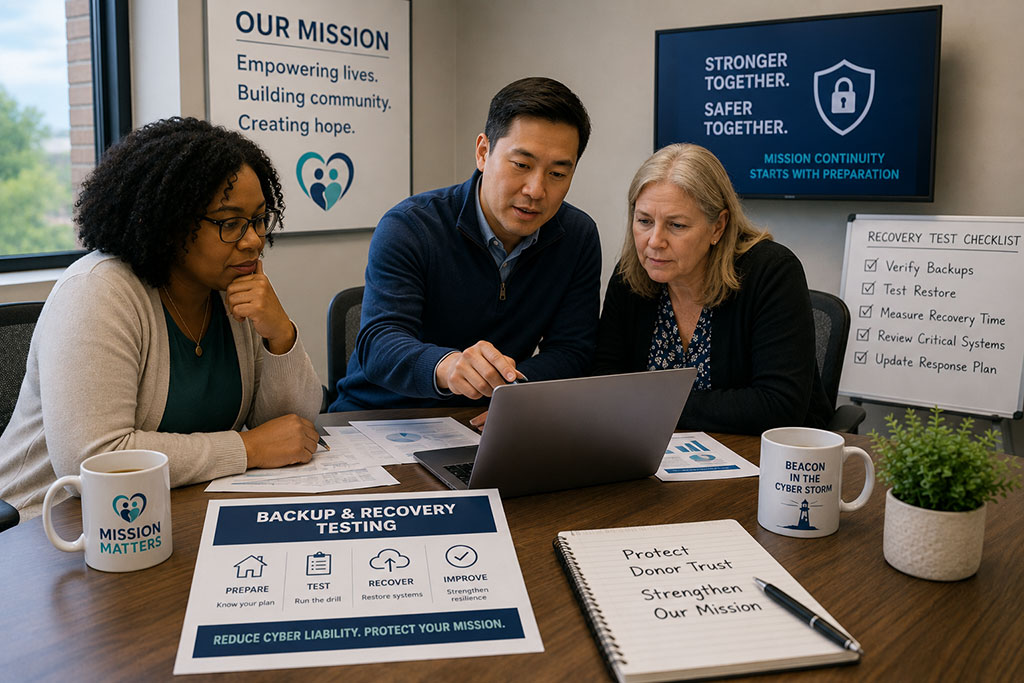
Having backups is important. Knowing they actually work is what protects your mission.
Many nonprofit leaders believe they're prepared for a cyber incident because they have backups.
But there's one question that matters even more:
Have you ever tested them?
Just as schools and workplaces conduct fire drills before an emergency happens, nonprofits should regularly test their backup and recovery plans before they're needed.
At MTS Consulting Group, we define cyber liability as the business, legal, regulatory, and operational responsibility an organization has to protect its people, donor information, financial systems, and mission-critical operations.
Testing your recovery plan isn't just an IT exercise.
It's one of the most effective ways to reduce cyber liability, strengthen board confidence, and ensure your organization can continue serving your community when unexpected events occur.
Why Fire Drills Work
Nobody schedules a fire drill because they expect a fire tomorrow.
They practice because emergencies create pressure.
During a fire drill, everyone learns:
- Who leads the response
- What happens first
- Where people should go
- Whether the plan actually works
If something doesn't go according to plan, it's discovered during practice—not during a real emergency.
Technology deserves the same preparation.
The goal isn't expecting disaster.
The goal is protecting your mission if one occurs.
The Nonprofit Version of a Fire Drill
Most nonprofits have backups.
Far fewer have tested recovering from them.
That's an important difference.
Without testing, organizations often don't know:
- Whether backups will successfully restore.
- How long recovery will actually take.
- Which systems should come online first.
- Whether staff can continue serving donors and clients during recovery.
- Who is responsible for leading the response.
Those questions become urgent only after systems go offline.
By then, every minute matters.
An outage doesn't simply interrupt technology.
It can interrupt:
- Donor services
- Online giving
- Client programs
- Payroll
- Grant reporting
- Internal communications
- Board reporting
That's why recovery planning is really mission planning.
What Backup Recovery Testing Actually Looks Like
Many nonprofit leaders imagine recovery testing as a complicated technical process.
In reality, it's about building confidence.
A recovery exercise helps your organization answer practical questions before a crisis occurs.
During testing, organizations can:
- Restore data from backups.
- Measure recovery time.
- Prioritize critical applications.
- Identify technology gaps.
- Confirm staff responsibilities.
- Validate communication procedures.
Instead of assuming everything will work, you gain confidence because you've already practiced.
That's one of the most effective ways to reduce cyber liability.
Why Recovery Testing Protects Donor Trust
Technology failures affect more than computers.
They affect people.
When systems remain unavailable:
Development teams can't access donor records.
Finance may struggle to process payments.
Programs lose access to participant information.
Leadership can't confidently answer board questions.
Community services may slow or stop altogether.
The longer recovery takes, the greater the impact on your organization's reputation.
Protecting donor trust begins long before a cyber incident.
It begins by knowing your recovery plan actually works.
What Happens When Recovery Plans Are Never Tested?
Organizations that never practice recovery often discover hidden problems during the worst possible moment.
Examples include:
- Incomplete backups
- Missing data
- Unexpected software failures
- Recovery processes taking much longer than expected
- Staff uncertainty about responsibilities
A disruption that should have lasted two hours can quickly become an all-day—or even multi-day—event.
Most cyber liability isn't created by one dramatic incident.
It grows from assumptions that were never tested.
Preparation changes everything.
Frequently Asked Questions
Why should nonprofits test their backups?
Testing verifies that backups can actually restore critical systems, confirms recovery timelines, and identifies problems before they interrupt fundraising, donor services, or daily operations.
How often should backup recovery be tested?
Most cybersecurity professionals recommend testing backup recovery at least annually, with more frequent testing for organizations managing critical donor information, financial systems, or essential community services.
What is cyber liability?
Cyber liability is the business, legal, regulatory, and operational responsibility an organization has to protect donor information, technology systems, employees, volunteers, financial data, and mission-critical operations.
What's the difference between having backups and testing them?
Having backups means data is being copied. Testing confirms those backups actually work, identifies recovery timelines, and ensures your organization can continue operating after an unexpected disruption.
Your Mission Deserves More Than Assumptions
Every nonprofit prepares for the unexpected.
You purchase insurance.
Develop emergency plans.
Train your staff.
Technology deserves the same level of preparation.
At MTS Consulting Group, we help nonprofit leaders understand cyber liability in plain language, strengthen operational resilience, and ensure technology supports—not threatens—their mission.
That's what it means to be your Beacon in the Cyber Storm™.
Schedule Your Complimentary Discovery Call
Not sure whether your recovery plan is truly ready?
Let's find out together.
During a complimentary 10-minute Discovery Call, we'll discuss your current backup strategy, what has—and hasn't—been tested, and identify practical opportunities to reduce cyber liability before a disruption ever occurs.