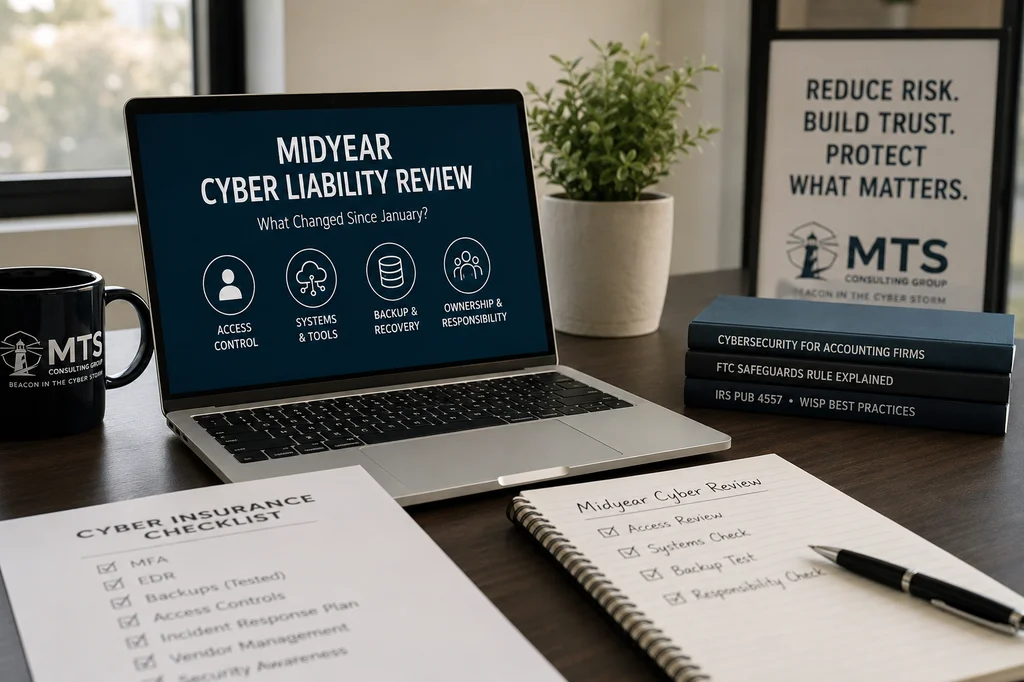
If you're like most accounting firms, your business looks different today than it did in January.
You've probably hired new employees, added seasonal staff, introduced new software, expanded remote work, or changed how your team collaborates.
Those changes help your business grow.
They can also quietly increase your cyber liability exposure.
At MTS Consulting Group, we define cyber liability as the business, legal, regulatory, and operational responsibility your firm carries for protecting client information—not simply meeting compliance requirements or carrying cyber insurance.
The good news?
A midyear review can help you find small issues before they become expensive problems.
Why Should Accounting Firms Perform a Midyear Cyber Liability Review?
Every technology change creates new responsibilities.
As your firm grows, access permissions, software integrations, backup systems, and vendor relationships change with it.
Without regular reviews, yesterday's good decisions can become today's hidden risks.
A midyear review helps your firm:
- Reduce cyber liability exposure
- Prepare for cyber insurance renewals
- Strengthen your Written Information Security Plan (WISP)
- Demonstrate operational proof for FTC Safeguards Rule and IRS Publication 4557
- Protect client trust during busy tax seasons
Think of it as a financial review—but for your technology and cyber liability.
1. Who Has Access to Your Client Data Today?
Access permissions change constantly.
Employees change positions.
Seasonal staff come and go.
Temporary vendors receive access.
Projects begin and end.
Unfortunately, permissions are rarely cleaned up afterward.
That means many firms unknowingly have:
- Former employees with active accounts
- Staff with unnecessary administrative privileges
- Vendors with access they no longer need
- No complete inventory of who can access sensitive client information
Ask Yourself:
Could you identify everyone with access to client data within five minutes?
If not, this is one of the easiest ways to reduce cyber liability.
2. Are Your Business Applications Working Together Securely?
Modern accounting firms rely on dozens of applications.
Examples include:
- QuickBooks
- UltraTax CS
- CCH Axcess
- Microsoft 365
- CRM platforms
- Client portals
- Billing systems
- Project management software
Each solves a business problem.
Together, they can create technology blind spots.
Information may now exist in multiple locations.
Software integrations may no longer function correctly.
Different departments may each manage only part of the overall system.
The result is fragmented visibility—and increased cyber liability.
Ask Yourself:
Does someone own the complete technology picture, or is every department managing its own piece?
3. Have You Tested Your Backup and Disaster Recovery Plan?
Many firms believe they are protected because backups exist.
That's only part of the story.
Recovery matters more than backup.
A strong recovery plan answers questions like:
- How long will it take to restore operations?
- Who leads recovery?
- When was the last successful restore test?
- Can client work continue during an outage?
Insurance carriers increasingly expect firms to demonstrate tested recovery procedures—not simply backup software.
Ask Yourself:
If ransomware struck tomorrow morning, would your team already know exactly what happens next?
4. Does Everyone Know Who Owns Cybersecurity Responsibilities?
Technology environments become more complicated every year.
Internal staff.
Cloud providers.
Software vendors.
Managed Service Providers.
Cyber insurance carriers.
Security tools.
Without clearly defined ownership, important issues often bounce between vendors while valuable time is lost.
Clear responsibility reduces downtime and improves business resilience.
Ask Yourself:
If a cybersecurity incident happened today, who would take charge immediately?
The Biggest Cyber Liability Risk Is Often Hidden
Most cyber liability doesn't come from broken technology.
It comes from technology that has changed without being reviewed.
Successful accounting firms aren't necessarily buying more software.
They're maintaining visibility.
They know:
- Who has access
- Where client information lives
- Which systems are protected
- That backups actually restore
- Who owns every critical responsibility
- How to produce evidence for insurers, auditors, regulators, and clients
That operational proof creates confidence.
It also makes cyber insurance renewals, client security questionnaires, and regulatory reviews much easier.
Frequently Asked Questions
What is cyber liability?
Cyber liability is the business, legal, regulatory, and operational responsibility your firm has to protect client information and demonstrate that your safeguards are working—not simply carrying cyber insurance.
Why should accounting firms review cybersecurity midyear?
Technology changes rapidly throughout the year. A midyear review helps identify outdated permissions, backup issues, software risks, and operational gaps before they affect clients or insurance coverage.
How often should a CPA firm perform a cyber liability assessment?
Most firms should perform a comprehensive assessment annually, with a midyear review to verify that technology changes have not increased cyber liability exposure.
Does cyber insurance require proof of security controls?
Increasingly, yes. Insurance carriers often request evidence of multi-factor authentication (MFA), endpoint detection and response (EDR), tested backups, access controls, and documented security procedures before issuing or renewing policies.
Schedule Your Complimentary Discovery Call
You don't need to become a cybersecurity expert.
You simply need a trusted partner who can help you understand your cyber liability and provide the proof your insurer, your clients, and your regulators expect.
Our complimentary 10-minute Discovery Call will help you identify where your technology stands today and where you may have opportunities to reduce cyber liability.
Schedule your Discovery Call today:
👉 https://mtsconsultinggroup.com/discovery-call
Because cyber liability isn't about panic.
It's about proof.