
Posted by Grace Delany | December 15, 2025
Cybersecurity & Managed IT for Nonprofits in Metro Detroit and Beyond
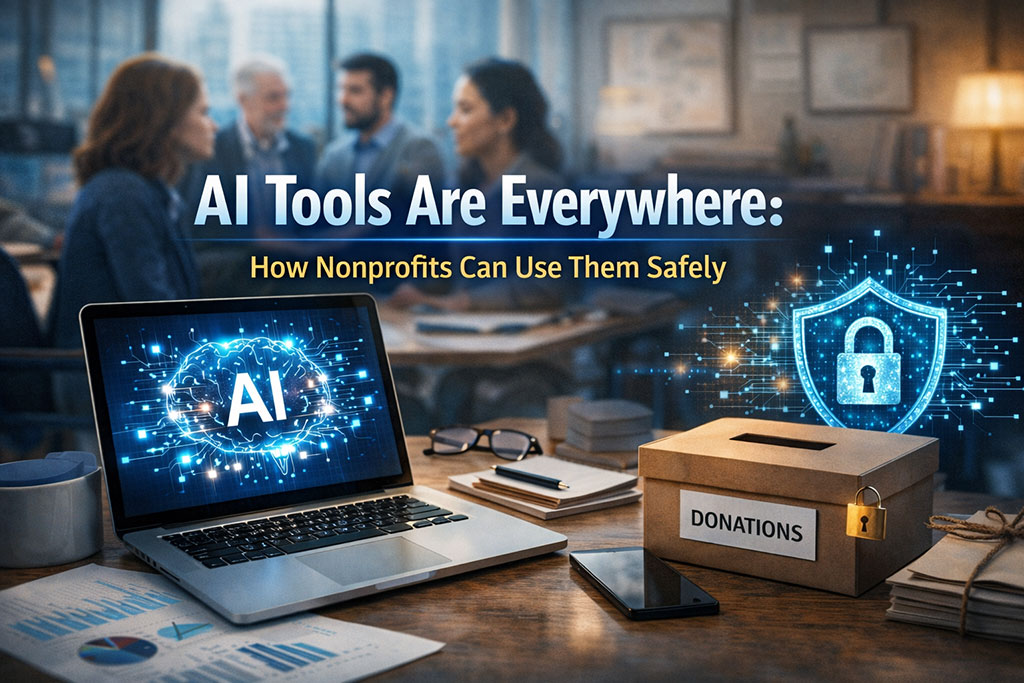
AI Tools Are Everywhere—and Nonprofit Leaders Are Feeling the Pressure
By February, the new-year momentum fades. The inbox is still overflowing. Meetings haven’t slowed. And nonprofit leaders across Metro Detroit, Southeast Michigan, and beyond are still being asked to do more—with the same resources and growing accountability.
At the same time, artificial intelligence is everywhere.
Every software platform now promises:
- “AI-powered productivity”
- “Smart automation”
- “Faster results with fewer staff”
For nonprofit executives, that often triggers a different question:
“Where does AI actually help our organization—and how do we make sure it doesn’t increase our cyber liability?”
That’s the right place to pause.
Because AI, when used casually, can quietly increase business, legal, regulatory, and operational risk—especially for nonprofits handling donor data, payment systems, grant reporting, and volunteer information.
At MTS, we see AI as a powerful tool—but only when it’s guided, governed, and aligned with your mission.
3 Practical AI Uses That Actually Save Time for Nonprofits
1) Email triage and first-draft responses
If your inbox feels unmanageable, AI can help—with clear boundaries.
AI is helpful for:
- Summarizing long email threads
- Identifying urgent messages
- Drafting first-pass responses to routine questions
AI should not:
- Send final messages
- Handle donor-sensitive communication
- Make judgment calls on tone or intent
The safest approach is simple:
AI drafts. Humans decide.
A small professional nonprofit organization we worked with used AI for common replies—status updates, scheduling, and FAQs. Leadership reclaimed 10–15 hours a month without increasing cyber risk or exposing donor information.
Quiet efficiency. No added liability.
2) Turning meeting notes into clear action steps
Meetings aren’t the problem.
Unclear follow-through is.
AI note tools can:
- Summarize conversations
- Capture decisions
- Create action lists
- Assign accountability
For nonprofits juggling board meetings, funder calls, and internal operations, this reduces dropped balls and keeps teams aligned—without creating new systems or complexity.
3) Simple reporting and trend summaries
Nonprofits don’t lack data.
They lack time.
AI can help translate information from:
- Donation trends
- CRM activity
- Support tickets
- System alerts
This isn’t about replacing leadership judgment.
It’s about creating clarity—so leaders can make confident, informed decisions faster.
The Guardrails: How Nonprofits Use AI Without Increasing Cyber Liability
This is where many organizations unintentionally create exposure.
Here are five rules we recommend to nonprofit leaders and boards:
Rule #1: Never enter sensitive data into public AI tools
That includes donor information, payment details, HR records, internal financials, or anything protected by privacy laws or donor trust.
If it identifies a person or organization, it doesn’t belong in a public AI prompt.
Rule #2: Control which AI tools your team can use
“Shadow AI” is growing fast—staff signing up for tools with good intentions but unclear safeguards.
Nonprofits need:
- An approved AI tools list
- Clear data-use rules
- Extra protections for finance, HR, and leadership roles
Rule #3: AI supports—humans approve
AI is confident, fluent, and sometimes wrong.
Anything shared externally under your organization’s name should always be reviewed by a human.
Rule #4: Assume everything is stored somewhere
Many AI platforms retain prompts or metadata. Even when anonymized, the data exists outside your control.
That’s a cyber liability consideration—not just a technical detail.
Rule #5: Make it easy to pause and ask
If someone isn’t sure whether something is safe to enter into AI, the answer is “not yet.”
Organizations with strong cyber posture create space for questions—without blame.
What Responsible AI Looks Like in a Real Nonprofit
AI done right isn’t flashy.
It looks like:
- Choosing one or two repetitive tasks
- Adding AI with guardrails
- Measuring time saved
- Expanding slowly and safely
The nonprofits pulling ahead aren’t chasing trends.
They’re reducing risk while protecting staff capacity and donor trust.
How a Nonprofit-Focused MSP Keeps AI Safe and Useful
Many nonprofit leaders don’t want to manage this alone—and they shouldn’t have to.
A managed IT partner experienced with nonprofits in Michigan and Metro Detroit helps by:
- Recommending secure, mission-aligned AI tools
- Managing access and permissions
- Creating plain-language AI usage guidelines
- Integrating AI into existing workflows
- Monitoring for risky data-sharing behavior
The result?
AI that supports your mission—without increasing cyber liability.
Where Does Your Nonprofit Stand Today?
If your team understands how to use AI safely, you’re ahead of many organizations.
If you’re unsure what information may already be flowing into AI tools, it’s worth understanding now—before it becomes a board or funder concern.
And if you know another nonprofit leader navigating AI uncertainty, feel free to share this article. Calm guidance travels fast.
Ready to Use AI Without Putting Your Mission at Risk?
If you want help creating AI guardrails that reduce cyber liability and support your nonprofit’s operations, we’re here.
👉 Schedule a Discovery Call
https://go.appointmentcore.com/MTSDiscoveryCall
Because the question isn’t whether your organization is using AI.
It’s whether you’re using it in a way that protects donor trust, board confidence, and mission continuity—no matter how noisy the digital world becomes.
Are AI Tools Already Inside Your Organization?
You don’t buy insurance after the accident.
And you don’t create AI governance after a data incident.
If your nonprofit or organization hasn’t formally evaluated how artificial intelligence tools are being used internally, there’s a strong chance AI adoption is already happening without visibility.
The question isn’t whether your team is experimenting with AI.
The question is:
Do you have executive-level clarity into what tools are active, what data may be exposed, and where cyber liability could surface?
As part of our patented, credential-free 26-Minute Cyber Risk Assessment, nonprofit leaders receive an AI Readiness Report.
In just 26 minutes, you begin to gain insight into:
- What AI tools are already operating in your environment
- Where usage may be occurring without formal policies
- Potential exposure tied to donor, financial, or program data
- Where governance may need strengthening before insurers or boards start asking questions
No passwords.
No disruption.
No technical overwhelm.
Just clarity.
Because leadership means preparing before the storm — not reacting inside it.
👉 Begin your Cyber Risk Assessment here:
https://mtsconsultinggroup.net/riskassessment
Be the Beacon in the Cyber Storm.