
The Quick Answer
An accounting or tax firm should choose a technology partner based on more than response time, software tools, or monthly price.
A strong technology partner should help leadership do at least seven things:
- Understand what the firm depends on to operate.
- Clearly define what is—and is not—in scope.
- Translate technology issues into business risk.
- Support recommendations with evidence.
- Help leadership prioritize what matters most.
- Document important decisions and remaining risk.
- Prepare the organization before an incident forces the conversation.
The goal is not to find a provider that promises:
“We handle everything.”
The better goal is to find a partner that can say:
“Here is what we manage. Here is what the evidence says. Here is what remains your responsibility. Here is what we recommend. And here is the decision in front of leadership.”
For MTS Consulting Group, that is the difference between simply managing technology and helping leadership manage Cyber Liability.
Choosing an IT Provider Has Become a Business-Risk Decision
Twenty years ago, many small businesses primarily needed someone who could:
- Fix computers
- Maintain servers
- Keep printers working
- Manage email
- Set up new employees
- Troubleshoot networks
Those responsibilities still matter.
But an accounting or tax firm now depends on technology for nearly every part of the business.
- Client documents.
- Tax applications.
- Cloud accounting platforms.
- Microsoft 365.
- Email.
- Remote work.
- Payroll.
- Electronic filing.
- Client portals.
- Vendor integrations.
- Backups.
- Cybersecurity.
- AI.
A technology provider therefore influences much more than whether employees can open Outlook.
A technology provider therefore influences much more than whether employees can open Outlook.
The relationship can affect:
- Business operations
- Sensitive client information
- Recovery capability
- Employee productivity
- Documentation
- Security
- Client trust
- Technology planning
- Leadership decisions
That means choosing a technology provider is no longer simply an IT decision.
It is a business-risk decision.
The Wrong Question: Who Is the Best MSP?
There is no universally best managed service provider.
There is only a provider that is—or is not—a good fit for a particular organization.
A five-person tax practice does not necessarily need the same relationship as a 50-person regional accounting firm.
A cloud-only firm has different dependencies than a firm running legacy applications.
A business that can tolerate a day of downtime has different requirements from one that cannot tolerate four hours.
That means leadership should avoid beginning with:
“Which MSP has the most tools?”
or:
“Which MSP has the lowest price?”
or even:
“Which MSP has the best reviews?”
Those questions can provide useful information.
But they do not answer the most important question:
“Can this technology partner understand our business well enough to help us manage the risks created by our dependence on technology?”
The MTS Seven-Question Technology Partner Framework
When an accounting or tax firm evaluates an IT provider, leadership can use seven questions.
Question #1: Does the Provider Understand How Our Firm Actually Operates?
A provider cannot give useful advice without understanding the business.
Before proposing technology, the provider should want to understand:
- How many employees you have
- Whether staffing changes seasonally
- Which applications are business-critical
- How clients exchange information with the firm
- Where employees work
- Which vendors have access
- Which systems contain sensitive information
- What filing deadlines matter most
- What would create serious operational disruption
- What leadership is trying to accomplish
This reflects an MTS operating principle:
Create Clarity Before Action.
Technology should follow understanding.
Not the other way around.
A Useful Test
Ask a prospective provider:
“What do you need to understand about our firm before recommending a technology solution?”
Listen carefully.
If the answer immediately becomes a list of products, packages, or hardware specifications, the conversation may already be moving too quickly.
A stronger answer begins with the business.
Question #2: Can the Provider Clearly Explain Scope?
This may be one of the most important questions in the entire selection process.
Clients often assume:
“Managed IT includes everything.”
It usually does not.
And that is not inherently a problem.
Different providers have different service models.
The risk comes from unclear responsibility.
Leadership should understand:
What Is Included?
What does the recurring agreement actually cover?
What Costs Extra?
What creates additional invoices?
What Is Not Provided?
What responsibilities sit outside the relationship?
What Is Shared?
Where does responsibility involve both the provider and the client?
MTS specifically treats scope clarity as part of Cyber Liability because assumptions about what an IT provider handles can create hidden exposure.
“We Handle Everything” Should Create More Questions
A provider may genuinely offer a very comprehensive service.
That can be excellent.
But leadership should still ask for specifics.
Does “everything” include:
- Cybersecurity monitoring?
- Security awareness?
- Recovery testing?
- Independent assessments?
- Written security planning?
- AI governance?
- Vendor risk?
- Technology lifecycle planning?
- Executive security reviews?
- Incident coordination?
- Strategic roadmaps?
- Documentation of accepted and deferred risk?
Do not assume.
Ask.
Clarity protects both parties.
Question #3: Can the Provider Translate Technology Into Business Risk?
A technical provider may say:
“Your endpoint agent isn’t checking in.”
A business advisor should be able to continue:
“That means we cannot currently verify that this device has the protection leadership believes it has.”
A technical provider may say:
“Your server needs replacement.”
A business advisor should be able to explain:
“The system is approaching a point where reliability and support limitations could create operational risk, so leadership should plan the replacement rather than waiting for an emergency.”
A technical provider may say:
“Your backup job completed.”
A business advisor should ask:
“Can we prove the business can recover?”
That translation is essential.
Leadership does not need more technical language.
Leadership needs to understand the decision.
The Four Cyber Liability Questions
For meaningful technology issues, a capable partner should help leadership consider four areas.
Business & Operational
Could this affect the firm’s ability to operate or serve clients?
Legal
Could this create responsibilities requiring qualified professional guidance?
Regulatory
Could this affect responsibilities expected of the firm?
Reputational
Could this affect client or stakeholder trust?
That is how a technology issue becomes a leadership conversation.
See the Whole Risk.
Question #4: Does the Provider Use Evidence—or Ask You to Trust Assumptions?
Trust matters in any long-term relationship.
But trust should not replace evidence.
Leadership should be cautious when important security conversations rely primarily on statements such as:
“Don’t worry. We handle that.”
“Everything looks good.”
“Our system says you’re protected.”
“We’ve never had a problem.”
Those statements may be sincere.
But leadership should be able to ask:
“What evidence supports that conclusion?”
MTS uses evidence-based recommendations as a core operating standard and incorporates security-tool reports, independent assessment information, recovery findings, recurring issue patterns, and business-impact analysis into leadership discussions.
Evidence Can Take Many Forms
Depending on the issue, evidence might include:
- Device-management reports
- Patch records
- Security-tool health
- Independent assessment findings
- Access reports
- Training records
- Recovery-test results
- Backup reports
- Documentation
- Ticket trends
- Lifecycle data
- Configuration records
The goal is not to bury leadership under reports.
It is to make sure important recommendations have a factual basis.
Independent Evidence Is Especially Valuable
Chapter 9 introduced the Independent Cyber Risk Assessment used through MTS.
That distinction matters when evaluating a technology provider too.
A mature provider should be willing to have its assumptions tested independently.
Independent evidence may confirm:
“Your provider is doing this well.”
Excellent.
It may reveal:
“This area deserves investigation.”
Also valuable.
The correct response is not defensiveness.
It is:
“Let’s understand what the evidence shows.”
The objective is protecting the client—not protecting the provider’s ego.
Question #5: Can the Provider Prioritize—or Does Everything Become an Emergency?
Cybersecurity can become exhausting when every recommendation is presented as urgent.
Replace this immediately.
Buy that now.
Approve this project.
Implement another platform.
Everything is red.
Everything is critical.
That is not useful leadership guidance.
Some risks genuinely require urgent attention.
Others can wait.
A strong technology partner should help leadership distinguish between them.
At MTS, we use a simple principle:
Focus leadership on the one to three findings that matter most.
A technology partner should be able to explain:
- What matters now
- Why it matters
- What can wait
- What needs investigation
- What decision leadership must make
Prioritization creates movement.
Overwhelm creates delay.
A Three-Finding Test for Prospective Providers
During the evaluation process, give the provider a hypothetical situation.
Say:
“Suppose you identified 25 technology and security issues in our firm. How would you present those findings to our managing partners?”
Listen to the answer.
A strong advisory response should sound something like:
“We would organize the findings, identify the few issues creating the most meaningful business exposure, explain why they matter, recommend next steps, and document the leadership decisions.”
A weak answer may simply describe the report.
Leadership needs decisions—not a vulnerability dump.
Question #6: Does the Provider Document Important Decisions?
Technology environments change.
People change.
Providers change.
Leadership changes.
Memory changes.
That is why MTS treats documentation as part of the protection system.
Important recommendations should not disappear after a meeting.
Leadership decisions should be visible.
For significant issues, the record should show:
- What was identified
- What evidence supported the finding
- What was recommended
- What leadership decided
- Who owns the next step
- When the issue should be reviewed again
MTS operating standards explicitly track recommendations that are accepted, deferred, or declined rather than allowing important risks to vanish between meetings.
“No” Is a Valid Leadership Decision
A trustworthy technology partner should be able to recommend something strongly without pretending leadership has no choice.
Leadership may:
Accept
Proceed.
Defer
Intentionally address the issue later.
Decline
Consciously decide not to proceed.
Investigate
Gather additional evidence before deciding.
The provider’s responsibility is to explain the consequences clearly.
Leadership owns the business decision.
Fear should not be used to manufacture a yes.
Teach Before We Act.
Question #7: Does the Provider Prepare You Before the Crisis?
The worst time to begin answering important questions is during the incident.
Who makes decisions?
Who communicates?
What can we recover?
Who has access?
What outside professionals need to be involved?
Where is the documentation?
What systems matter most?
What does leadership tell employees?
A strong technology relationship should help answer some of those questions before they become urgent.
This is part of the MTS principle:
Guide Through the Storm.
The goal is not to promise there will never be a storm.
The goal is to make sure leadership has better visibility when one arrives.
The 7 Questions to Ask Before Choosing a Technology Partner
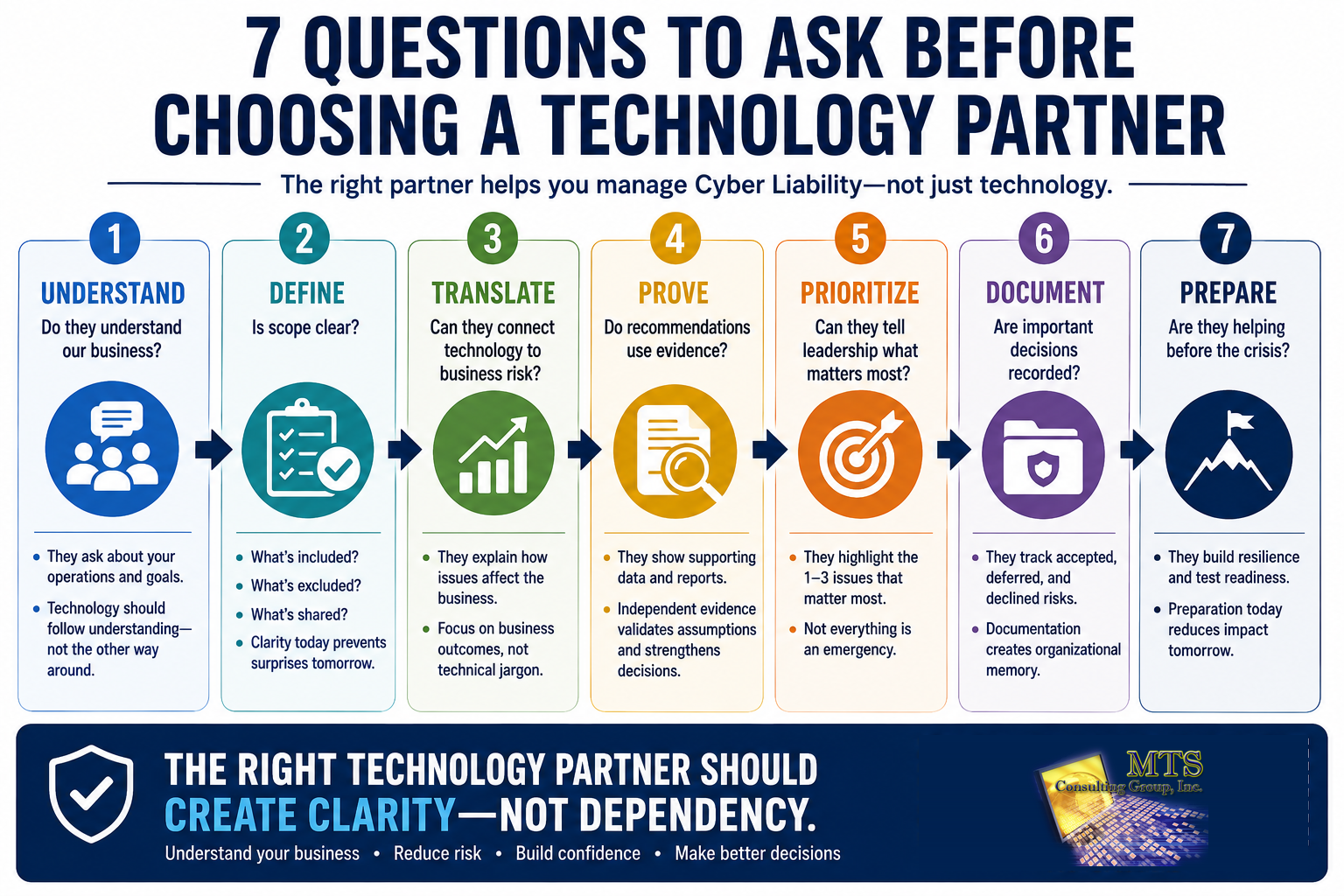
The right technology partner should create clarity—not dependency.
Managed IT Is the Foundation—Not the Entire Cyber Liability Program
This point from Chapter 3 deserves to return here.
Managed IT is essential.
Accounting firms need:
- Reliable systems
- Responsive support
- Maintained devices
- User administration
- Technology documentation
- Network management
- Microsoft 365 support
- Lifecycle planning
That is the foundation.
But leadership should also understand whether the organization has:
- Appropriate security protections
- Monitoring
- Independent verification
- Recovery readiness
- Documentation
- Risk tracking
- AI governance
- Executive review
- A process for accepted and deferred risks
MTS explicitly positions managed IT as the foundation rather than the entire Cyber Liability program.
This does not mean every provider has to personally perform every function.
It means leadership needs to know who owns each one.
The Technology Partner Does Not Own the Business
There is another important boundary.
Outsourcing IT does not outsource leadership responsibility.
Your technology provider can recommend.
Your legal counsel can advise.
Employees can follow procedures.
Vendors can perform services.
Independent security professionals can provide evidence.
Leadership still makes business decisions.
The goal of a good technology partner should therefore not be:
“Make the client dependent on us.”
The goal should be:
“Help the client understand the decision well enough to make it confidently.”
MTS describes this directly as confidence—not dependency.
That is an important buying criterion.
What Should an Executive Technology Review Look Like?
One way to evaluate a prospective provider is to ask how leadership meetings work.
A traditional technology review may focus heavily on:
- Ticket counts
- Response times
- Device inventories
- Patch percentages
- Licensing
- Projects
Those metrics can be useful.
But executive leadership should also be able to answer:
What has changed?
What does the evidence say about our current risk?
What progress have we made?
Which gaps remain?
Which decisions need to happen next?
MTS’s Strategic Security Briefing is specifically designed around those questions rather than being a traditional QBR centered on generic “everything looks good” reporting.
Ask potential providers how they conduct strategic reviews.
Their answer will tell you a lot about the relationship they expect to build.
From IT Vendor to Technology Partner
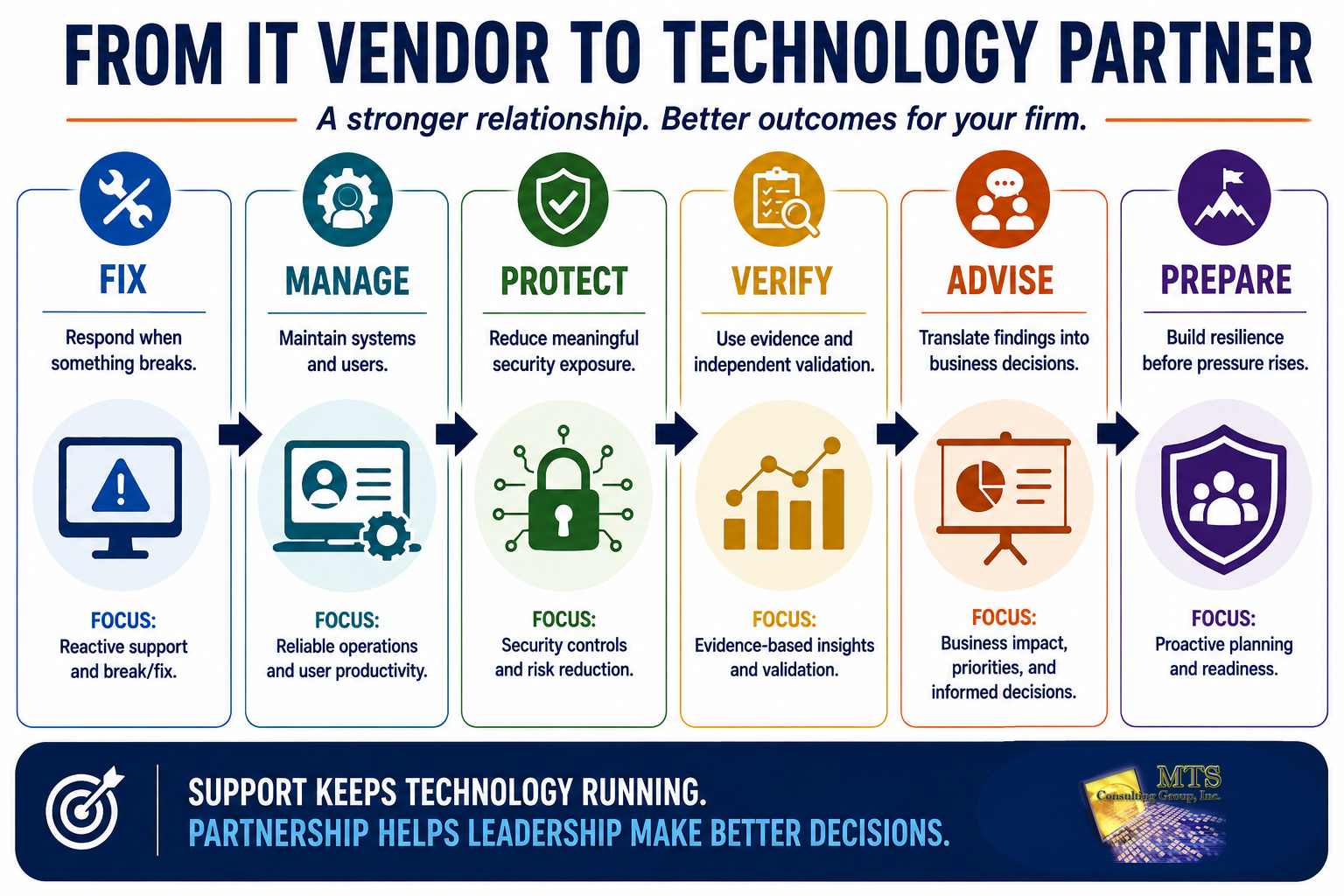
Support keeps technology running. Partnership helps leadership make better decisions.
Red Flag #1: The Conversation Is Mostly About Products
Tools matter.
But a list of tools is not a Cyber Liability strategy.
If the sales conversation focuses primarily on:
- Antivirus brands
- Security platforms
- Hardware manufacturers
- Monitoring products
- License counts
ask:
“What business risk is each of these intended to reduce?”
The provider should be able to answer.
If not, the technology stack may be leading the strategy instead of supporting it.
Red Flag #2: Security Is Described as “Included” Without Explanation
“Cybersecurity included” sounds reassuring.
It is not specific.
Ask:
- What is protected?
- What is monitored?
- Who responds?
- What is not included?
- What happens after-hours?
- What has been verified?
- What responsibilities remain with our firm?
A provider should welcome the opportunity to clarify.
Red Flag #3: Nobody Wants to Discuss What Is Outside Scope
Clear boundaries are a sign of maturity.
A provider who clearly explains:
“We do this, but we do not provide that.”
is often giving leadership valuable information.
Cyber Liability grows when responsibilities remain ambiguous.
Scope clarity is not weakness.
It is protection.
Red Flag #4: Every Security Finding Becomes a Sales Opportunity
A finding does not always require a new product.
Sometimes the correct response is:
- Change a process
- Remove access
- Update documentation
- Verify a configuration
- Educate an employee
- Test recovery
- Review a vendor
- Monitor the issue
- Accept the risk consciously
The recommendation should follow the evidence.
The product should not create the recommendation.
Red Flag #5: The Provider Cannot Explain Recovery
Ask:
“If our most important system became unavailable tomorrow, what happens?”
Leadership should receive more than:
“Don’t worry. We have backups.”
Ask:
- What is protected?
- What can be recovered?
- How long might it take?
- What has actually been tested?
- What dependencies exist?
Backup is a technology function. Recovery is a business outcome.
Red Flag #6: Strategic Reviews Are Really Ticket Reviews
Tickets matter.
But a managing partner does not need an hour of help-desk statistics.
Leadership needs to understand:
- Meaningful changes
- Recurring patterns
- Risk
- Evidence
- Roadmap
- Priorities
- Decisions
If every strategic meeting begins and ends with ticket volume, leadership may be missing the larger Cyber Liability conversation.
Red Flag #7: The Provider Does Not Welcome Independent Evidence
A technology provider does not need to agree blindly with every third-party assessment.
Independent tools can produce false positives.
Context matters.
But the provider should be willing to investigate.
A healthy answer sounds like:
“Let’s verify the finding.”
An unhealthy answer sounds like:
“Ignore it because it didn’t come from us.”
Evidence should be investigated—not dismissed because of its source.
Illustrative Accounting-Firm Buying Scenario
Consider a 30-person accounting firm evaluating two technology providers.
Provider A
The sales meeting emphasizes:
- Fast response time
- A long list of security products
- Unlimited support
- A low per-user price
Leadership asks:
“What Cyber Liability responsibilities remain with us?”
The answer is unclear.
Leadership asks how security recommendations will be prioritized.
The provider explains that the firm will receive regular security reports.
Provider B
The sales meeting begins by asking:
- Which applications are critical during busy season?
- What information creates the greatest exposure?
- How long can the firm tolerate downtime?
- Which responsibilities belong to existing vendors?
- What has already been verified?
- What does leadership expect from the relationship?
Provider B may eventually recommend products too.
But leadership now has evidence of a different advisory process.
The point of the example is not that Provider B is automatically better.
Price, service quality, technical expertise, capacity, and many other factors still matter.
The lesson is:
Evaluate how the provider thinks—not only what the provider sells.
A 10-Question Interview for Your Next MSP
When interviewing technology providers, ask these ten questions.
1. What do you need to understand about our business before recommending technology?
2. What is included in your agreement?
3. What is specifically excluded?
4. What Cyber Liability responsibilities still belong to us?
5. How do you verify that important security protections are working?
6. How do you prioritize findings for leadership?
7. How do you document recommendations we accept, defer, or decline?
8. How do you help us understand recovery—not just backup?
9. How do you respond when an independent assessment identifies something you did not find?
10. What should our managing partners expect from a strategic review with you?
Do not grade the answers based on technical vocabulary.
Grade them based on clarity.
A Simple Provider Scorecard
Leadership can score each candidate from 1 to 5 across seven areas.
Understands our business: ___
Scope is clear: ___
Translates technology into business risk: ___
Uses evidence: ___
Prioritizes effectively: ___
Documents decisions: ___
Helps us prepare proactively: ___
Maximum score: 35 Points
This is not a scientific ranking system.
It is a conversation tool.
A provider scoring 32 is not automatically better than one scoring 30.
The value comes from forcing leadership to evaluate more than price and tools.
What About Price?
Price absolutely matters.
Chapter 4 established an MTS planning range of approximately $125–$400 per user per month, depending on scope and requirements.
Chapter 5 established another important principle:
Cheap is not the problem. Unclear is the problem.
Do not automatically choose the most expensive provider.
Do not automatically reject the lowest-priced provider.
Normalize scope.
Understand responsibilities.
Compare outcomes.
Then compare price.
A lower-cost provider with clear scope and the right capabilities may be an excellent business decision.
A more expensive provider may also be appropriate when the additional investment produces outcomes the firm actually needs.
Price should follow understanding.
Should Your Technology Partner Understand Accounting and Tax Firms?
Industry knowledge can be valuable.
A provider working with accounting and tax firms should appreciate issues such as:
- Busy-season pressure
- Sensitive client information
- Seasonal employees
- Tax software
- Secure document exchange
- Remote access
- Backup and recovery expectations
- Cybersecurity responsibilities
- IRS and FTC security guidance
- Client trust
But industry language alone should not determine the decision.
A provider can say:
“We specialize in accounting firms.”
Leadership should still ask:
“Show us how that changes what you actually do.”
Specificity matters.
What Should the Right Relationship Feel Like?
Not effortless.
Technology and Cyber Liability still require decisions.
But the relationship should gradually produce:
More Clarity
Leadership understands responsibilities.
Better Evidence
Important assumptions are verified.
Fewer Surprises
Technology lifecycle and risks become more predictable.
Better Prioritization
Leadership knows what matters most.
Better Documentation
Decisions do not disappear.
Greater Confidence
Leadership understands the organization better.
That is a very different outcome from simply having a company to call when a computer breaks.
Frequently Asked Questions
What should an accounting firm look for in an IT provider?
Look for a provider that understands your business, clearly defines scope, provides reliable support, translates technology into business risk, supports recommendations with evidence, prioritizes findings, documents decisions, understands recovery, and helps leadership prepare proactively.
Is cybersecurity experience enough?
No.
Cybersecurity expertise is important, but leadership also needs someone capable of explaining how technology and security findings affect the business.
Technical expertise without business translation can leave leadership with information but no decision.
Should our IT provider handle every cybersecurity responsibility?
Not necessarily.
Different responsibilities may belong to the technology provider, an independent security partner, leadership, employees, vendors, legal counsel, or other specialists.
The objective is not one provider doing everything.
The objective is clear ownership.
Why does independent verification matter?
Independent evidence can validate existing protections or reveal assumptions worth investigating.
A mature technology partner should be willing to examine evidence even when it challenges the provider’s own work.
Should we choose the MSP with the most security tools?
Not automatically.
Ask what each tool is intended to accomplish, how it is managed, what evidence proves it is functioning, and what risk remains.
A longer product list does not automatically produce a stronger organization.
How often should our provider meet with leadership?
The right cadence depends on the organization.
The important point is that leadership reviews should be intentional and should address risk, evidence, progress, priorities, and decisions—not simply ticket statistics.
What should happen when we decline a recommendation?
The decision should be documented.
Leadership should understand the potential consequence and, when appropriate, establish a future review date.
An informed “no” is different from a forgotten recommendation.
Should our IT company help us with IRS and FTC security requirements?
A technology partner can help implement controls, provide evidence, identify technical gaps, and explain technology implications.
Questions requiring legal interpretation should be directed to appropriate legal or regulatory professionals.
The MTS Perspective
A technology provider should do more than make technology harder to leave.
The relationship should make leadership more capable of understanding the organization.
The provider should help leaders answer:
What do we know?
What are we assuming?
What does the evidence tell us?
What matters most?
What can wait?
What decision comes next?
That is how MTS thinks about technology partnership.
Managed IT is the foundation.
Cybersecurity helps protect the foundation.
Independent evidence tests assumptions.
Documentation creates organizational memory.
Strategic guidance helps leadership make decisions.
And Cyber Liability connects all of it to the business.
Create Clarity Before Action.
Guide Through the Storm.
Teach Before We Act.
See the Whole Risk.
The goal is not dependency.
The goal is confidence.
Your Next Step
Before renewing your current IT agreement—or signing with a new provider—ask these three questions:
1. What exactly are you responsible for?
2. What are you not responsible for?
3. How will you help our leadership understand the risks that remain?
Then ask for evidence.
You may discover that your current provider is exactly the partner your firm needs.
That is a good result.
You may discover areas where the relationship needs more clarity.
That is also useful.
The objective is not to change providers simply because you read an article about technology partners.
The objective is to make the relationship deliberate.
Do not begin with “Who should we hire?”
Begin with:
“What does our business actually need from a technology partner?”
If you want an independent view before making that decision, MTS offers accounting and tax firms a Complimentary Independent Cyber Risk Assessment through an independent security partner.
The process starts with 26 minutes, requires no passwords or system credentials, and gives leadership independent evidence it can use to ask better questions.
Get an Independent View Before You Make Your Next Technology Decision.
Continue Through the Cyber Liability Knowledge Center
Start Here:
What Is Cyber Liability, and How Is It Different from Cybersecurity?
Previous Chapter:
How Does an Independent Cyber Risk Assessment Help Accounting Firm Leaders Make Better Decisions?
Next Chapter:
What Should the First 90 Days of Reducing Cyber Liability Look Like for an Accounting Firm?
Related chapters:
- What Is Cyber Liability, and How Is It Different from Cybersecurity?
- Why Doesn’t Traditional IT Support Fully Address Cyber Liability?
- How Much Should an Accounting Firm Budget for Managed IT and Cybersecurity?
- Why Can the Cheapest IT Provider Become the Most Expensive Business Decision?
- What Should Managed IT Actually Do to Reduce an Accounting Firm’s Business Risk?
- How Does an Independent Cyber Risk Assessment Help Accounting Firm Leaders Make Better Decisions?
Explore MTS services: